Dual-fuel or all-gas range: choose the oven as carefully as the burners
Both choices can retain a gas cooking surface. Decide whether the particular electric-oven package earns its installation and purchase cost, without assuming that every gas oven or dual-fuel oven cooks alike.
Choose a dual-fuel range when you want to retain gas surface cooking and prefer the actual electric oven offered in that complete appliance enough to accept its purchase and installation scope. Choose an all-gas range when its gas oven, controls and cooking arrangement already satisfy the household. The useful comparison is between complete candidates, not a promise that one fuel makes every meal better.
A range combines the surface and oven in one appliance. In this comparison, both retain gas at the top; the oven heat source changes. That can be attractive to someone who enjoys cooking on gas but wants a particular electric-oven feature package. It can also be an unnecessary change for someone satisfied with the gas oven being offered. Begin with the work the oven will perform, since the familiar burner appearance can otherwise dominate the decision.
Separate the heat source from the feature list
Wolf's range catalog distinguishes an electric oven in its dual-fuel family from a gas oven in its gas family, and describes convection cooking across its range categories. Convection and fuel type therefore should not be treated as interchangeable labels.
A fan-related cooking feature does not tell you which energy source heats the oven. Likewise, dual fuel does not mean the owner can switch that oven between gas and electricity whenever convenient. Read the specific product's mode list and operating instructions. Do not interpret the category as a backup-energy arrangement or assume either candidate can be operated during a power outage.
Make the comparison with the actual ovens. A mode you want, a control you can use comfortably or a rack arrangement that suits your trays can be a good reason to choose a particular model. None should be credited to every appliance using the same fuel. An older comparison chart may describe an earlier generation whose controls and features are different; match the documents to the model being offered.
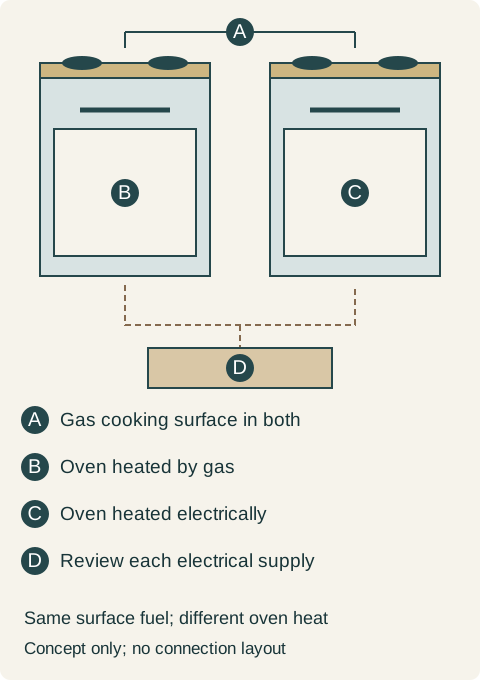
Teaching example Functional comparison, not an installation diagram. A identifies gas surface cooking in both concepts; B is the gas-heated oven and C the electrically heated oven. D shows the electrical-supply review required for either complete appliance, with different requirements determined by the selected model. Lines indicate review relationships, not wiring or gas routes. Colors do not claim equal size, controls, output or cooking results.
Let familiar baking expose the meaningful differences
Select the dishes that represent normal oven use: perhaps the usual covered casserole, a favorite cake pan and the sheets used for a regular batch of baked goods. Establish which supported mode you would use and which rack arrangement is allowed. If using several racks together matters, assess that exact task rather than equating an extra rack with a proven result.
A supervised manufacturer or dealer demonstration can help the household judge the particular candidate. Keep the task comparable and understand the instructions used. A successful demonstration of one oven does not establish that all electric ovens outperform all gas ovens, nor does a disappointing result from an unfamiliar setting settle a whole category. Ask what the owner would actually do differently at home.
Avoid buying an imagined cure for every baking problem. Before attributing uneven results in the old appliance to its fuel, distinguish a known appliance fault, an unsuitable arrangement and a feature the household genuinely wants to change. Those issues can lead to different purchases. This guide does not supply recipe conversions, cooking times or food-safety directions; it helps decide which documented capabilities are worth purchasing.
The useful conclusion is specific. You may prefer the selected oven's interface, supported batch arrangement and demonstrated process. Or you may find that both candidates perform the work acceptably and that the additional feature package brings little benefit. Either finding is more useful than an adjective such as professional on the front of the brochure.
An all-gas range can still require electricity
The cited KitchenAid commercial-style range guide lists electrical requirements for both its covered gas and dual-fuel models, with different supply requirements. A gas oven is therefore not evidence that the complete appliance needs no electrical connection.
Have the responsible professional compare the existing provision with the exact proposed model. An outlet that served the old gas range does not, by itself, establish suitability for a dual-fuel replacement. Conversely, do not assume that every home needs the same additional work. The completed assessment may identify usable existing provisions or a defined alteration; those are project findings.
Keep any required electrical work in the dual-fuel proposal before comparing totals. Include access and restoration where they belong in the job. At the same time, confirm the selected gas arrangement and ventilation for both alternatives. Retaining gas burners means the surface-cooking installation remains part of the project even though the oven below becomes electric.
The buyer needs a completed scope, not a connection tutorial. Do not treat a plug adapter, a similar appliance width or a promise that the installer will work it out as the finished plan. The model, required work and cabinet arrangement should agree before the cabinet order commits the surrounding openings.
The same-looking front can conceal a different purchase
Compare the cooking surface as well as the oven, even if both candidates show gas burners. Place the ordinary cold, empty pans in the intended arrangement and look at handles, grate layout and controls. The preferred electric oven may be sold with a surface configuration the owner does not actually want. Do not pay for an unused cooking module just to acquire a feature below it without recognizing that tradeoff.
Check the oven with the real vessels, including their handles, and follow the loading and unloading movement. A shared advertised width does not establish identical interior space, door projection or control position. Keep the adjacent landing surface available for the way the owner transfers ovenware. Changing the heat source does not remove the need for that working space.
Review the complete surrounding installation for each candidate: cabinet and counter junctions, wall treatment, required clear areas and the selected ventilation arrangement. An attractive front view can make two proposals look interchangeable while the installation documents require different work. The gas candidate also needs current verification; an old range having occupied that spot is not approval for every new gas range.
This household keeps the gas oven
Consider a hypothetical renovation in which the owners want gas surface cooking and regularly bake a covered casserole and a batch of cookies. They compare an all-gas range with a dual-fuel range that offers additional oven modes and a different control interface. Their ordinary pans fit both permitted arrangements, and product demonstrations show them how each candidate handles the tasks they actually intend to repeat.
The owners are comfortable with the gas candidate's supported process and controls. The additional dual-fuel modes do not replace a recurring task, and they do not prefer its interface enough to make that the deciding feature. This is an acceptance of the chosen gas oven, not a finding that electric ovens have no value or that every gas model gives the same result.
The completed dual-fuel quote also includes electrical alteration and restoration that the assessed gas replacement does not require in this particular kitchen. Both proposals include their own installation and ventilation review. The family chooses the all-gas package, keeps the accepted adjacent cookware drawers and tray landing area, and leaves the extra work out of the renovation because it has no corresponding household benefit.
They still buy the selected gas model's full installation and accept its documented cleaning routine. The decision is not based on a claim that gas needs no power, costs less to run or is always cheaper to buy. Another home with suitable existing provisions and a strong preference for the selected electric oven could reasonably choose the dual-fuel package.
Compare the care you will actually perform
Read the care instructions for the particular oven, racks, surface and any special modules included in the order. Do not infer self-cleaning, a removable part or a particular cleaning method from the fuel category. If a care feature is important, make it part of the named candidate comparison and understand the manual work that remains.
Keep appliance price, necessary installation and desired optional features visible as separate parts of the total. A premium control package and an electrical alteration are different expenses even when both occur in the dual-fuel offer. Separating them helps the owner understand what is being purchased and which change would matter if the quote changes.
The final selection should identify the oven process the household wants, the gas surface it will use and the complete installation the room can support. Dual fuel is a useful way to combine particular preferences. All-gas remains a coherent choice when the selected oven already does the job. Neither requires the kitchen to buy a category reputation in place of a tested, fully scoped appliance.
Pure White
Cream White
Light Warm Gray
Gray
Navy
Black
Oak Tone
Dark Walnut Tone
Design study These finish studies are design references, not a list of currently orderable colors. Screens and lighting change the appearance; compare a physical sample before choosing.See all finish options →
A range combines surface cooking and baking in one appliance. Separates let you choose those components and their supported positions independently, but the cabinet and installation package must earn that flexibility.
The appliance price is only part of a gas-to-induction change. Include compatible cookware, the cooking layout, electrical work, the retained countertop and the storage left below before deciding.
Compare the cooking arrangement, removable parts and surrounding kitchen before choosing an open-burner or sealed-burner appliance. The burner label does not rank the complete purchase.
The sample shows the door frame, a separate center panel, the face frame and the cabinet box. Each component has its own place in this Shaker construction.
Shaker construction: door frame, center panel, face frame and cabinet box. The cutaway helps locate these parts; confirm each material in the specifications for the selected cabinet.
01 / Door frame
The Shaker door has rails and stiles around a separate center panel. The frame and center panel are different components; confirm their materials in the specifications for the selected cabinet.
02 / Face frame
The face frame surrounds the opening at the front of the cabinet box and sits behind the doors. The face frame, door frame and cabinet box are separate parts.
03 / Cabinet box
The sample exposes the cabinet sides, interior surfaces and layered edges. The image does not establish the wood species or material specification of a selected cabinet.