Dowels, Confirmat screws and cam connectors: compare the complete cabinet joint
Different connectors locate, clamp and retain panels in different ways. A good comparison includes the core, preparation, assembly and complete cabinet construction.
Do not choose a cabinet box by declaring dowels, Confirmat screws or cam connectors universally best. Each system joins panels differently, and its result depends on the panel, prepared holes, connector details and complete assembly. First establish whether the joint is factory glued, mechanically assembled or uses a combination. Then compare how the documented construction fits the installation and future service needs.
Dowels locate the panels and can form a bonded joint
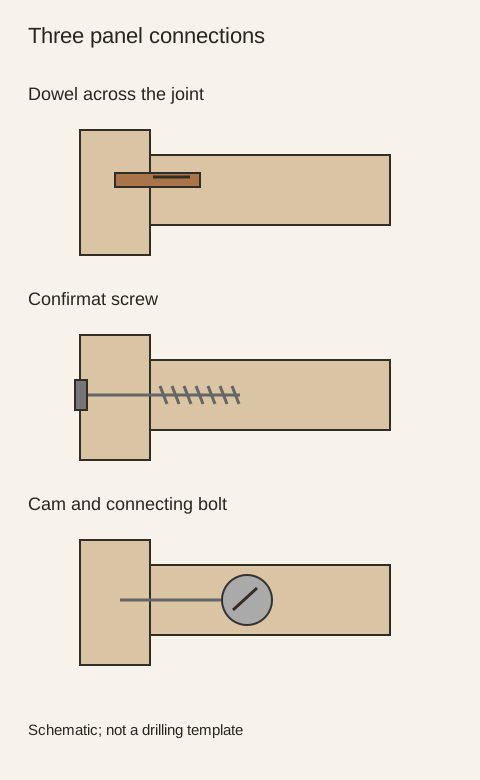
A dowel crosses the seam through matching holes in the adjoining parts. In a glued dowel joint, fit, adhesive and the surrounding panel material contribute to the connection. The dowel is not merely a decorative plug over a screw, though a visible round mark can be misleading. Obtain the maker's detail instead of identifying a hidden connection from a photograph of its surface.
The USDA's discussion of bonded joints explains how dowels introduce bonding surfaces within an end-to-edge connection. It also explains why prepared surfaces and moisture conditions matter. That principle does not set the correct hole size or glue quantity for an unknown cabinet. Follow the assembly instructions for the actual system, including any stated curing period, rather than adding glue wherever a dowel appears.
Diagram Connector shapes are simplified to explain their roles. The figure provides no hole diameters, spacing, torque, capacity or compatible product identification. Prepare and save project notes →
A Confirmat connection needs its matching preparation
A Confirmat is a furniture connector screw, commonly used through one panel into the edge of another. Its shape is different from a general-purpose wood screw. The joint description should identify the connector and the panel preparation together. A screw that appears to fit an existing hole can still have the wrong thread, head or engagement for that connection.
Ask where the head will remain accessible and whether a cap or finished surface conceals it. That affects assembly order and later access; it does not establish strength. Do not replace the supplied connector with a drywall screw or select a longer screw simply because the original seems short. If a fastener or hole is damaged, preserve the part identification and request the manufacturer's corrective detail.
A cam captures a connecting bolt
In a common cam-and-bolt arrangement, a round cam housing in one panel engages the head of a connecting bolt attached to the adjoining panel. Turning the cam draws the connection together. Additional dowels may locate the parts. The housing's position and orientation therefore matter, as does the correct bolt projection. A partly engaged cam is not equivalent to the completed assembly shown in its instructions.
Häfele lists cam-system families and Confirmat connectors as different furniture hardware choices. The family name alone does not provide drilling or tightening instructions. Some systems are intended to allow disassembly, but that does not promise unlimited repeated assembly or undamaged holes after a move. Ask what the particular manufacturer permits, and whether the installed cabinet will leave access to the connector.
A box must also resist changes in shape. Its back, fixed members, base and installed support can influence behavior as much as the conspicuous corner connector. A cam connection in a documented cabinet is not comparable to a loose sample corner without a back. Similarly, counting extra screws does not establish a stronger design if their location and preparation are unknown.
AWI publishes tested construction drawings using dowel and Confirmat arrangements with identified panel and back constructions. It explicitly warns that using the drawings alone does not establish compliance. The useful lesson is to compare complete, documented assemblies. The presence of a familiar connector does not confer a tested duty level on any cabinet.
A hypothetical assembled cabinet and a flat-pack alternative
Imagine comparing a factory-glued dowel cabinet with a mechanically assembled cabinet for a room reached through a restrictive doorway. The assembled box may have a clear construction record but not fit the route. The flat-pack option may fit the route, yet still require suitable assembly space and documented instructions. The connector choice is part of the decision, not the answer to every question about it.
For the glued box, confirm its complete delivered dimensions and that the intended joints are factory assembled. For the flat-pack box, review the parts, assembly sequence and access needed to tighten the connections before adjacent cabinets close them off. Ask how the back is retained in each. Choose between the actual completed arrangements rather than assuming assembled means solid wood or that a visible cam means disposable furniture.
A tight-looking seam cannot verify hidden workmanship
During authorized assembly, check that the identified parts correspond to the instructions and meet without being forced. Misaligned holes, damaged edges or a joint that will not close need clarification before further tightening. Excess force can conceal the initial symptom by damaging the surrounding material. Keep a photograph and the part label instead of improvising a new hole pattern.
After assembly, use ordinary opening and closing observations to identify movement, noise or a changing gap. Do not rack the cabinet by hand as a substitute for a controlled test. If a joint moves, stop loading the affected unit and arrange assessment of the complete cabinet and installation. A connector that can be tightened again does not prove that the surrounding panel remains undamaged.
Write a connection description that survives the handoff
Retain the panel specification, connector identification, any adhesive requirement, assembly instructions and the relevant back detail. Record which connections become inaccessible after installation and how the maker expects future service to be handled. This is especially useful when an end panel or neighboring cabinet will cover a connector head that was visible during assembly.
Finish references
Pure White
Cream White
Light Warm Gray
Gray
Navy
Black
Oak Tone
Dark Walnut Tone
Design study These finish studies are design references, not a list of currently orderable colors. Screens and lighting change the appearance; compare a physical sample before choosing.See all finish options →
Read the rear-panel construction and mounting information separately so an attractive interior back does not stand in for the cabinet’s installation requirements.
A dado seats a panel in a channel, a rabbet seats it at an edge and a butt joint meets a surface without that recess. Geometry, retention and remaining material all matter.
The sample shows the door frame, a separate center panel, the face frame and the cabinet box. Each component has its own place in this Shaker construction.
Shaker construction: door frame, center panel, face frame and cabinet box. The cutaway helps locate these parts; confirm each material in the specifications for the selected cabinet.
01 / Door frame
The Shaker door has rails and stiles around a separate center panel. The frame and center panel are different components; confirm their materials in the specifications for the selected cabinet.
02 / Face frame
The face frame surrounds the opening at the front of the cabinet box and sits behind the doors. The face frame, door frame and cabinet box are separate parts.
03 / Cabinet box
The sample exposes the cabinet sides, interior surfaces and layered edges. The image does not establish the wood species or material specification of a selected cabinet.