Dado, rabbet or butt joint: read the cabinet section before ranking it
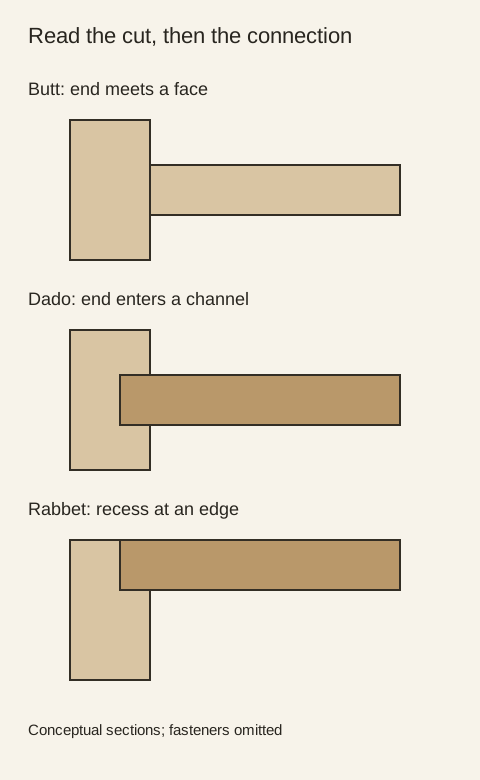
A dado seats a panel in a channel, a rabbet seats it at an edge and a butt joint meets a surface without that recess. Geometry, retention and remaining material all matter.
A dado, rabbet and butt joint describe where adjoining panels meet. They do not, by themselves, tell you what keeps the joint together or how much load the cabinet can carry. Read the cut shape first, then identify the glue, dowels, screws or other retention. A recess can locate a panel and provide a bearing shoulder, but it also removes material from the part that receives it.
Identify the geometry in a section
In a butt joint, the end or edge of a panel meets the face of another without a receiving recess. In a dado joint, the receiving panel has a channel that houses the adjoining part. A rabbet is a recess open at an edge, so the adjoining part seats against an edge shoulder rather than between the sides of an interior channel. These are simplified descriptions; combinations and proprietary variations also exist.
A groove often runs with the grain of solid wood, while a dado is commonly described across it. In sheet goods, shop usage can be less consistent, so a marked section is more reliable than debating the word alone. The USDA illustrates several related end-to-edge connections, and Lee Valley separately identifies dado and rabbet work in its joinery material.
Diagram The diagram isolates joint geometry. Fasteners and adhesive are omitted for clarity; their absence here is not a proposed cabinet assembly method. Prepare and save project notes →
A shoulder can locate a panel without completing the joint
Consider a fixed horizontal panel housed in a cabinet side. Its lower edge can bear against the bottom shoulder of the recess under downward loading. The recess also establishes its position during assembly. That explains a useful role for the geometry. It does not answer how the panel is kept from pulling out, how the cabinet resists racking or how a damaged core behaves at the shoulder.
For a butt joint, those alignment and load-transfer questions may be addressed by dowels, screws or another specified connection. A well-documented mechanically joined box cannot be dismissed because its section lacks a channel. Conversely, a deep-looking dado does not prove a complete connection. Ask what the section leaves out, especially at the back and at corners concealed by the face frame.
Every recess leaves a thinner region behind it
The receiving panel retains less material at the recess than it has away from the joint. A cut near another groove, a hardware hole or an opposite-face recess deserves particular attention. A plan view showing neat panel positions may hide those intersections. Ask for a section through the crowded location, not just the standard detail from a different part of the cabinet.
In a hypothetical section, a side panel is 3/4 inch thick and a dado is 1/4 inch deep. The material remaining behind it is 1/2 inch. If an opposing dado at the same location is also 1/4 inch deep, only 1/4 inch remains between the cuts. This is subtraction, not an acceptable machining depth or proof that either arrangement is adequate. Actual construction requires the maker's design and panel information.
Fit and bonding surfaces are part of the construction
A housed panel should match the intended preparation, but tightness judged by hand is not a strength test. A part that must be forced can damage the edge or prevent other joints from closing. A loose fit can leave a gap where the specified adhesive expects contact. Different adhesives tolerate different conditions; adding more glue does not automatically repair an incorrect cut.
The USDA explains that bond performance depends on the wood surface, adhesive and manufacturing conditions. Its discussion of shaped joints also distinguishes added bonding area from plain end-grain contact. These principles help explain why a joint shape alone is incomplete evidence. They do not justify choosing a household glue or changing a factory joint after delivery.
Stopped and through cuts change what is visible
A through dado reaches a visible edge; a stopped dado ends before it. The stopped version can leave the front edge uninterrupted, while a through cut may need to be concealed by another component or included in the intended exposed detail. Neither appearance proves stronger construction. Inspect how the actual panel end is shaped and how the edge finish meets the joint.
A cabinet back may sit in a groove, a rabbet or another arrangement. Its retention and role in the complete box still need identification. Do not assume that a recessed back is a hanging member or that the deepest visible strip is the correct fastening location. The installation detail governs attachment to the building; the joint section explains how the cabinet parts meet.
A hypothetical divider with joints on both faces
Imagine a tall cabinet divided vertically, with fixed panels entering the divider from opposite sides. A front drawing makes the layout look symmetrical. Before choosing the joint detail, inspect where those cuts land through the divider. If they overlap, the remaining section differs from that of a side panel with a recess on only one face. If they are staggered, the geometry is different again.
The appropriate response is a reviewed divider detail, not simply a deeper groove or an added screw. Check which material the fastener engages, whether holes intersect a recess and how the back ties into the arrangement. AWI's tested construction resources reinforce the importance of defined whole assemblies; their drawings do not grant compliance to an improvised variation.
Ask for the section that answers your uncertainty: a fixed shelf connection, a divider with opposed joints or the termination of a back. Mark the receiving panel, the inserted part, the retention method and the remaining material. Keep specified dimensions attached to their source instead of measuring them from a stylized illustration. A diagram without scale is for understanding the relationship, not fabricating parts.
Finish references
Pure White
Cream White
Light Warm Gray
Gray
Navy
Black
Oak Tone
Dark Walnut Tone
Design study These finish studies are design references, not a list of currently orderable colors. Screens and lighting change the appearance; compare a physical sample before choosing.See all finish options →
Different connectors locate, clamp and retain panels in different ways. A good comparison includes the core, preparation, assembly and complete cabinet construction.
Read the rear-panel construction and mounting information separately so an attractive interior back does not stand in for the cabinet’s installation requirements.
The sample shows the door frame, a separate center panel, the face frame and the cabinet box. Each component has its own place in this Shaker construction.
Shaker construction: door frame, center panel, face frame and cabinet box. The cutaway helps locate these parts; confirm each material in the specifications for the selected cabinet.
01 / Door frame
The Shaker door has rails and stiles around a separate center panel. The frame and center panel are different components; confirm their materials in the specifications for the selected cabinet.
02 / Face frame
The face frame surrounds the opening at the front of the cabinet box and sits behind the doors. The face frame, door frame and cabinet box are separate parts.
03 / Cabinet box
The sample exposes the cabinet sides, interior surfaces and layered edges. The image does not establish the wood species or material specification of a selected cabinet.