Dishwasher cutlery basket or third rack: choose with the whole meal loaded
A top cutlery tray can free part of the lower rack, but the complete arrangement still has to fit glasses, plates and cookware together. Compare actual rack configurations before paying for an extra layer.
The better rack is the one that fits the whole load
Choose a third-rack dishwasher when its actual top tray provides useful homes for utensils while the remaining racks still accommodate the household's dishes. Keep a lower-rack cutlery basket in the comparison when it gives a more workable complete load or a handling routine the users prefer. An extra horizontal layer is not automatically a better dishwasher for the objects in this kitchen.
Compare representative plates, bowls, glasses, utensils and dishwasher-suitable cookware together. A display containing only flatware can make either arrangement look generous. The question is whether the same regular meal fits in one permitted configuration, not whether each difficult item fits after all the others have been removed.
Moving cutlery changes where space is occupied
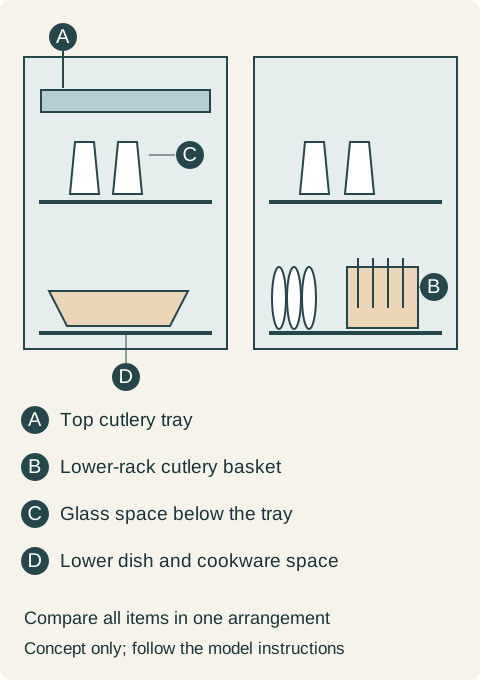
A basket occupies a defined footprint in the lower dish area. That footprint may otherwise accommodate plates or cookware, depending on the rack and its permitted arrangement. A top tray moves some of that cutlery assignment upward. It creates a different allocation within the appliance rather than enlarging the cabinet opening around it.
The tray itself also occupies space. Its depth, shape and any adjustable portions interact with the objects below. A shallow flatware tray and a deeper utensil tray should not be treated as identical. Neither should the room around a central recess be assumed to exist across the entire width.
Bosch's current US buying guide distinguishes a standard third rack from a Flexible version with drop-down wings for deeper items. That describes different rack configurations, not a universal amount of extra capacity.
Ask to see the supplied rack, rather than accepting a generic statement that the dishwasher has a third rack. A photograph may show another version within the brand. Also establish whether the proposed appliance includes a cutlery basket in addition to the tray and which arrangements its instructions permit. The buyer should know the actual supplied pieces.
Teaching example Conceptual rack allocation, not a model drawing. A identifies a top cutlery tray in the left proposal; B shows a lower-rack cutlery basket in the right. C marks the glass area below the top tray, and D the lower dish area shared with the basket. The sketches do not establish clearance, approved loading or equivalent capacity.
An adjustment gives space somewhere specific
Miele's covered 3D MultiFlex tray permits its left insert to move inward to accommodate taller items below. The same manual describes a cutlery basket in the lower rack, depending on model. These are product-specific alternatives.
The useful lesson is to observe exactly where an adjustment creates room. Moving part of a tray aside may help a tall glass in that part of the upper basket while leaving less tray area available in its previous position. Check the utensils again after making the allowed adjustment. Do not show the glass in one arrangement and the flatware in another and call them a single full load.
Likewise, moving the main upper rack changes its relationship with the rack below. Test the lower dishes after an approved height change, including the required unobstructed operation specified by the manufacturer. A setting that helps a glass can affect the plate or pan underneath it. The closed door alone is not a loading test.
These are purchase demonstrations with clean representative objects and the correct product guidance. Do not alter rack stops, bend supports or remove components outside the permitted arrangement to make the comparison succeed. An unsupported modification is a different proposal.
Try the shape of the utensils, not just their count
Lay out the regular flatware and the larger tools intended for machine washing. A deep ladle, bulky whisk or long serving utensil has a different shape from a dinner fork. Determine where each piece belongs under the candidate machine's loading instructions. The fact that a utensil fits somewhere in an empty appliance does not establish a useful place during a normal meal load.
A tray may make small groups easy to see, while a basket may suit the user's preferred loading and carrying routine. Those are preferences to test with the actual equipment. Do not promise better cleaning from separation or basket shape alone; appropriate loading, the selected cycle and the appliance's own instructions still matter.
Include the person who normally loads and unloads. Check their access to the top tray and to a basket in its installed position. A removable basket is helpful only if the user can handle it as intended. Follow the product's utensil-handling directions; this article does not prescribe a universal orientation for sharp pieces.
Compare a simultaneous arrangement before rejecting a feature
Imagine a household whose regular load contains flatware, tall everyday glasses and a broad dishwasher-suitable serving pan. In the basket proposal, the basket uses part of the lower rack. The pan can fit only after several normal plates are omitted. That is a real limitation of this particular proposed load, not proof that all basket machines have inadequate capacity.
A third-rack proposal gives the flatware an upper home and provides a permitted lower arrangement for the pan and plates together. The first trial then reveals a problem with the tall glasses below the tray. The household does not immediately declare the third rack unsuitable.
The selected candidate has a documented adjustable tray section. With that section in its approved position, the glasses fit below and the flatware still fits in the remaining permitted tray area. The pan and plates also remain properly arranged below. All groups are present in the same final trial, with the manufacturer's loading and movement conditions respected.
The owners choose that complete third-rack machine. They accept its actual price and the extra upper loading step because it solves their regular pan-and-plate combination. They do not choose it because of a general capacity percentage or an assumption that all top trays adjust the same way.
If the flatware no longer fit after the glass adjustment, this trial would not support that choice. The household would need another permitted arrangement, another candidate or an accepted change in its washing routine. A feature succeeds only when the final configuration holds the entire intended set.
Keep the kitchen consequences in the appliance comparison
The chosen rack arrangement does not create a wider cabinet beside the dishwasher. Keep the exact appliance installation requirements, front treatment and service access in the kitchen plan. If moving to another model changes those requirements, compare the resulting cabinet work as well as the rack feature.
Consider what happens to items excluded from the regular load. They may occupy the sink, need another cleaning method or wait for a later load. Decide whether that consequence is acceptable instead of erasing the objects from the comparison. The goal is not to force every occasional platter into the daily load, but to avoid overlooking a difficulty that happens every evening.
Price the complete candidate models and the installation work they actually require. If the third-rack model also changes drying, controls or other equipment, the whole difference cannot be attributed to the tray. Identify which features the household wants and avoid paying for an assumed loading benefit that was never demonstrated.
Keep the approved rack configuration and the representative load with the appliance selection. A replacement basket or top tray must be appropriate for the exact model; similar-looking rails do not establish compatibility. Once the whole load, user access and cabinet requirements work together, the rack choice has a concrete reason behind it.
Pure White
Cream White
Light Warm Gray
Gray
Navy
Black
Oak Tone
Dark Walnut Tone
Design study These finish studies are design references, not a list of currently orderable colors. Screens and lighting change the appearance; compare a physical sample before choosing.See all finish options →
Compare the cabinet arrangement and the daily dish load together. A narrower appliance can leave an unusable strip, while the countertop above an undercounter machine may remain exactly the same.
Compare a stacked double appliance with appropriately specified single-drawer locations through real loads, clean-dish turnover and cupboard access. Drawer count alone does not describe useful capacity.
The closest cabinet is useful only if it can be reached and opened while unloading. Map the actual clean-dish destinations with the appliance door and racks in use.
The sample shows the door frame, a separate center panel, the face frame and the cabinet box. Each component has its own place in this Shaker construction.
Shaker construction: door frame, center panel, face frame and cabinet box. The cutaway helps locate these parts; confirm each material in the specifications for the selected cabinet.
01 / Door frame
The Shaker door has rails and stiles around a separate center panel. The frame and center panel are different components; confirm their materials in the specifications for the selected cabinet.
02 / Face frame
The face frame surrounds the opening at the front of the cabinet box and sits behind the doors. The face frame, door frame and cabinet box are separate parts.
03 / Cabinet box
The sample exposes the cabinet sides, interior surfaces and layered edges. The image does not establish the wood species or material specification of a selected cabinet.