Deep Kitchen Base Cabinets: Using the Space at the Back
Extra depth can hold long objects or a rear reserve, but those are different storage jobs. Assign the back zone and show how its contents reach the opening with the front occupied.
Treat the back of an unusually deep base cabinet as a storage assignment that needs its own retrieval method. Extra depth can be useful for a long item spanning front to back, or it can become a separate rear reserve behind everyday contents. Those arrangements use the same volume differently. Choose which job the depth should perform instead of leaving the back as an unplanned place for whatever does not fit elsewhere.
Confirm which part of the depth is actually usable
Obtain the selected cabinet’s interior layout from the access side to the rear boundary. Distinguish usable shelf or drawer floor from any closed space, partition or area reserved for services. A deep counter or outer cabinet footprint does not prove the storage interior extends equally far. Record the real opening and any interruption along the path to the back.
If a moving interior is proposed, check its actual usable platform and open position. A mechanism can change which part of the storage comes forward, but its name alone does not show the rear item’s final position. Use the selected cabinet and hardware details rather than assuming that everything at the back will become directly available when the front opens.
Choose between continuous-depth storage and a rear group
A long object placed along the cabinet depth can use the rear without creating a separate hidden row. Test its front grip and full extraction, including the space outside the opening. The object still has to emerge far enough to be held and carried; a successful static placement does not establish that movement.
ABCD
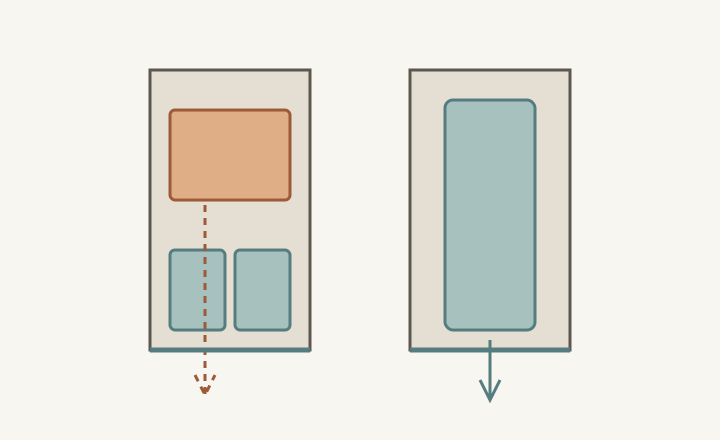
Diagram The left retrieval line crosses the front contents; the right arrangement assigns the depth to a long object. Neither drawing proves opening fit, handling or hardware capacity. These are alternative storage jobs to test.
A
Front contents that affect the route to the back.
B
A separate rear group needing a defined extraction order.
C
A long item using depth without a separate rear row.
D
The long item still needs a complete path out of the cabinet.
A separate rear reserve can also be useful when its contents are clearly identified and a workable retrieval sequence exists. Mark which front items must move first and where they go temporarily. Calling the rear group occasional does not make it accessible; it simply changes how often that sequence occurs. Include the return of the front group after the rear item is replaced.
Compare a deep-shelf case with the same inventory
In a hypothetical kitchen, pans occupy the front of a deep shelf and spare serving containers sit behind them. To retrieve a rear container, the user must remove pans onto a nearby counter. That counter is normally used during meal preparation, so the reserve cannot be reached conveniently at the moment it is requested. The issue is not just reach distance; it is the complete removal order and the missing temporary destination.
Compare assigning a long roasting pan along the depth and moving the reserve to another identified home, or retaining the reserve with a practical front-group removal method. A suitable removable grouping may simplify handling, but the loaded group, grip and landing surface still need testing. Keep every item accounted for in both options; a clearer drawing that omits the spare containers has not solved their storage.
Test identifying, removing and returning the rear contents
View the stored arrangement from the normal approach with the front occupied. Identify how the user knows what is behind it. A label or location record can reduce searching, but it does not provide the missing extraction route. Test the rear item’s return while neighboring contents remain in their ordinary places, then restore the front group as the household would after use.
Check whether a restocking change can accidentally block the agreed path. A taller front item, a different handle orientation or a newly added container can alter access without changing the cabinet. Define the front group’s boundary and the rear group’s home clearly enough that routine putting-away preserves the chosen method.
Record usable depth as a task, not a volume claim
Save the interior boundary, assigned long item or rear group, removal order, temporary landing and return sequence. Include selected moving hardware where relevant and its own fit and loading requirements. Recheck after changes to contents or fittings. The back zone contributes useful storage when the household can repeatedly retrieve its assigned contents, rather than when a deep outline simply increases the apparent capacity.
Pure White
Cream White
Light Warm Gray
Gray
Navy
Black
Oak Tone
Dark Walnut Tone
Design study These finish studies are design references, not a list of currently orderable colors. Screens and lighting change the appearance; compare a physical sample before choosing.See all finish options →
Less cabinet depth can help a constrained location, but check the complete projection and the inventory it displaces. A shallower box under an unchanged counter does not move the counter edge.
A deeper upper cabinet can change storage and the space above a task. Test the same counter setup with the finished projection, user position and doors included.
The sample shows the door frame, a separate center panel, the face frame and the cabinet box. Each component has its own place in this Shaker construction.
Shaker construction: door frame, center panel, face frame and cabinet box. The cutaway helps locate these parts; confirm each material in the specifications for the selected cabinet.
01 / Door frame
The Shaker door has rails and stiles around a separate center panel. The frame and center panel are different components; confirm their materials in the specifications for the selected cabinet.
02 / Face frame
The face frame surrounds the opening at the front of the cabinet box and sits behind the doors. The face frame, door frame and cabinet box are separate parts.
03 / Cabinet box
The sample exposes the cabinet sides, interior surfaces and layered edges. The image does not establish the wood species or material specification of a selected cabinet.