Blind Corner Cabinet Pullouts: Capacity and Clearance
An empty mechanism can move cleanly while a handle or lid obstructs the loaded path. Confirm which shelves move, what moves with them and how the contents return.
Evaluate a blind-corner pullout with the intended contents present and the entire opening and closing sequence understood. A mechanism’s empty motion does not prove that the loaded arrangement works. Items can extend beyond the platform, interfere with another level or require a different grip when brought forward. Start with the selected system, then assign a load that fits its actual conditions.
Identify which shelves move independently and which depend on others
Do not treat every blind-corner product as the same motion. Kesseböhmer’s US LeMans II page describes independently moving shelves. That is a feature of that system, not a promise about every corner pullout.
The manufacturer’s US MagicCorner I page instead describes a sideways shelf movement that brings the rear pullout forward. These examples show why the actual product sequence must be identified before assigning front and rear contents.
For the proposed model, record the starting state, door position, moving group and final access position. Identify any group that moves merely to make another reachable. Include how the sequence reverses. A photograph showing all shelves open can hide the order required to get there, including where the user stands while the mechanism moves.
Load the actual platforms within their stated limits
Obtain usable platform shape and dimensions, vertical clearances, load limits and loading instructions for the exact configuration. Do not substitute total cabinet volume or assume every shelf has the same rating. Include any basket or organizer that is part of the proposed load. Use the manufacturer’s definitions when checking loading rather than inventing a shared limit from a similar-looking product.
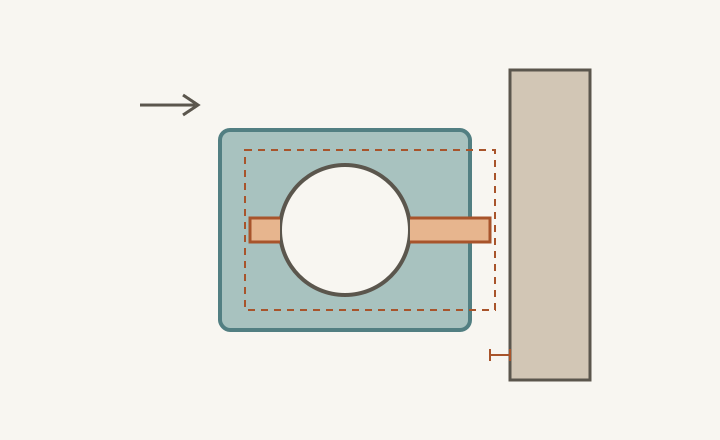
ABCD
Diagram This is a loaded-outline check, not a drawing of either named product. The remaining space must be assessed throughout the selected mechanism’s real motion; no clearance value or load approval is implied.
A
The platform outline is only part of the moving arrangement.
B
A handle extends beyond the platform.
C
A fixed neighboring obstruction must remain in the test.
D
Check the loaded outline through motion, not just this position.
Fit the everyday stored form of each item. A lid resting on a pot changes its height; a handle changes the outline; a nested group may be wider than its bottom piece. If the proposed arrangement relies on separating those parts, give the separated pieces their own usable home. Do not compare a fully equipped collection with a demonstration that quietly removes its awkward pieces.
Observe the loaded path through intermediate positions
Follow the product instructions and check the loaded arrangement through its complete movement, including the return. Watch the parts nearest the cabinet opening, adjacent handles and other shelf levels. A platform that clears an obstacle may carry an item that does not. Do not force a mechanism past interference; revise the assignment or have the specific installation and compatibility checked.
Include the person’s working position and the place where the selected item is set down. In a linked arrangement, contents not being selected may still move. Check that they remain suitably arranged under the product’s loading instructions and do not obstruct access to the requested item. Seeing the rear shelf is not the same as having room to lift an object from it.
Check a pot with its normal lid and handle orientation
In a hypothetical corner, an empty platform operates correctly. The household then places its usual pot with the lid on and the long handle pointing outward. At an intermediate position, the loaded outline reaches a neighboring obstruction even though the platform itself clears it. The earlier empty demonstration did not test the arrangement the household intends to use.
Compare a verified handle orientation, separate lid storage with an assigned home or another pot location. Retest the full motion after a change. If the revised load only fits when an unrelated drawer is closed, record that operating condition. Keep the usable contents and the required sequence visible rather than treating every adjustment as a free increase in capacity.
Keep a record of the approved configuration and actual load
Save the exact system and configuration, relevant instructions, platform assignments and observed opening and return sequence. Include any adjacent fronts that must be closed and items that need separate homes. Recheck after changing cookware or organizers. The useful result is a repeatable loaded operation, not simply a mechanism that moved smoothly while empty in a display.
Pure White
Cream White
Light Warm Gray
Gray
Navy
Black
Oak Tone
Dark Walnut Tone
Design study These finish studies are design references, not a list of currently orderable colors. Screens and lighting change the appearance; compare a physical sample before choosing.See all finish options →
A diagonal front can expose a broad interior, but the opening, turning space and rear handling remain different checks. Use the intended objects and the actual door position.
Opening each drawer alone and opening both are different tests. Track front, box and handle movement in plan and height before deciding whether the corner needs a physical revision or an agreed sequence.
The sample shows the door frame, a separate center panel, the face frame and the cabinet box. Each component has its own place in this Shaker construction.
Shaker construction: door frame, center panel, face frame and cabinet box. The cutaway helps locate these parts; confirm each material in the specifications for the selected cabinet.
01 / Door frame
The Shaker door has rails and stiles around a separate center panel. The frame and center panel are different components; confirm their materials in the specifications for the selected cabinet.
02 / Face frame
The face frame surrounds the opening at the front of the cabinet box and sits behind the doors. The face frame, door frame and cabinet box are separate parts.
03 / Cabinet box
The sample exposes the cabinet sides, interior surfaces and layered edges. The image does not establish the wood species or material specification of a selected cabinet.