Corner carousel: does the door rotate with the shelves or open separately?
A pie-cut carousel with an attached front is a different cabinet assembly from rotating shelves behind hinged doors. Match the front mechanism before comparing shelf diameter.
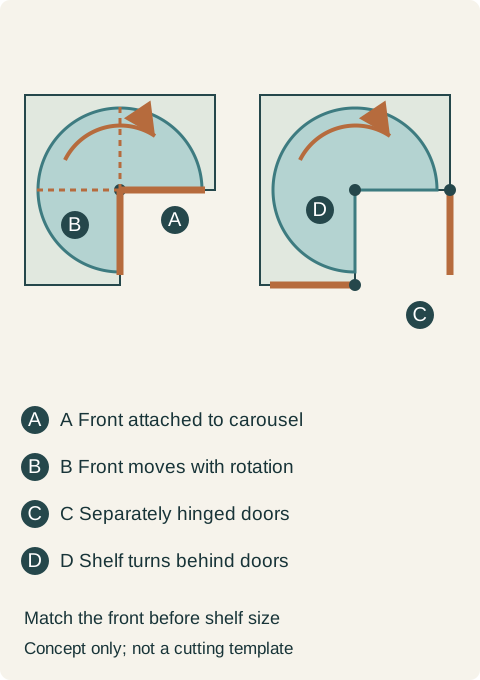
Before ordering a corner carousel, identify what carries the doors. In an attached-front arrangement, the door panels belong to the moving carousel assembly. In a hinged-door arrangement, the doors open independently and the shelves rotate behind them. A similar shelf outline or diameter does not make the hardware interchangeable.
Rev-A-Shelf's application guide identifies a pie-cut corner with the door attached and separately distinguishes shelf shapes and dependent or independent shelf rotation. Door attachment and how the shelf levels move are therefore separate selection questions.
With separate hinges, the user opens and parks the doors before turning a shelf. The hinged leaves need room beside the cabinet, including clearance from neighboring handles. The shelf then has its own rotating envelope inside the opening.
When the front is attached to the carousel, its travel belongs to the rotating assembly. The front must return to the intended closed position along with that mechanism. The door panels' thickness, connection and path cannot be treated as an optional decorative cover. Compare the selected system's complete drawing with the corner cabinet and its neighboring fronts.
The shelf levels also matter. If they rotate together, retrieving something from a lower level moves the upper load as well. If they rotate independently, the levels can be positioned separately. Neither description removes the need to keep handles, lids and other contents within the permitted loaded outline.
Teaching example Conceptual plans: the left front moves with the carousel; the right doors open separately from the rotating shelves. The contrasting lines distinguish front motion from shelf rotation. Shapes are explanatory, not product templates.
A replacement with the same shelf diameter can still be wrong
An existing corner has fronts fastened to its rotating assembly. A replacement proposal offers similarly sized shelves on a post but provides no approved door attachment. The shelves may fit inside, yet the proposal leaves the fronts unsupported in their intended role. It is rejected as an equivalent replacement. The acceptable route is a documented compatible attached-front system, or a separately designed conversion that includes the doors, hinges and cabinet changes.
For a new cabinet, compare both complete front arrangements. A household that wants the doors parked independently may select a hinged-front design with independently rotating shelves after checking its door sweep. Another may prefer the integrated movement, but must select its front and carousel as one supported assembly. “Lazy Susan included” is too little information to distinguish those orders.
Keep the cabinet and mechanism together
The quote should identify the front arrangement, shelf shape, how the levels rotate and the compatible cabinet configuration. For retained cabinets, preserve the documented support and attachment conditions instead of removing parts to imitate another mechanism. The useful comparison is between complete working corners, not two loose circles with similar dimensions.
Pure White
Cream White
Light Warm Gray
Gray
Navy
Black
Oak Tone
Dark Walnut Tone
Design study These finish studies are design references, not a list of currently orderable colors. Screens and lighting change the appearance; compare a physical sample before choosing.See all finish options →
An empty mechanism can move cleanly while a handle or lid obstructs the loaded path. Confirm which shelves move, what moves with them and how the contents return.
A balanced corner front can hide awkward access. Compare how each proposed opening exposes the assigned contents and where its open panels leave the user’s hands and transfer path.
The sample shows the door frame, a separate center panel, the face frame and the cabinet box. Each component has its own place in this Shaker construction.
Shaker construction: door frame, center panel, face frame and cabinet box. The cutaway helps locate these parts; confirm each material in the specifications for the selected cabinet.
01 / Door frame
The Shaker door has rails and stiles around a separate center panel. The frame and center panel are different components; confirm their materials in the specifications for the selected cabinet.
02 / Face frame
The face frame surrounds the opening at the front of the cabinet box and sits behind the doors. The face frame, door frame and cabinet box are separate parts.
03 / Cabinet box
The sample exposes the cabinet sides, interior surfaces and layered edges. The image does not establish the wood species or material specification of a selected cabinet.