Copper kitchen sinks: living copper or a nickel-plated surface?
A copper body does not always mean an exposed copper working surface. Decide whether you want changing copper color or the particular plated finish, then choose and care for the complete sink accordingly.
Choose an exposed living copper finish if changing surface color is part of the sink you want. If you prefer a nickel finish, buy the specified plated sink and follow the care for that surface, even when the body underneath is copper. These are different finished products. A silver-colored sink is not necessarily stainless steel, and a copper-bodied sink does not automatically invite copper polish. The working surface should determine the maintenance choice.
The body and the surface can be different metals
Native Trails describes its Antique Copper as unsealed and subject to patina, with prolonged acidic contact able to alter the finish. Its Brushed Nickel is nickel plated over copper; both receive nonabrasive basic care. That distinction is the starting point for this comparison. Read the finish name with the body description instead of stopping at the material category in a shopping filter. The coating belongs to the purchase, not merely to the photograph.
Think about what the preferred showroom image actually shows. The hammered relief is a shape; the warm or silvery surface is a finish. Liking that relief does not require choosing the same metal at the exposed surface. Conversely, wanting copper color does not necessarily mean wanting the surface to remain like the display forever. Separate these preferences before looking for a matching faucet, drain or cabinet finish. Otherwise, a visual choice can quietly become a maintenance commitment that the buyer did not intend.
A living finish asks for a different appearance expectation
A family that wants every visible area to remain exactly the same shade should not treat a living finish as an ordinary fixed-color sample. The sample still matters for texture, initial appearance and workmanship, but it cannot be used as a promise that normal use will never change the color distribution. This is especially relevant to a large exposed apron: that face is part of the room’s composition as well as part of a working sink. Decide whether a changing focal point is welcome.
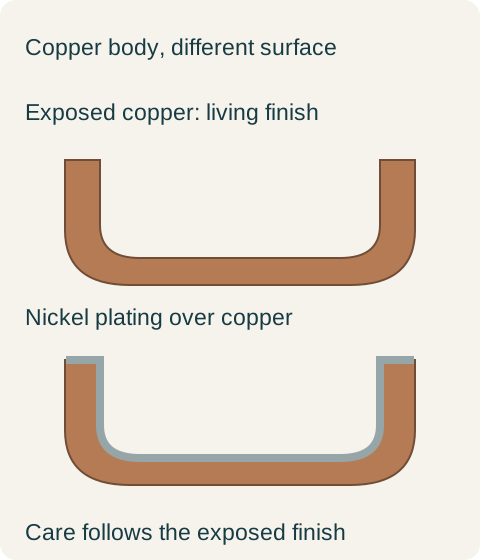
Diagram Conceptual sections show an exposed copper surface and a nickel layer over a copper body. The plating is exaggerated for visibility; this is not a thickness specification or a forecast of patina color.
Keeping the hammered form while changing the surface
In a hypothetical selection, the owners like a hammered sink’s shape but do not want the changing brown surface that attracted them in the first showroom photograph. They compare the offered Antique Copper and Brushed Nickel versions, then choose Brushed Nickel after seeing it beside their faucet and counter. They accept the plated product’s own care instructions and its actual texture. They are not ordering bare copper with a request that the installer somehow preserve its initial color indefinitely.
The reason for that decision is more precise than saying the nickel option is maintenance-free. Any chosen sink still needs ordinary cleaning and appropriate treatment of marks. The owners prefer this finish and its care requirements; they have not purchased immunity to wear. Keeping that distinction makes future questions easier. A mark can be described and assessed against the selected finish rather than being judged against an imagined surface that never changes under any circumstances.
Do not transfer a metal-cleaning recipe by appearance
A product sold as copper cleaner is not automatically suitable for a plated copper sink. The exposed finish, any protective treatment and the manufacturer’s instructions must agree. Equally, an abrasive method used on a different stainless product should not be copied onto a silvery plated surface. Store the sink’s identification with the care record so a household member or cleaner does not choose a method from color alone. This is a practical benefit of writing down the complete material description at purchase.
Keep texture in the sample decision. Look at the basin floor, corners, rim and exposed front under normal light, rather than judging only a cropped image of hammer marks. A large faucet or strongly patterned counter can alter how prominent the sink appears in the room. The hypothetical owners use the actual proposed combination to choose nickel; they do not require every metal in the kitchen to have an identical sheen. Coordinating a group is an appearance decision, not proof that its components share the same chemistry.
The finish choice does not complete the cabinet specification
After choosing the surface, retain the exact sink configuration for the cabinet and countertop design. A similar-looking apron, a different bowl arrangement or a replacement model may change the required opening and support. The finish comparison cannot authorize those substitutions. Compare complete sink offers, including the selected drain and required supporting work, rather than assuming all products with the same nominal size will occupy the cabinet in the same way.
Do not assign a universal price ranking to living copper and nickel-plated sinks. The actual offers may differ in model, size, fabrication, accessories and scope. If a quote changes only the finish, that specific difference can be evaluated against the appearance the household prefers. If it changes the whole sink, compare the whole proposal. The owners in the example buy the plated version because it retains the form they want with the surface they have accepted.
Retain the finished-product identity
The useful record names the sink model, copper body where specified, exposed finish and accepted care document. A later replacement should preserve those details or be treated as a new selection. That keeps a material shorthand from undoing the decision: neither “copper sink” nor “silver sink” fully describes what this household chose.
Pure White
Cream White
Light Warm Gray
Gray
Navy
Black
Oak Tone
Dark Walnut Tone
Design study These finish studies are design references, not a list of currently orderable colors. Screens and lighting change the appearance; compare a physical sample before choosing.See all finish options →
Compare the actual sink finish, care routine and sound treatment. A colored composite is not maintenance-free stone, and a stainless sink need not stay scratch-free to serve its purpose.
Match the selected sink to the cabinet interior, front and countertop drawing. Worked examples show why bowl width and nominal cabinet size do not settle the fit.
Compare the actual countertop products, heat-source routine and fabrication proposal. A fired porcelain slab and resin-bound quartz are different materials, but neither label replaces a complete kitchen specification.
The sample shows the door frame, a separate center panel, the face frame and the cabinet box. Each component has its own place in this Shaker construction.
Shaker construction: door frame, center panel, face frame and cabinet box. The cutaway helps locate these parts; confirm each material in the specifications for the selected cabinet.
01 / Door frame
The Shaker door has rails and stiles around a separate center panel. The frame and center panel are different components; confirm their materials in the specifications for the selected cabinet.
02 / Face frame
The face frame surrounds the opening at the front of the cabinet box and sits behind the doors. The face frame, door frame and cabinet box are separate parts.
03 / Cabinet box
The sample exposes the cabinet sides, interior surfaces and layered edges. The image does not establish the wood species or material specification of a selected cabinet.