Buying kitchen cabinets and a custom dining table that belong together
A coordinated table does not have to copy a cabinet door. Agree on the shared wood character and details while giving the table its own chair, support and finishing requirements.
Order related pieces, not a cabinet made horizontal
Buy the dining table and kitchen cabinetry as a coordinated package when their shared appearance matters and the proposed makers can show how they will achieve it. Keep each piece's function explicit. A cabinet door and a table are different assemblies, even when they share wood, color and a recognizable detail. A successful package should be coherent from across the room and comfortable when someone actually sits down.
This question comes after deciding that the room needs a table. It is not a choice between an island and dining furniture. The useful comparison is between a purpose-designed companion table, a separately sourced table that coordinates, and an existing table worth keeping. Do not replace good furniture merely because the cabinet supplier offers to make another matching object.
Silent Rivers describes a Craftsman kitchen and a custom quartersawn white oak dining table developed with the same household. The table borrowed elements from the cabinetry, while the makers checked the fit of chairs the owners had already purchased. That documented project illustrates coordination with a separate furniture brief, not a requirement that every kitchen buy a bespoke table.
Choose the specific connection: wood character, a color relationship, a repeated small detail or the broad shape of the supports. These do not all need to match. A table base might repeat a geometric accent from the cabinets while the tabletop remains visually simpler. Another room might pair an existing darker table with lighter cabinetry and use a related shape to connect them.
Look at the table in the room, not only beside a door sample. Its broad horizontal top receives light differently from vertical cabinet fronts. The visible floor, chairs and nearby built-ins also participate. If the table and cabinets are different in the actual view, decide whether the difference is intentional and pleasing before asking the finisher to chase identical color on unlike surfaces.
Distinguish a matching stain name from an agreed appearance. The underlying material, selection and finishing process can affect the result. If the proposal names oak for both pieces, ask which oak and what representative grain will be supplied. A promise of identical boards is not a realistic substitute for approved samples that show the accepted range.
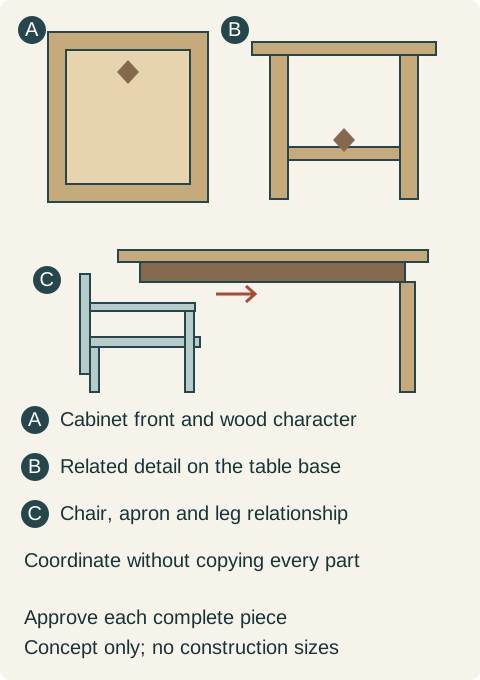
Teaching example Conceptual coordination study: A shows a framed cabinet front; B repeats a restrained geometric accent in the table base; C checks an actual chair against the table apron and legs. Matching appearance does not establish furniture dimensions, joints or construction.
Borrow a detail at the right scale
A cabinet frame contains a door panel; a table apron and legs support a surface and frame the seated position. The table maker must design those parts for the table. Repeating a cabinet rail's exact width on every furniture member can produce an awkward result or interfere with seating. Coordinate the visual idea without treating the cabinet elevation as a furniture construction drawing.
Choose a location where the shared detail will actually be seen. An accent on the table base may be visible from the entry but hidden behind chairs during a meal. That may be fine. It is less useful to pay for a repeated decorative feature that never participates in the view you are trying to connect. Show the table with its chairs in the composition.
Keep the tabletop from becoming an oversized cabinet front by default. If the cabinet has a framed or patterned face, decide whether that motif belongs on a surface used for dishes, papers and cleaning. There is no obligation to repeat every visual division. Ask the furniture maker to resolve the usable top, edge and construction for the task rather than assembling decorative parts around a style label.
Bring the chairs into the purchase early
Use the chairs intended for this table, including their arms if present. Check entry, seated movement and the relationship to the apron, legs or pedestal. A chair that slides under the tabletop may still stop at the apron, and a table that accommodates empty chairs may feel different with people seated. Inspect the whole relationship instead of checking tabletop height alone.
If the table expands, review its expanded and closed configurations. Where do the extra chairs go, and where do unused leaves live? Do the supporting members change the usable seats? Ask for the proposed mechanism and handling routine, not a general statement that an extension will fit. Additional capacity is useful only when the furniture can be used in that state.
Keep circulation through the room visible. The table's relationship to the kitchen is not just color: someone must leave their chair while another person uses the adjacent cabinets. Preserve the actual positions when reviewing the completed package. Decorative coordination is not a reason to enlarge the table beyond the space available for its normal use.
A single maker still needs separate approvals
One shop may make it easier to compare samples and discuss a repeated detail, but one invoice does not prove both pieces satisfy their requirements. Approve the cabinet arrangement and the table design separately, then check their shared appearance together. Include the exposed table underside and cabinet ends that matter in the room, rather than reviewing only their most photographed faces.
Ask what finish is proposed for each use and how each piece should be cared for. A shared visual tone does not require identical coating systems. If different systems are selected, review representative finished samples together and record that distinction. Do not assume a table finish can be used to repair the cabinets, or the reverse, because the purchase was described as matching woodwork.
With separate makers, designate who resolves the appearance comparison before production. Send the approved physical references where practical and keep their identification. A screen image and the word warm can mean different things in different workshops. Agreement should include the expected relationship and permitted variation, not an unsupported promise of perfect future matches.
One household keeps its chairs and orders a companion table
In a hypothetical kitchen project, the owners have comfortable armchairs and want a new dining table beside oak cabinetry. A matching-looking stock table is rejected because its apron conflicts with their chairs during the trial. Replacing the chairs would solve a problem created by the table, not a problem the household originally had.
They choose a companion table whose maker resolves the supports and apron around the retained chairs. A small geometric accent in the base relates to the cabinet design, while the broad top stays plain. The owners approve the wood appearance as coordinated rather than demanding that every tabletop board duplicate a door panel. They test the seating arrangement in the actual room.
The cabinet order remains complete on its own. The furniture order separately identifies the table, finish, support design and chair compatibility, with shared appearance references attached to both. The household pays for a table that fits its use and connects to the kitchen, not for unnecessary replacement chairs or exact repetition of every cabinet detail.
Pure White
Cream White
Light Warm Gray
Gray
Navy
Black
Oak Tone
Dark Walnut Tone
Design study These finish studies are design references, not a list of currently orderable colors. Screens and lighting change the appearance; compare a physical sample before choosing.See all finish options →
A dining table and a cabinet island use the middle of the kitchen differently. Compare ordinary meals, preparation, chairs, storage and complete purchase scope before giving the space to either.
Use transitional design to connect a new kitchen with an existing home. Assign traditional detail to specific places instead of buying an unrelated mix of favorites.
Oak is a species choice; the visible grain still needs a decision. Compare broad arches, ray fleck and straighter patterns on complete finished fronts.
The sample shows the door frame, a separate center panel, the face frame and the cabinet box. Each component has its own place in this Shaker construction.
Shaker construction: door frame, center panel, face frame and cabinet box. The cutaway helps locate these parts; confirm each material in the specifications for the selected cabinet.
01 / Door frame
The Shaker door has rails and stiles around a separate center panel. The frame and center panel are different components; confirm their materials in the specifications for the selected cabinet.
02 / Face frame
The face frame surrounds the opening at the front of the cabinet box and sits behind the doors. The face frame, door frame and cabinet box are separate parts.
03 / Cabinet box
The sample exposes the cabinet sides, interior surfaces and layered edges. The image does not establish the wood species or material specification of a selected cabinet.