A convertible fridge/freezer compartment: useful flexibility or capacity counted twice?
A compartment that switches functions can follow changing needs, but it cannot provide extra fresh and frozen storage simultaneously. Compare its actual modes, the regular load and where contents go before a change.
Flexibility helps when the demand changes over time
Choose a fridge/freezer-convertible compartment when the household needs extra refrigerated space on some occasions and extra frozen space on others, and can manage the change without displacing a necessary load. Choose a suitable fixed allocation when those needs occur together or when the movable assignment would remain unchanged in practice. The deciding issue is when the space is needed, not how many settings appear on the controls.
A flexible compartment has a real physical boundary. Assigning it to the freezer does not leave a second copy available for drinks. That sounds obvious while the appliance is empty, yet it is easy to miss when a salesperson shows successive attractive loading arrangements. Compare complete operating states, with every regular group accounted for in each one.
An adjustable-temperature drawer is not automatically convertible
LG's refrigerator guide identifies Full-Convert Drawer as able to switch between refrigerator and freezer use. This establishes the change of function; it does not establish the size, loading arrangement or transition procedure for every model carrying that feature.
Samsung's cited specification sheet lists meat, beverage, deli and wine settings for its FlexZone drawer, separately from the freezer. Do not assume an adjustable drawer provides freezer conversion, or generalize that particular sheet to every Samsung product.
Use the exact offered model's operating documents to identify its supported functions. A name containing flex, fresh or variable is insufficient. Likewise, a divider used to organize packages does not by itself create separately controlled temperature zones within a drawer. Establish what changes together before assigning unlike storage duties to its sections.
The useful comparison is between the complete refrigerators actually under consideration. One may have a convertible middle drawer; another may have a different fixed refrigerator/freezer balance that already serves the household. An extra exterior handle does not tell you which arrangement provides the right usable storage.
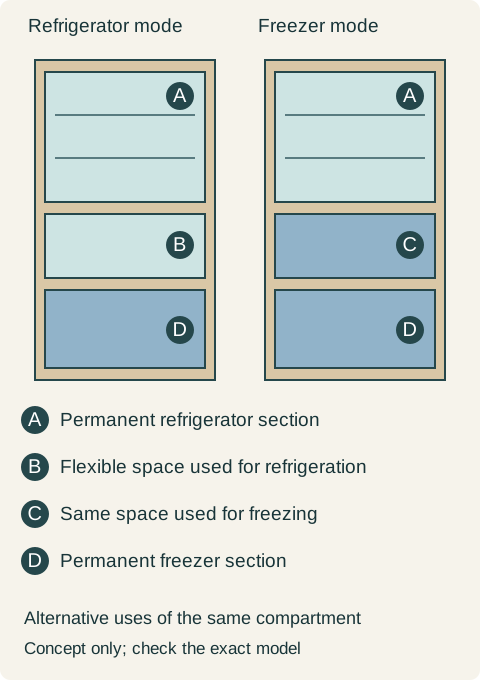
Teaching example Conceptual alternative states of the same refrigerator. A is the permanent refrigerated section. B is the convertible compartment assigned to refrigeration; C shows that same compartment assigned to freezing on another occasion. D is the permanent freezer in both states. The right-hand view is not an additional appliance or extra volume. Colors identify functions, not temperatures; proportions, controls and installation dimensions are not product specifications.
Map the permanent compartments before assigning the flexible one
Start with the contents that need a home throughout the ordinary shopping cycle. Separate the refrigerated collection from the frozen collection and test each in the candidate's appropriate permanent compartments. Include the fitted bins, shelves and ice equipment that will be present. Do not assume those interiors match another refrigerator merely because the outer width or advertised total capacity looks similar.
Then assign the changing group. If the flexible compartment holds drinks during a gathering, the permanent freezer must still accommodate the frozen items needed then. If it holds frozen packages during another period, the permanent refrigerator must accommodate the fresh-food load for that period. The fit must work in both states that justify the purchase.
Use representative empty containers, including their lids and normal orientations, for a showroom or planning trial. A drawer's usable height and retrieval shape matter even when its temperature function is correct. A broad covered dish may fit an open footprint yet conflict with the actual closure or fitted parts. That is a container-fit problem, not evidence against conversion itself.
Switching requires an assignment for the contents already there
Before changing a compartment's role, determine what happens to its present contents. A refrigerator that is already full cannot be treated as an unlimited temporary home. Nor should the kitchen counter be counted as another refrigerated compartment. The purchase comparison should establish an acceptable storage arrangement without prescribing food-handling temperatures or a conversion procedure.
Follow the selected appliance's instructions for changing mode and when the compartment is ready for its new use. Do not build the buying decision around an invented instant transition or an assumed wait time. A button can change a setting without proving that a freshly changed space is ready for everything the family intends to put there.
There is also an ownership choice. If everyone reaches into the same drawer, can they recognize its current purpose and keep the arrangement consistent? A frequently changing assignment may be easy for an organized household and frustrating for one that expects drinks to remain in the same place. The feature should reduce a recurring storage problem rather than create a daily search.
A household selects conversion for separate seasons of use
Consider a hypothetical remodel in which the owners host a recurring series of gatherings during one part of the year. Those occasions need additional refrigerated space for a checked group of covered serving containers. Their frozen reserve is modest at that time and fits the candidate's permanent freezer. During a different period, the household carries more frozen reserve, while its usual refrigerated load fits the permanent refrigerator without that serving group.
The comparison includes a fixed-allocation refrigerator and a model with a freezer-convertible drawer. In the fixed candidate, accommodating the gathering collection leaves an ordinary refrigerated group without an acceptable place. In the convertible candidate, the serving containers fit the flexible drawer in its permitted arrangement while the normal refrigerated contents remain in their permanent section.
For the other period, the owners repeat the whole-load test. The additional frozen packages fit the convertible compartment, and the regular fresh-food collection fits elsewhere in the same appliance. The serving-container collection is no longer a refrigerated-storage demand then; it has not simply been hidden outside the drawing. The owners also accept the model's documented changeover and readiness requirements between these periods.
They select the convertible refrigerator and retain the planned pantry cabinet instead of reserving another location for a supplementary cold-storage appliance. Their decision depends on the tested nonoverlapping demand. If a future gathering coincides with the larger frozen reserve, that conflict must be addressed separately; the selected compartment cannot perform both assignments at once.
When a fixed allocation is the stronger purchase
A household may need its extra frozen reserve and extra refrigerated collection at the same time every week. Conversion then offers little relief: either state leaves the other group short of space. Compare a refrigerator with a suitable fixed balance, or a separately justified supplementary appliance with a verified location. Do not buy flexibility as a substitute for simultaneously required capacity.
Another household may find that the flexible section would always be a drinks drawer. That can still be a pleasant arrangement, but the purchase should be evaluated as the storage it will actually provide. Compare a suitable temperature-controlled drawer or ordinary refrigerator layout on access, fit and complete cost. Do not pay for hypothetical future conversion without considering whether it changes the decision.
Neither outcome establishes a universal price or energy ranking. Compare actual proposals, including cabinet work and any additional appliance that makes one proposal function. Feature packages may differ in other ways. Avoid attributing the entire price difference to the convertible compartment when ice equipment, exterior finish or unrelated controls also change.
Keep the selected storage plan with the cabinet order
Confirm the refrigerator's actual installation envelope, ventilation, connections and opening movements after choosing the storage arrangement. A useful internal mode does not excuse a drawer that cannot open fully beside the island or an appliance that conflicts with the proposed surround. Use the selected model's requirements rather than a generic clearance copied from a buying guide.
Keep the accepted refrigerated and frozen assignments for each intended state with the appliance schedule. If a substitution changes the compartment functions, fitted interior or permanent capacity, revisit those assignments before approving the cabinet relationship. A replacement described as another four-door model may not preserve the feature that justified the original purchase.
Conversion earns its place when the household can name the changing demand, demonstrate both complete loads and accept the transition between them. Where the demand stays constant, a well-chosen fixed arrangement can make the kitchen simpler to use. In either case, the order should buy storage the household can actually occupy, not the same compartment counted under two headings.
Pure White
Cream White
Light Warm Gray
Gray
Navy
Black
Oak Tone
Dark Walnut Tone
Design study These finish studies are design references, not a list of currently orderable colors. Screens and lighting change the appearance; compare a physical sample before choosing.See all finish options →
A wide fresh-food compartment and a tall divided layout solve different storage problems. Compare the containers you actually use, their shelf assignments and the freezer routine before selecting the refrigerator surround.
A drawer favors a view from above, while a door unit presents shelf openings from the front. Choose from the containers you keep, not from matching cabinet-panel lines.
A top-opening chest and a front-opening upright use storage depth and room space differently. Compare actual packages, access and ownership work before giving either appliance a permanent place beside the kitchen.
The sample shows the door frame, a separate center panel, the face frame and the cabinet box. Each component has its own place in this Shaker construction.
Shaker construction: door frame, center panel, face frame and cabinet box. The cutaway helps locate these parts; confirm each material in the specifications for the selected cabinet.
01 / Door frame
The Shaker door has rails and stiles around a separate center panel. The frame and center panel are different components; confirm their materials in the specifications for the selected cabinet.
02 / Face frame
The face frame surrounds the opening at the front of the cabinet box and sits behind the doors. The face frame, door frame and cabinet box are separate parts.
03 / Cabinet box
The sample exposes the cabinet sides, interior surfaces and layered edges. The image does not establish the wood species or material specification of a selected cabinet.