Conestoga’s 2026 finish expansion: compare paint and stain routes separately
The announced palette adds choices in different finish categories. It can justify reopening an unfinished color decision without replacing an already accepted cabinet design.
Conestoga’s finish expansion is useful news for a buyer still choosing a finish within that supplier’s program. It is a reason to review the applicable current palette, not a reason to replace a satisfactory approved kitchen. Start by deciding whether the desired result is a painted color field or a wood-focused stained finish, then compare the relevant additions within that route.
What the announcement actually added
On June 8, 2026, Conestoga announced 15 summer additions: 8 paint-based Colourtones and 7 Wiping Stains. The count describes additions across those categories, not an all-paint collection or a sales ranking.
This review observed the public announcement and linked catalog on October 23, 2026. Publication date, editorial observation and a project’s confirmed ordering arrangements are different records; a public launch page does not establish a dealer’s stock or the lead time for a particular kitchen.
A color name is not a complete finish configuration
The linked Bay Leaf sample record identifies Hard Maple and the Paint; Colourtones finish style, with the displayed glaze treatment marked N/A. That is the documented sample configuration, not proof that every possible door construction or optional treatment shares that configuration.
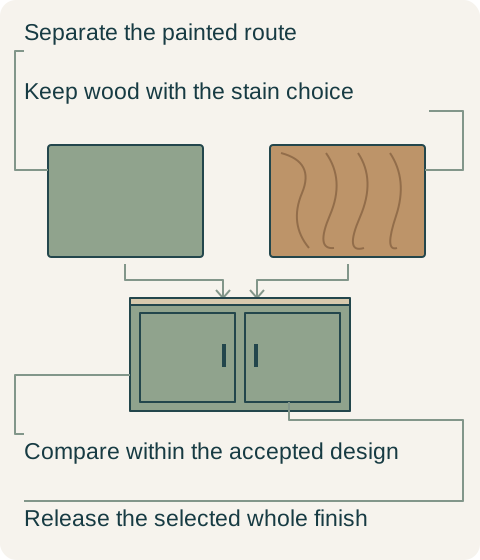
Teaching example Original hypothetical selection diagram: a painted sample and a stained wood sample feed a decision on an unchanged cabinet design. Colors are illustrative and do not reproduce Bay Leaf or any manufacturer swatch.
For a stained route, Conestoga describes its wiping stains as hand-applied and wiped off to develop the appearance while highlighting natural grain. The selection therefore includes the wood appearance, not simply a flat color patch borrowed from a different material.
If a project is still undecided, reopen only the part of the selection that the new options could improve. Keep the accepted door shape, room materials and storage plan visible while comparing finishes. Changing those at the same time makes it difficult to tell whether a new finish is actually helping. A new palette is most useful when it answers a specific unresolved concern, such as wanting a colored door instead of the wood appearance previously considered.
Keep candidate finish records separated by route. On the painted side, record the selected color and complete door construction. On the stained side, keep the chosen wood and its actual finished appearance attached to the stain identity. Do not rank an attractive stained wood sample against a painted chip as though only the hue changed. The room may be gaining visible grain, different visual movement and a different relationship to the floor at the same time.
An undecided homeowner can change the finish without restarting the kitchen
Imagine a hypothetical kitchen whose cabinet layout and framed door shape are approved but whose finish remains open. The owners originally considered stained wood because the earlier selection they had seen did not offer a painted appearance they liked. The updated palette prompts them to review a Bay Leaf sample alongside the proposed wood finish, with their existing floor and selected countertop present.
In this hypothetical comparison, they prefer the painted route because it gives the cabinets a distinct color while allowing the existing wood floor to remain the main wood surface. They review a complete representative front and a supported finished-component proposal. They then choose the painted package, retain the accepted layout and door shape, and remove the stained alternative from the order. Their decision does not depend on assuming a new color is more durable, more fashionable or cheaper.
The accepted package keeps the actual color, door construction and treatment identified together. The owners do not add a decorative glaze merely because other images in the program show glazed examples. If that effect becomes desirable, it needs its own supported configuration and appearance review. In the chosen example, the simpler approved finish remains the purchase.
An approved project has a different threshold for change
For a kitchen already released with an accepted finish, compare the concrete benefit of a change with its actual consequences. A new option can be attractive without solving a problem in the approved room. Obtain the project-specific change terms before making a switch; the announcement itself supplies no cancellation, rescheduling or price commitment. Keeping the accepted finish is a reasonable decision when the new palette does not improve the room enough to justify reopening it.
The same distinction matters when adding cabinets beside an existing installation. A new finish name is not a replacement-match instruction for older doors. That project needs an accepted relationship to the installed finish, whether matching or deliberately contrasting. The practical effect of this launch is a broader menu to evaluate within the supplier’s program. It does not establish a market-wide preference, a mandatory redesign or a current usaKT.com offering.
Pure White
Cream White
Light Warm Gray
Gray
Navy
Black
Oak Tone
Dark Walnut Tone
Design study These finish studies are design references, not a list of currently orderable colors. Screens and lighting change the appearance; compare a physical sample before choosing.See all finish options →
A color name does not identify a finish system. Compare the decorative surface, the core, the edge and the repair method before choosing a cabinet front.
The quarter’s current-activity and near-term readings pointed in different directions. For cabinet businesses, that distinction matters when choosing between preparing for demand and committing to additional inventory.
The sample shows the door frame, a separate center panel, the face frame and the cabinet box. Each component has its own place in this Shaker construction.
Shaker construction: door frame, center panel, face frame and cabinet box. The cutaway helps locate these parts; confirm each material in the specifications for the selected cabinet.
01 / Door frame
The Shaker door has rails and stiles around a separate center panel. The frame and center panel are different components; confirm their materials in the specifications for the selected cabinet.
02 / Face frame
The face frame surrounds the opening at the front of the cabinet box and sits behind the doors. The face frame, door frame and cabinet box are separate parts.
03 / Cabinet box
The sample exposes the cabinet sides, interior surfaces and layered edges. The image does not establish the wood species or material specification of a selected cabinet.