A nearby seller is convenient only if its service fits your project. An online quote is competitive only if it covers what you need delivered. Compare the actual cabinet package and the work around it before deciding which buying channel offers better value. A distance label cannot tell you who checks measurements or handles a replacement.
Make the product comparison fair
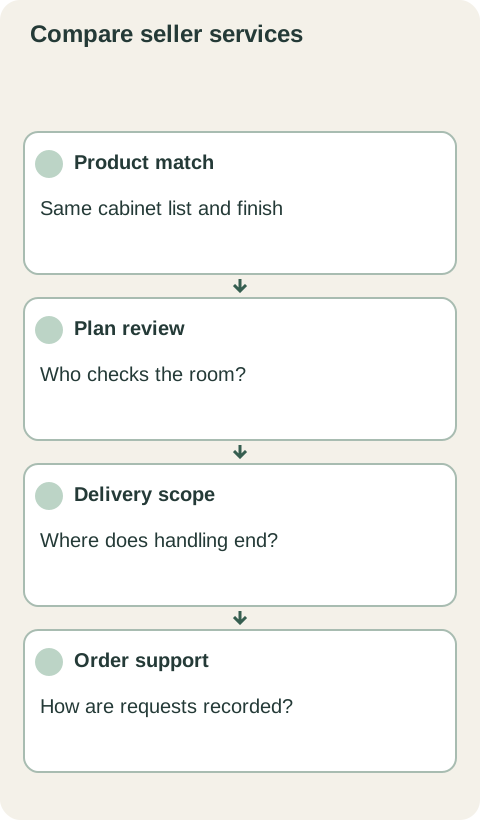
Give each seller the same cabinet schedule and finish brief. Match door construction, box material, drawer system and assembly condition rather than relying on similar photographs. KraftMaid’s FAQ identifies selections such as cabinet type, size and finish as price variables. Use that as a reason to specify your package, not as evidence of anyone else’s prices. Put proposed substitutions beside the requested item and explain their effect on storage or fitting.
Send a labeled room drawing and ask what information is needed to check the order. A helpful response identifies unresolved appliance models, exposed ends or corner conflicts. A rendering with no itemized cabinet list leaves those decisions hard to verify. KraftMaid provides a measuring workflow for planning; the final field check still needs a named person for your job. Record whether plan review, measuring or design is offered, its scope and any fee.
Diagram Use evidence for each part of the purchase instead of judging by distance alone.
Compare delivery to the same endpoint
Use the actual destination and access description in every freight inquiry. A local truck route and a nationwide shipment may have different arrangements for unloading, appointments and inside carry. FedEx Freight’s published service levels illustrate why ground-level delivery and delivery inside a building are distinct services. That carrier example is not usaKT.com’s delivery offer. Compare the quoted endpoint and included handling, then arrange the work left between that point and the installation room.
If a seller offers samples, establish whether you are looking at a finish chip, a door sample or a display cabinet. They answer different questions. A chip helps with color; a door shows profile and edge treatment; a specification identifies the ordered construction. Ask whether samples represent the selected line and finish. Take them into the room with surrounding materials. Do not infer current stock, every cabinet detail or an exact future color match from a display or a screen image.
Look at the response process before a problem
Compare how the seller identifies an order, records revisions and receives reports of damage or missing parts. Request the relevant written procedure and contact route. Responsiveness during quoting matters, but a friendly conversation does not define replacement cost or timing. Read what evidence is needed and who follows the request. A nearby pickup point is useful only if pickup is actually offered; an online portal helps only if it keeps the approved item and revision identifiable.
Choose using a short evidence file
Keep the comparable quote, scope, sample identification, delivery terms and unresolved questions together. Note which benefits you will actually use: a documented site measure may matter more than a nearby address, while a clear remote ordering process may suit an experienced installer. Evaluate unanswered items as unanswered, rather than assuming the local or online model solves them. Release the purchase when the plan, items and responsibilities align, and preserve the accepted version for receiving.
Use the same test question with each seller
Choose an unresolved detail from your plan, such as an exposed end beside an appliance. Ask each seller how it appears in the drawing and item list, what additional information is needed and how a change would be recorded. Compare whether the answers are specific enough for your installer to use. This is more informative than counting response messages. Also check whether any promised sample, pickup or consultation requires an appointment or charge. Add only the services that are actually offered and relevant to your project to the comparison.
Before you release the order
Send the same cabinet schedule to each seller.
Compare sample type and actual specification.
Match delivery endpoint and handling services.
Keep unresolved service terms visible before selection.
Finish references
Pure White
Cream White
Light Warm Gray
Gray
Navy
Black
Oak Tone
Dark Walnut Tone
Design study These finish studies are design references, not a list of currently orderable colors. Screens and lighting change the appearance; compare a physical sample before choosing.See all finish options →
Choose the service that covers the decisions your remodel actually needs. Compare product choices, room coordination, drawings and compensation before paying for overlapping work.
A microwave on a table is not a complete meal arrangement. Decide what you will prepare, where the supplies will live and how cleanup works before the old kitchen is removed.
A smaller first order is useful only if it leaves a finished, usable kitchen and does not force expensive work to be repeated. Separate genuinely independent additions from connected cabinet and countertop work.
The sample shows the door frame, a separate center panel, the face frame and the cabinet box. Each component has its own place in this Shaker construction.
Shaker construction: door frame, center panel, face frame and cabinet box. The cutaway helps locate these parts; confirm each material in the specifications for the selected cabinet.
01 / Door frame
The Shaker door has rails and stiles around a separate center panel. The frame and center panel are different components; confirm their materials in the specifications for the selected cabinet.
02 / Face frame
The face frame surrounds the opening at the front of the cabinet box and sits behind the doors. The face frame, door frame and cabinet box are separate parts.
03 / Cabinet box
The sample exposes the cabinet sides, interior surfaces and layered edges. The image does not establish the wood species or material specification of a selected cabinet.