Combi-steam or conventional oven: choose cooking capability before the cabinet opening
A combi-steam oven is worth comparing when its steam cooking adds a method you will use while preserving the dry-heat tasks you still need. A Steam Clean label does not establish that capability.
Compare a combi-steam oven with a conventional oven when steam cooking is a recurring part of the kitchen you want, and the proposed appliance can also perform the dry-heat work that remains important. Keep the conventional option when its actual baking and roasting functions already cover the household's needs and the additional steam capability has no clear job. Neither decision should be made from the word steam on a feature list.
Begin with familiar dishes and their intended methods, not a collection of aspirational recipes. Record which tasks you already do successfully, which you want to move into the oven and which you would be willing to learn differently. Buying a new method can be worthwhile. Buying it on the assumption that every existing method transfers unchanged is a different proposition.
Separate cooking modes from cleaning labels
Wolf's current convection steam oven guidance lists steam, convection and combined convection-steam cooking modes. These are distinct functions within the named product family; the listing does not mean every appliance described as a steam oven has the same capabilities.
Read the actual cooking-mode list for each candidate. Does it provide the steam task you want? Does it retain the dry-heat mode required for your ordinary baking? If another function, such as broiling, matters to the household, verify that separately rather than treating it as automatically included. A similar face or a more elaborate display is not a substitute for a supported mode.
GE describes Steam Clean as a cycle that loosens minor oven spills for subsequent wiping. That cleaning feature, by itself, does not establish a steam-cooking program.
Keep cleaning and cooking in different parts of the comparison. An oven may have a steam-related care feature without providing the cooking method you intended to buy. Conversely, a steam-cooking appliance still has its own cleaning requirements. The presence of water in either description does not make the functions equivalent.
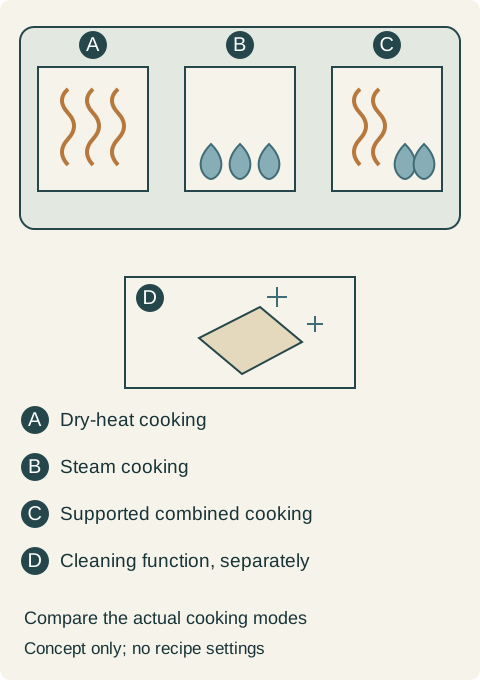
Teaching example Cooking functions are compared separately from cleaning. A represents a dry-heat cooking task; B represents steam cooking; C represents a supported combined program. The surrounding outline groups possible modes in a combi-steam appliance, not separate cavities. D is a cleaning function and is outside that cooking group. Symbols do not specify operating settings or appliance construction.
Judge the method through a dish, not an adjective
Choose a familiar dish for which you would actually use the proposed steam function and another that represents the dry baking you want to retain. Use the manufacturer's demonstrations and applicable cooking guidance to understand how the selected product handles those tasks. Ask what the user chooses on the controls, which vessel is used and what work happens afterward. This is a way to investigate the purchase, not a recipe or a promise about a result.
The point is not to declare steam healthier or to assume a combined mode makes every dish better. Those broad claims do not tell you whether the food you enjoy and the routine you accept match this appliance. A homeowner may value a new method enough to learn it, while another wants the familiar oven routine with minimal change. Both are reasonable priorities.
Avoid translating an existing recipe by guessing a temperature adjustment or adding steam to a program that does not support it. Cooking instructions belong to the chosen appliance and food. At the shopping stage, establish that the desired method is documented and that the household wants to use it; the cabinet plan should not invent the cooking procedure.
A matching front width does not preserve your pans
Bring the actual shapes into the comparison: baking sheets, covered dishes, roasting vessels and any trays specified for the intended modes. Check the useful interior, the permitted supports and the path through the door. A pan can pass the opening yet be unsuitable for the selected mode or support arrangement. Physical fit and approved use need separate answers.
Do not solve a mismatch simply by assuming every recipe will be divided into smaller portions. That might be acceptable, but it changes the household's work. Decide consciously whether replacing a favored vessel or changing a batch is part of the purchase. A candidate with useful new functions can still be the wrong main oven if it makes ordinary baking inconvenient.
Also account for the supplied and optional pieces you actually plan to use. Compare their storage shapes after they are clean and ready to put away. A new appliance need not create more clutter if those parts have a suitable home, but removing an old oven does not automatically free space for them. The nearby cabinet should contain the real equipment list, not a generic label saying accessories.
Compare ownership after the demonstration
Before approving the cabinet opening, review the actual water arrangement, recurring care tasks, installation and service requirements. Keep that review tied to the selected version. The practical question here is whether those commitments are acceptable in return for the cooking capability; reservoir handling and connection details need their own layout check.
Include the user in that ownership review. A product demonstration can be appealing while leaving out the tasks that follow a normal meal. Read what the chosen appliance requires and where any removable components will be handled. Do not promise that a connected version removes every water-related task or that a cleaning program eliminates manual care.
Compare complete proposals: the appliance, permitted cabinet installation, required connections, selected accessories and any altered storage. There is no universal price difference or maintenance interval in this guide. The relevant additional scope is what the actual quotes include and what the household will use.
A baker replaces the oven without adding an appliance tower
In a hypothetical remodel, the household regularly bakes fruit tarts and currently steams vegetables in a pot on the cooking surface. When a skillet is also in use, that steamer occupies a surface-cooking position the owners would rather leave available. They want to move the vegetable task to a documented oven steam program while retaining their dry-heat tart baking. The existing oven position is being replaced as part of the cabinet work. The owners are not trying to gain another independently usable cavity; the question is which appliance should occupy the planned oven position.
They compare a conventional candidate with a combi-steam candidate. Both are checked with the actual tart pan. The steam candidate is also reviewed with the permitted tray arrangement for the vegetables the family normally prepares; the comparison does not assume the tart pan becomes a steaming vessel. The combi-steam proposal retains the dry mode they need, accommodates those vessels in its approved arrangement and provides the steam mode they want to learn. A suitable product demonstration gives them enough information to accept that change in routine; no cooking time or result is assumed from the cabinet drawing.
They choose the combi-steam package and keep the planned appliance count. The water and care arrangements are reviewed for the selected version, and a nearby drawer is assigned to the actual extra trays instead of an unused set of occasional serving pieces. Those serving pieces have a verified home elsewhere. The owners accept the added purchase and care scope because moving that repeated vegetable task into the oven releases the cooking-surface position they wanted to keep available. The stovetop steamer still has a storage home for occasions when they choose to use it. They have changed where a familiar task happens rather than purchasing a promise that every dish will improve.
The conventional alternative would remain sensible if the desired steam use were occasional and the household preferred its existing method. In that case, preserving a familiar oven and the original accessory storage could be the better allocation. The benefit has to survive the actual cooking and ownership comparison rather than a demonstration's novelty.
Keep the final decision specific
Name the selected appliance, the cooking tasks retained, the new method being added and the accessory storage that supports it. Then coordinate its exact cabinet opening and installation. Buying a combi-steam model does not authorize copying the previous oven's cutout, and retaining a conventional oven does not mean ignoring its current instructions.
The useful distinction is clear: cooking capability is verified through the chosen modes and vessels; cleaning capability is reviewed as care; cabinet suitability is confirmed for the exact product. When those decisions agree, the oven purchase follows the household's kitchen rather than an ambiguous feature name.
Pure White
Cream White
Light Warm Gray
Gray
Navy
Black
Oak Tone
Dark Walnut Tone
Design study These finish studies are design references, not a list of currently orderable colors. Screens and lighting change the appearance; compare a physical sample before choosing.See all finish options →
Manual filling and connected water create different household tasks and installation reservations. Confirm the exact version, including its remaining maintenance access, before assigning surrounding storage.
Count independently usable cooking cavities before counting modes. A single cavity can simplify the cabinet layout, but it cannot accept an unrelated microwave task while occupied by a baking task that must continue.
The sample shows the door frame, a separate center panel, the face frame and the cabinet box. Each component has its own place in this Shaker construction.
Shaker construction: door frame, center panel, face frame and cabinet box. The cutaway helps locate these parts; confirm each material in the specifications for the selected cabinet.
01 / Door frame
The Shaker door has rails and stiles around a separate center panel. The frame and center panel are different components; confirm their materials in the specifications for the selected cabinet.
02 / Face frame
The face frame surrounds the opening at the front of the cabinet box and sits behind the doors. The face frame, door frame and cabinet box are separate parts.
03 / Cabinet box
The sample exposes the cabinet sides, interior surfaces and layered edges. The image does not establish the wood species or material specification of a selected cabinet.