Colored-through fiberboard cabinet fronts still need a finished surface
Color inside a routed cabinet front and protection on its surface do different jobs. Compare a completed colored fiberboard front with the painted alternative, including edges and grooves.
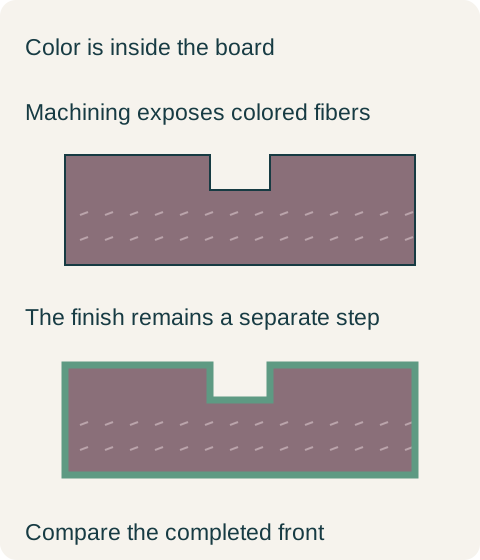
A routed groove can reveal what a colored cabinet front is made from. If the color belongs only to a surface coating, a newly machined recess exposes the material underneath until it is finished. With a colored-through fiberboard, the recess cuts into colored material. That distinction can be useful for a design with visible edges or machined detail, but it does not mean the front is ready to install directly from a sheet. Choose the panel and the protective finish as parts of one completed door.
Look at a shaped edge, not only a flat chip
Place the proposed front so you can see its face, outer edge and any recessed grip or groove. The goal is to understand where its color comes from and how the surfaces meet. A flat color chip cannot show a machined return. Conversely, a raw cut edge cannot demonstrate the final sheen or feel. Ask the fabricator to show a detail completed in the intended process, then judge whether its visible material character belongs in the room.
Investwood describes Valchromat as a wood-fiber panel whose color runs through the material, allowing cut and machined details to express that color. This named panel illustrates the construction; a generic colored-MDF description does not establish an equivalent product.
Color and coating are separate layers of the decision
Think of the color as a property of the board and the finish as the surface you will touch and clean. The material beneath a scratch may retain color, yet a damaged coating can still change reflection or texture. It would therefore be misleading to buy the board as an invisible-repair system. The same distinction matters at a handle recess: continuing color does not by itself establish that the recess has been prepared and finished in the same way as the broad face.
Teaching example Hypothetical sections of a colored-through routed front before and after finishing. The sketch is not a coating recipe, scratch test, panel rating or usaKT product specification.
Investwood’s installation guide calls for a protective finish and warns against wax or oil finishes in humid applications such as kitchens and bathrooms. It also describes shade variation between panels. The specified finish and the actual panel arrangement therefore remain part of the purchase.
A painted alternative may use the coating to create the requested surface color. Compare that finished result with the colored board after its selected finishing treatment, not with an unfinished sheet. Include the back, edge and machined grip in both proposals. If one option has a separate handle while the other uses a routed grip, recognize that additional design difference. A cheaper rectangle without the intended grip is not the same cabinet front at a lower price.
The island keeps colored grooves and a specified finish
In a hypothetical island, the owner wants shallow vertical grooves and visible colored edges. The fabricator presents a completed colored-through panel with the proposed kitchen-suitable varnish system, alongside a painted alternative. The owner chooses the colored board because the visible routed material is part of the desired appearance. The order includes the finishing work on the face, back, edges and grooves; a raw sheet offer is not accepted as the finished-door price. The remaining kitchen fronts retain their original painted treatment.
This allocation avoids turning a feature material into a requirement for every cabinet. The island carries the machined detail where it is visible, while the surrounding fronts can remain quieter. Review how adjacent doors sit together before fabrication locks their positions. The intended effect might be a coordinated material surface rather than a perfectly uniform painted plane. If the buyer wants a uniform plane instead, the finished painted option deserves consideration on that basis, without calling natural-looking variation a defect in every design.
Keep machining changes ahead of final finishing
If the grip shape or door edge changes after approval, return to the completed detail. A revised cut can create another surface that needs preparation and finishing, even when its color already appears correct. The component schedule should identify who carries out that work before the door reaches installation. Do not assume that a last-minute site trim will leave the approved coating system continuous merely because the new cut is the same color as the face.
For receiving, distinguish a material-color difference from missing finish or local damage. Compare the front with the accepted reference in the intended orientation, and look through the grip and along the edge. A rough-looking recess should not be dismissed solely because colored fibers remain visible there. Equally, a modest variation accepted in the original selection should not be reclassified as a promise of exact paint-like uniformity. The agreed completed appearance needs to be clear enough to make those judgments.
Purchase the work that produces the surface
The quotation should describe the panel, final front geometry and finishing work together. A panel brand alone does not include cutting, hardware preparation, coating, handling or installation. Keep the selected finish information for later care and repair, since the board’s color does not identify which cleaning products belong on its surface. The useful advantage of colored-through material is design freedom at visible machining, while the finished assembly still has to satisfy the ordinary demands of a cabinet front.
Pure White
Cream White
Light Warm Gray
Gray
Navy
Black
Oak Tone
Dark Walnut Tone
Design study These finish studies are design references, not a list of currently orderable colors. Screens and lighting change the appearance; compare a physical sample before choosing.See all finish options →
Judge a painted MDF door by its actual profile, finished edges and construction, with a sample that represents the size and details you intend to order.
Compare the actual countertop products, heat-source routine and fabrication proposal. A fired porcelain slab and resin-bound quartz are different materials, but neither label replaces a complete kitchen specification.
The sample shows the door frame, a separate center panel, the face frame and the cabinet box. Each component has its own place in this Shaker construction.
Shaker construction: door frame, center panel, face frame and cabinet box. The cutaway helps locate these parts; confirm each material in the specifications for the selected cabinet.
01 / Door frame
The Shaker door has rails and stiles around a separate center panel. The frame and center panel are different components; confirm their materials in the specifications for the selected cabinet.
02 / Face frame
The face frame surrounds the opening at the front of the cabinet box and sits behind the doors. The face frame, door frame and cabinet box are separate parts.
03 / Cabinet box
The sample exposes the cabinet sides, interior surfaces and layered edges. The image does not establish the wood species or material specification of a selected cabinet.