Store a colander where the whole bowl and its handles can be lifted without dismantling the kitchen’s mixing-bowl collection. Give a long-handled sieve a separate, supported position if nesting it leaves the handle trapped or its mesh pressed against other tools. These items serve related tasks but have different shapes. Grouping them near their work area can help without requiring them to occupy the same stack.
Separate the bowl-shaped items from the long-handled ones
Set the collection on a surface and identify the features that govern storage. A colander may have side handles, feet or an extended rim. A sieve may have a long handle on one side and a small supporting hook on the other. Measure the complete outline rather than the diameter of the working bowl alone. Include anything that remains attached during storage.
Notice how each piece rests. A stable base can sit on a shelf; a rounded sieve without a suitable support may roll or lean into its neighbors. A purpose-appropriate divider or holder can establish a position, but its own footprint belongs in the cabinet plan. The goal is to support the tool’s normal shape, not bend the handle or squeeze the rim to make it fit.
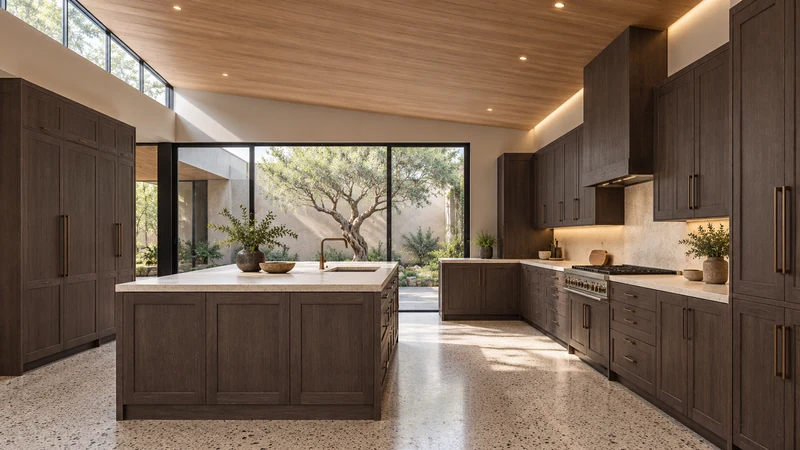
Design study Nearby storage may shorten the rinse-and-return route. The image is a design study and does not show strainer supports or usable drawer dimensions.
Check what nesting makes you move
A colander inside a mixing bowl can save shelf area. It can also tie up both pieces when only one is needed. Try retrieving the colander, setting it by the sink and returning the unused bowl to its place. Then reverse the test for a recipe that needs the mixing bowl but not the colander. If both actions require moving a whole stack, a separate position may be worth the additional space.
Do not assume the mesh of a sieve is an appropriate shelf for another object. Use the tool maker’s care and storage guidance, and arrange neighboring pieces so they do not depend on pressing against the working surface. A long utensil dropped into the same bin can change the arrangement even if the empty layout looked orderly.
Give the long handle a deliberate direction
In a drawer, align the handle where it can be seen and grasped. Check the supporting hook at the opposite end as well as the main handle. A diagonal position may consume the spaces beside the bowl, leaving less useful room than its narrow handle suggests. Trace the entire outline on a removable paper layout to compare it with other utensils before choosing fixed dividers.
For a door-mounted holder, include the depth of the stored tool, the mounting system and the space required when the door closes. A holder that fits on the door itself can still collide with a shelf or something inside the cabinet. Confirm that the selected cabinet and holder permit the proposed installation; a photograph of a hanging tool does not establish compatibility.
Try a meal-preparation sequence
Consider a household that uses a colander for rinsing ingredients and a fine sieve for a separate preparation step. The colander can live in a nearby base cabinet with its rim easy to grasp, while the sieve can occupy a defined utensil-drawer lane. Both are close to work without one being buried beneath the other. Test whether opening either location blocks the person already at the sink.
After cleaning according to the tools’ instructions, provide an appropriate route for drying and returning them. Do not plan to stack pieces together simply to clear the counter before they are ready to store. A temporary landing area may matter more to the routine than adding another permanent cabinet compartment.
Make the cabinet fit the tools you actually use
Compare overlapping sizes and identify which tools earn the most accessible locations. An occasional oversized colander can have a separate, clearly known home if it otherwise dictates an awkward arrangement for the daily group. Record complete outlines, support requirements and the removal sequence. The useful result is a set that can be selected and returned without catching handles or unpacking unrelated bowls.
Pure White
Cream White
Light Warm Gray
Gray
Navy
Black
Oak Tone
Dark Walnut Tone
Design study These finish studies are design references, not a list of currently orderable colors. Screens and lighting change the appearance; compare a physical sample before choosing.See all finish options →
The sample shows the door frame, a separate center panel, the face frame and the cabinet box. Each component has its own place in this Shaker construction.
Shaker construction: door frame, center panel, face frame and cabinet box. The cutaway helps locate these parts; confirm each material in the specifications for the selected cabinet.
01 / Door frame
The Shaker door has rails and stiles around a separate center panel. The frame and center panel are different components; confirm their materials in the specifications for the selected cabinet.
02 / Face frame
The face frame surrounds the opening at the front of the cabinet box and sits behind the doors. The face frame, door frame and cabinet box are separate parts.
03 / Cabinet box
The sample exposes the cabinet sides, interior surfaces and layered edges. The image does not establish the wood species or material specification of a selected cabinet.