New cherry cabinets vs. aged samples: approving the color range
Black cherry can darken with light exposure. That does not guarantee that a pale new door will become identical to an older sample or neighboring front.
Judge new cherry cabinetry against an agreed initial appearance range, with the sample’s exposure history understood. Do not approve a visibly unacceptable run solely because someone expects it to darken later. Natural color development is relevant to the purchase, but it is not a reliable correction plan for an unknown mismatch. A buyer who needs an almost unchanging, uniform color should resolve that requirement before choosing a natural cherry finish.
Light can change the wood, not just how it looks
Purdue Extension reports that black cherry darkens with light exposure and describes lighter areas left where wall decorations protected the wood. That is a physical exposure-history issue, distinct from the temporary appearance change caused by viewing the same sample under a different lamp.
An older showroom door and a newly finished order may therefore represent different histories. Record whether the reference is new, aged or of unknown exposure; do not assign an age by guessing from its color. A photograph of a dark display does not tell a shop how a fresh door must look or how long it should take to reach that appearance. The product’s actual finish and selected wood also remain part of the comparison.
Before approval, view a representative group of the proposed fronts together, including the frame and center panel relationship. A single attractive corner sample cannot show how the run will read. Establish which natural variation is acceptable at delivery and which difference calls for review. This is an agreement about the offered construction and sample range, not a claim that every cherry piece should begin with one exact color.
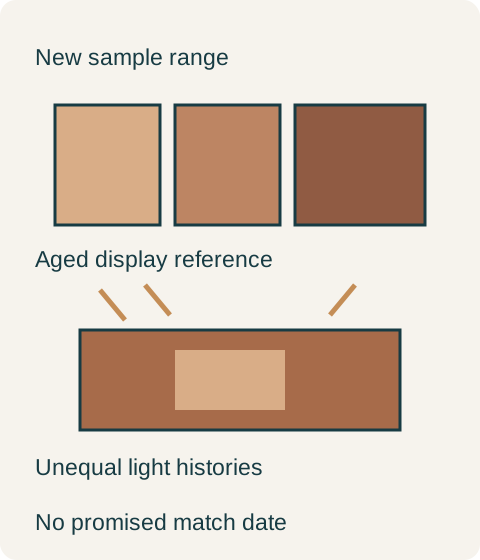
Teaching example Conceptual cherry comparison: new samples, an aged reference and protected versus exposed areas. Colors are illustrative; no aging rate or eventual color match is predicted.
A hypothetical choice made before the order
Suppose a hypothetical buyer likes the deep color of an aged cherry display but rejects the pale and dark contrasts visible in the supplier’s representative new-door set. The supplier cannot offer a documented initial range that the buyer accepts. The buyer selects a different, approved opaque finish package before ordering. The completed decision gives up exposed cherry grain to obtain the desired initial uniformity; it does not reserve an unresolved objection for a promised future darkening.
A different hypothetical buyer likes both the new-door range and the prospect of natural change. That buyer selects the cherry package and records acceptance of the whole sample group at delivery, while acknowledging that the eventual color is not specified by a timetable. These are different aesthetic priorities, not different levels of knowledge. The important distinction is that each buyer accepts the appearance actually being offered.
Why waiting does not resolve every mismatch
If a delivered door falls outside the agreed initial range, document it beside the relevant fronts under comparable viewing conditions and identify the part. Natural aging alone cannot establish whether the cause is ordinary variation, a different finish, an alternate wood selection or a production issue. Do not let a general statement about cherry’s behavior replace that comparison. A specific acceptance decision still needs the actual order and parts.
Unequal exposure also makes a precise future-match promise difficult. A protected reference and a front facing a window do not share the same history. Avoid improvised attempts to accelerate change by placing doors in direct sun or applying a different coating: those actions would change the original condition without establishing a controlled match. Use the product’s care directions for the chosen finish and keep any assessment separate from an unapproved treatment.
For later replacement, retain the original material and finish identities, but expect to compare the proposed replacement with the installed group. A retained spare can have a different exposure history too. The order record helps identify the product; it cannot freeze the wood’s appearance. A replacement decision should address the current visible relationship, including whether an accepted group replacement is preferable to an isolated front.
The useful approval record contains the initial sample range, where it was judged and what was accepted about natural change. It should not contain an invented date when every piece will look alike. That gives the buyer a defined starting point and gives a later reviewer a fair basis for distinguishing an initial discrepancy from subsequent exposure-related change.
Pure White
Cream White
Light Warm Gray
Gray
Navy
Black
Oak Tone
Dark Walnut Tone
Design study These finish studies are design references, not a list of currently orderable colors. Screens and lighting change the appearance; compare a physical sample before choosing.See all finish options →
A cabinet color that looks warm online can read differently next to your floor. Compare an identified physical sample in the positions and lighting where the cabinets will live.
The sample shows the door frame, a separate center panel, the face frame and the cabinet box. Each component has its own place in this Shaker construction.
Shaker construction: door frame, center panel, face frame and cabinet box. The cutaway helps locate these parts; confirm each material in the specifications for the selected cabinet.
01 / Door frame
The Shaker door has rails and stiles around a separate center panel. The frame and center panel are different components; confirm their materials in the specifications for the selected cabinet.
02 / Face frame
The face frame surrounds the opening at the front of the cabinet box and sits behind the doors. The face frame, door frame and cabinet box are separate parts.
03 / Cabinet box
The sample exposes the cabinet sides, interior surfaces and layered edges. The image does not establish the wood species or material specification of a selected cabinet.