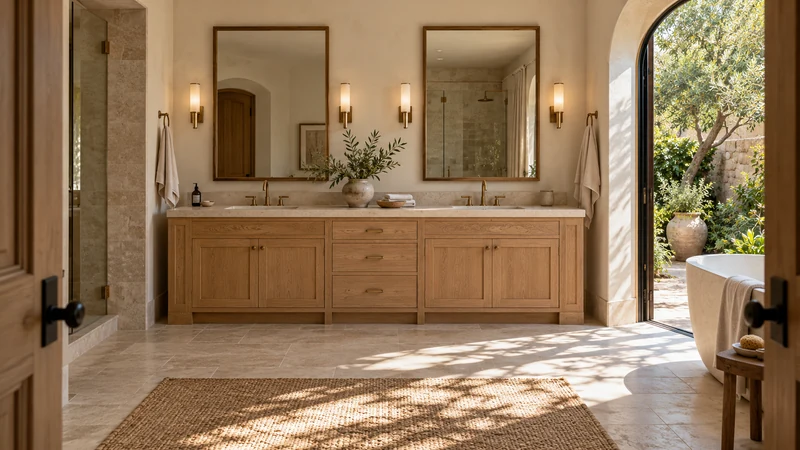
If you want wood grain to continue across neighboring cabinet fronts, specify the arrangement on the cabinet elevation before ordering. A wood species, stain name or attractive veneer sample does not promise continuity across doors and drawers. Define the surfaces included, their grain direction, and the breaks that are acceptable. Then confirm the supplier can produce that arrangement in the actual sizes being ordered.
Design study Compare the visible grain directions on door frames, center panels and drawer fronts. This design study helps define a visual arrangement; it does not prove real veneer, sequence matching or an orderable configuration.
Separate veneer matching from front-to-front continuity
Columbia Forest Products distinguishes book matching, which turns alternate veneer leaves, from slip matching, which places them side by side without turning. These describe how veneer is arranged on a panel face. They do not, by themselves, promise a continuous pattern across separate cabinet fronts.
A door can have carefully matched veneer within its own face and still look unrelated to the door next to it. Likewise, a set of fronts can share a consistent grain direction without the individual lines flowing across their gaps. Use ordinary descriptions alongside any technical term: say which fronts should read together and what visual relationship you expect between them.
Draw the boundaries of the matched group
Mark the intended group directly on an elevation. Include drawers, doors, exposed ends and fillers only where their relationship matters. An end panel turns away from the front plane, so decide whether it needs a coordinated tone, the same grain direction or a planned wraparound appearance. Those are different requests and may need different fabrication decisions.
Identify deliberate stopping points such as a change of cabinet height or an opening between groups. Trying to match everything in the room can add expectations that a small sample never addressed. If the primary concern is a prominent uninterrupted bank of fronts, concentrate approval on that group and state how the remaining surfaces may vary.
Approve an arrangement, not just a favorite patch
Ask for the supplier’s available way to review the proposed relationship. This could be a labeled sample group or an arrangement drawing supported by representative finished samples; it is not a promise that every supplier offers a custom veneer layout. Establish what the approval actually covers and which natural variation remains part of the selection.
Compare the group in its intended orientation. A sample turned sideways may give an appealing grain effect that the ordered door does not use. Keep labels on the backs and preserve the approved viewing order. If stain and sheen are involved, review them on the relevant veneer rather than assuming a color chip will describe the entire grain appearance.
A worked example: stacked drawer fronts
Imagine a bank of stacked drawers beside a door. You want the drawer fronts to read as parts of one vertical pattern, while the neighboring door may have its own pattern. Write that boundary into the elevation and identify each drawer front in order. Merely writing “vertical grain throughout” would allow every front to have vertical grain without the pattern continuing between them.
Now consider a future replacement of the middle front. A matching species and finish may reproduce the general appearance without recreating its exact position in the original grain sequence. Ask how replacement would be handled and whether the proposed arrangement makes a whole group relevant to an appearance decision. Do not assume a single new front can always restore the original visual flow.
Make receiving and installation preserve the choice
Before release, retain the approved group, orientation, front identifiers and finish selection with the order. Confirm how parts will be labeled so their intended position survives packing and installation. Do not rearrange fronts simply because their outer dimensions match; a visually coordinated set may depend on where each piece belongs.
At delivery, lay out or inspect the labeled parts using the supplier’s handling guidance and compare them with the approval before drilling or installing. Report an unexplained sequence change with photos that show the group together. The purpose is to protect a specific design decision, while leaving room for the natural variation that was understood when the veneer was chosen.
Pure White
Cream White
Light Warm Gray
Gray
Navy
Black
Oak Tone
Dark Walnut Tone
Design study These finish studies are design references, not a list of currently orderable colors. Screens and lighting change the appearance; compare a physical sample before choosing.See all finish options →
A painted door, a wood-grain side and a plywood cabinet box can belong to the same cabinet. Here is how to read those parts, what the sample photos actually show, and which details to put on a quote.
Check the edge-to-face transition, corners and visible match on a finished sample, and separate appearance questions from claims about hidden bonding quality.
Locate and document a painted joint line, distinguish an appearance change from looseness or damage, and request an assessment before filling or repainting.
The sample shows the door frame, a separate center panel, the face frame and the cabinet box. Each component has its own place in this Shaker construction.
Shaker construction: door frame, center panel, face frame and cabinet box. The cutaway helps locate these parts; confirm each material in the specifications for the selected cabinet.
01 / Door frame
The Shaker door has rails and stiles around a separate center panel. The frame and center panel are different components; confirm their materials in the specifications for the selected cabinet.
02 / Face frame
The face frame surrounds the opening at the front of the cabinet box and sits behind the doors. The face frame, door frame and cabinet box are separate parts.
03 / Cabinet box
The sample exposes the cabinet sides, interior surfaces and layered edges. The image does not establish the wood species or material specification of a selected cabinet.