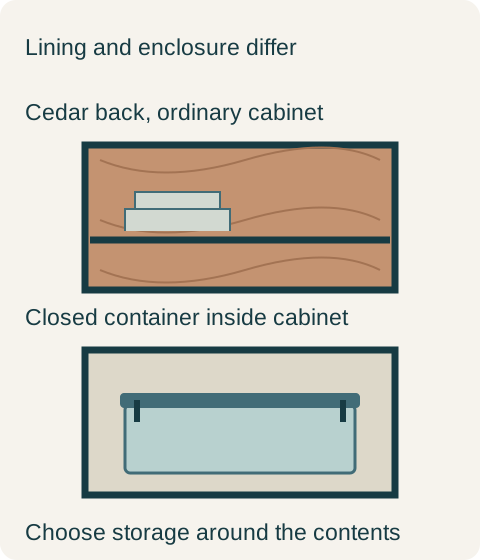
Cedar-lined storage cabinets: choose the lining and clothing enclosure separately
A cedar interior can provide a wood appearance and scent. For stored clothing, distinguish that lining from the closed container that protects the contents.
A cabinet with aromatic cedar lining is still a cabinet. Open the door and examine the storage space before deciding what the cedar adds. Shelves, drawer fronts, a lined back and a solid-wood chest are different constructions; a cedar label does not tell you which you are buying. For seasonal wool clothing, make the enclosure decision separately from the interior finish. You can choose an ordinary cabinet with suitable closed containers, or choose cedar because you want its appearance and fragrance without treating the wood as a permanent protective system.
Follow the opening, not the wood grain
Look at the path from the room to the stored item. A wardrobe door closes against a cabinet opening, while a storage container has its own lid and closure. If clothing sits on an open shelf behind an ordinary door, the cabinet is the only enclosure. If it sits inside a properly closed container on that shelf, the container provides a separate boundary. These arrangements are visibly different. A drawing that merely colors the cabinet interior brown does not describe either one.
University of California IPM recommends storing clean, pest-free clothing in airtight containers. Its cedar discussion describes limited, declining effectiveness and says a tightly constructed chest matters more for long-term protection than the wood type. Cedar lining alone is not that enclosure.
Start with the objects that will actually be stored: folded blankets, knitwear or linen, in the containers or covers intended for them. Set one on the proposed shelf and open it. A container can fit through the opening yet have insufficient space to lift its lid. A deep shelf can also put a frequently needed box behind another. Resolve those access problems in the storage layout instead of assuming that adding aromatic wood makes the cabinet useful. The purchase should suit how the contents enter, remain stored and leave.
Teaching example Conceptual hypothetical storage sections. Cedar lining and a separately closed container perform different roles; the sketch is not an insect-resistance or airtightness test.
A lined back is not a cedar cabinet box
Columbia Forest Products describes its aromatic cedar plywood for dry, conditioned interior uses, including closet and storage applications, and notes that fragrance strength varies. This is a particular lining-panel option; it does not establish shelf capacity or an airtight cabinet.
Read the proposed construction from outside to inside. Identify the cabinet carcass, then which interior surfaces receive cedar, then any removable storage equipment. A cedar-veneered back does not make the shelves solid cedar. Similarly, a drawer liner says nothing about the drawer sides or its closure. This distinction matters when comparing a basic cabinet with added lining against a purpose-built chest. Ask for the actual component description so a lining upgrade is not mistaken for a change to every structural part.
The blanket cupboard keeps a plain interior
In a hypothetical linen-and-wool cupboard, the owner wants to separate frequently used towels from seasonal wool blankets and does not want a scented interior. The selected arrangement has plain finished shelves: towels remain accessible, while the cleaned, pest-free wool items go into appropriately closed airtight containers. Shelf positions are set using the chosen containers so their lids can be opened after removal. The cedar-lining option is omitted. The decision follows the contents and access routine rather than an assumption that the most aromatic interior gives the best storage.
A different owner may value cedar scent enough to choose it for a wardrobe. In that case, specify the intended lined surfaces and evaluate the scent as a preference, not a measurable protection promise. Do not approve a small piece with a strong smell and assume a full cabinet will always smell equally strong. For scent-sensitive users, a plain interior may be the more comfortable choice. The clothes and linens should still be stored according to their own care needs; a pleasing wood interior does not replace that work.
Keep damp laundry out of the storage brief
A dry storage cupboard and a place to hold damp laundry have different jobs. Do not transfer a dry-interior panel application to a wet collection area because both sit in a laundry room. Separate the location where items await washing from the place where clean, dry items are stored. If the room or cabinet regularly becomes damp, address that condition in the room and cabinet design. The lining is not a reason to accept an unsuitable storage environment or a substitute for correcting it.
Check the usable interior after the lining is installed
For a retrofit, judge the finished interior rather than the bare box. An added panel changes the surface against which a shelf, rail or container sits, so the completed arrangement needs to be shown. Look at exposed cut edges, corners and the junction with an existing back. Decide which pieces are fixed and which can be removed for access. This is a practical fit review, not permission to attach panels or drill through an unknown cabinet construction. The fabricator should supply the intended finished detail.
At delivery, compare the lined locations with the accepted component list and try the storage equipment in the completed cabinet. A missing side liner is a scope issue if the order included it; a milder scent is not automatically proof of a different panel. Keep the material identification for replacement pieces. The useful result is a cabinet whose interior treatment, closures and storage routine agree with the contents you plan to keep, with cedar included only where it serves a purpose you actually want.
Pure White
Cream White
Light Warm Gray
Gray
Navy
Black
Oak Tone
Dark Walnut Tone
Design study These finish studies are design references, not a list of currently orderable colors. Screens and lighting change the appearance; compare a physical sample before choosing.See all finish options →
Changing to forward-facing hanging changes which cabinet dimension holds the line of garments. Compare the full coat collection and rear-item access before reducing wardrobe depth.
Separate a temporary transfer shelf from permanent linen storage. Organize finished loads by destination so the laundry cabinet does not hold everyone’s unfinished return trip.
Compare the actual countertop products, heat-source routine and fabrication proposal. A fired porcelain slab and resin-bound quartz are different materials, but neither label replaces a complete kitchen specification.
The sample shows the door frame, a separate center panel, the face frame and the cabinet box. Each component has its own place in this Shaker construction.
Shaker construction: door frame, center panel, face frame and cabinet box. The cutaway helps locate these parts; confirm each material in the specifications for the selected cabinet.
01 / Door frame
The Shaker door has rails and stiles around a separate center panel. The frame and center panel are different components; confirm their materials in the specifications for the selected cabinet.
02 / Face frame
The face frame surrounds the opening at the front of the cabinet box and sits behind the doors. The face frame, door frame and cabinet box are separate parts.
03 / Cabinet box
The sample exposes the cabinet sides, interior surfaces and layered edges. The image does not establish the wood species or material specification of a selected cabinet.