Does a shallow entry wardrobe hold as many coats as a deeper one?
Changing to forward-facing hanging changes which cabinet dimension holds the line of garments. Compare the full coat collection and rear-item access before reducing wardrobe depth.
A shallow entry wardrobe may need forward-facing hanging, so its capacity cannot be inferred from the same width in a deeper wardrobe. The hanger shoulders can run across the cabinet while the garments accumulate from front to back. In a conventional crosswise rail arrangement, garments accumulate along the cabinet width instead. That change can affect the number of cabinets worth buying.
Find the direction of the rail before counting coats
An elevation showing a coat facing the viewer can look generous because the front garment hides the others. Ask for the plan view and identify the rail. The width needed for a hanger is different from the rail length needed for a collection of thick coats. A wide front does not create a long front-to-back storage line.
IKEA's US KOMPLEMENT page documents forward-facing hanging for a shallow PAX frame. Its linked assembly drawing shows the supported rail arrangement. That example establishes a real alternative to a conventional rail across the cabinet; it does not establish that the rail slides out. Verify the selected product's actual function rather than transferring a feature from an older model or another accessory.
Also check the complete garment. The hanger alone may clear the body while padded shoulders, sleeves or a hood press against surrounding parts. Closing a door adds another boundary. Test the ordinary winter collection in the intended stored condition, rather than substituting thin shirts for the coats this entry must hold.
Follow both dimensions in a simple comparison
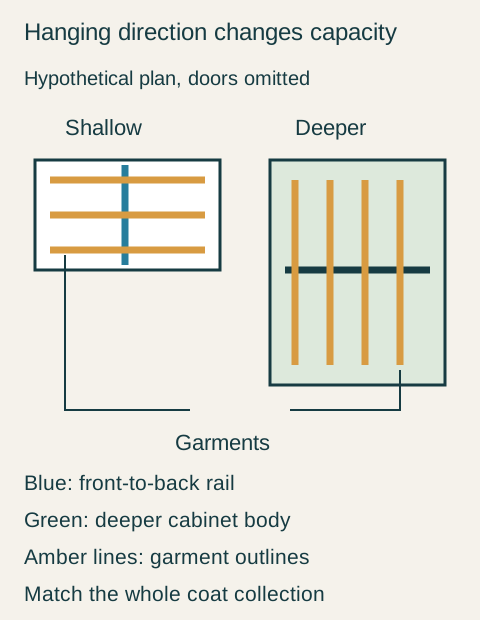
For an explicitly hypothetical example, a shallow cabinet has 24 inches of clear width and 12 inches of usable front-to-back rail length. The sample coats span 18 inches across their hung shoulders and each occupies 3 inches along the rail in the tested arrangement. The shoulders fit across the width, but the rail holds only 4 coats. None of these values describes the referenced IKEA product.
Teaching example Hypothetical plan: amber garment outlines run across the width of the shallow cabinet and accumulate from front to back along its blue rail. In the deeper green cabinet, garments turn and accumulate along the wall. This diagram compares orientation only; it does not show an IKEA product, a pull-out mechanism or exact clearances.
In the deeper hypothetical option, 22 inches of clear depth accommodates the same tested garment outline, and the crosswise rail has 24 inches of usable length. At the same 3-inch allowance, it holds 8 of these coats. The owner needs 6 coats at this entry. One shallow bay therefore fails the inventory even though its front width matches the deeper option; two shallow bays could hold the collection but would consume more wall length.
This calculation is a screening comparison, not a universal packing formula. The mockup must still check the actual supports, door space and comfortable movement between garments. A single bulky coat can alter the arrangement, and tightly compressing clothes to reach an advertised count may remove the access the owner wants.
Retrieve the coat at the back
With forward-facing storage, a rear garment can sit behind the entire front group. Try taking out that specific coat and returning it while the other coats remain. Some users can move the front garments aside conveniently; others find the repeated handling unsuitable for an entry used in a hurry. Judge the selected rail and the person's routine, not a general promise that every shallow system is awkward.
If a supplier proposes a pull-out alternative, review its documented travel and the space in front of the wardrobe separately. It may change rear access, but it does not make a fixed rail slide or remove the storage-length limit. The moving loaded arrangement would need its own verified support and room-use check.
Buy one deeper bay instead of doubling the shallow run
For the hypothetical collection above, the owner chooses one deeper bay after a room trial confirms its closed depth, doors and coat retrieval preserve the necessary entry route. The wider wall length that two shallow bays would have consumed remains available for the planned seat. The seat does not intrude into the wardrobe's working position.
The final order preserves the rail orientation and actual coat inventory used in the comparison. A later substitution to a shallower frame is therefore a functional change, not merely a slimmer version of the same storage. It must be checked again before the cabinet dimensions are released.
Pure White
Cream White
Light Warm Gray
Gray
Navy
Black
Oak Tone
Dark Walnut Tone
Design study These finish studies are design references, not a list of currently orderable colors. Screens and lighting change the appearance; compare a physical sample before choosing.See all finish options →
Entry gear and clean laundry can share a room without sharing every surface. Assign the arrival, washing and departure tasks before choosing one continuous cabinet run.
A rod may fit between cabinets while sleeves, hangers and long hems do not. Plan the occupied space and the movement needed to hang and remove garments.
The sample shows the door frame, a separate center panel, the face frame and the cabinet box. Each component has its own place in this Shaker construction.
Shaker construction: door frame, center panel, face frame and cabinet box. The cutaway helps locate these parts; confirm each material in the specifications for the selected cabinet.
01 / Door frame
The Shaker door has rails and stiles around a separate center panel. The frame and center panel are different components; confirm their materials in the specifications for the selected cabinet.
02 / Face frame
The face frame surrounds the opening at the front of the cabinet box and sits behind the doors. The face frame, door frame and cabinet box are separate parts.
03 / Cabinet box
The sample exposes the cabinet sides, interior surfaces and layered edges. The image does not establish the wood species or material specification of a selected cabinet.