A long cabinet warranty is not the whole service plan
Read what happens after a covered problem: which part is supplied, who handles the work and what access is required. The headline term cannot answer those questions.
The warranty term tells you how long specified coverage may run. It does not, by itself, tell you what happens if a door, drawer mechanism or cabinet part develops a covered problem. To compare warranties usefully, follow a plausible service event from the first report to a usable cabinet. That reveals differences a large number on a brochure cannot show.
Start with the part and the problem
Identify the cabinet line and components covered by the actual document. Box construction, fronts, finish and separately supplied hardware may not all be described in the same way. Read the covered conditions as well as the term. Do not assume every problem occurring during that period belongs to the warranty; the document needs to connect the condition and component.
As one manufacturer example, IKEA US separates duration from the response to a covered problem. Its general conditions describe examination followed by a repair or replacement decision, with access conditions. This illustrates why the remedy deserves its own reading; these are not usaKT.com warranty terms.
Ask for the applicable document before comparing options, not merely a verbal assurance that the product has a warranty. Keep the selected configuration with it. If the quote changes to another product line or includes an accessory from a different source, check which document covers that item rather than extending the cabinet headline to everything in the room.
Walk through a replacement-door example
Suppose an issue is accepted as covered on an installed door. Does the stated remedy provide a part, a repair service, or another response chosen by the provider? Ask how the door is identified, who submits the request and whether the replacement comes ready for the existing hardware. These details affect how easily the cabinet returns to use.
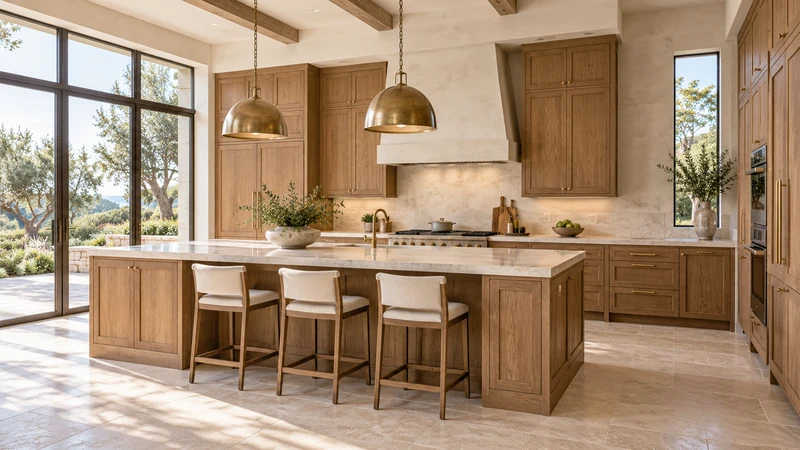
Design study A finished kitchen combines many visible parts. A warranty should identify which parts and conditions it covers; this design image establishes no coverage.
Then examine the work surrounding that part. Removal, fitting, adjustment, travel and shipping are separate tasks even when the component itself is supplied. Ask which are included and who arranges the rest. Avoid assuming either that all labor is covered or that none is; the useful answer is the one in the applicable terms and the supplier’s written explanation.
Consider access and changing product lines
A replaceable component may sit behind trim or beside another installed surface. Before ordering, ask how the proposed design allows ordinary service to the relevant parts. This is especially useful for concealed hardware and integrated-looking panels. A service remedy cannot answer a layout question that makes the component hard to reach.
Also ask what the terms say if the original finish or part is no longer offered. Does the document describe a comparable replacement or some other solution? That is a separate question from whether an exact visual match will be available. Do not treat a long term as a promise that every future replacement will be indistinguishable from aged surrounding fronts.
Keep a service record that can identify the order
Save the purchase record, cabinet list, configuration and applicable warranty version. A photo of the whole kitchen can locate the affected cabinet; a closer photo can show the issue. Keep any identifying label information available without dismantling an installed cabinet merely to create a file. When asking for service, distinguish what you observed from what you think caused it.
Compare options by the practical path they offer for the problems that matter to your project. Duration remains relevant, but coverage, remedy, access and responsibility complete the picture. Before buying, resolve a vague answer such as parts covered into the specific next steps and included work. That turns warranty reading into a useful part of cabinet selection.
Pure White
Cream White
Light Warm Gray
Gray
Navy
Black
Oak Tone
Dark Walnut Tone
Design study These finish studies are design references, not a list of currently orderable colors. Screens and lighting change the appearance; compare a physical sample before choosing.See all finish options →
A room view shows the design. Open-door, drawer and edge views answer different questions. Ask for the missing angle that could change your cabinet selection.
Compare the same samples in the same position before judging color. Then change the lighting or surroundings deliberately, so you know what changed the impression.
The sample shows the door frame, a separate center panel, the face frame and the cabinet box. Each component has its own place in this Shaker construction.
Shaker construction: door frame, center panel, face frame and cabinet box. The cutaway helps locate these parts; confirm each material in the specifications for the selected cabinet.
01 / Door frame
The Shaker door has rails and stiles around a separate center panel. The frame and center panel are different components; confirm their materials in the specifications for the selected cabinet.
02 / Face frame
The face frame surrounds the opening at the front of the cabinet box and sits behind the doors. The face frame, door frame and cabinet box are separate parts.
03 / Cabinet box
The sample exposes the cabinet sides, interior surfaces and layered edges. The image does not establish the wood species or material specification of a selected cabinet.