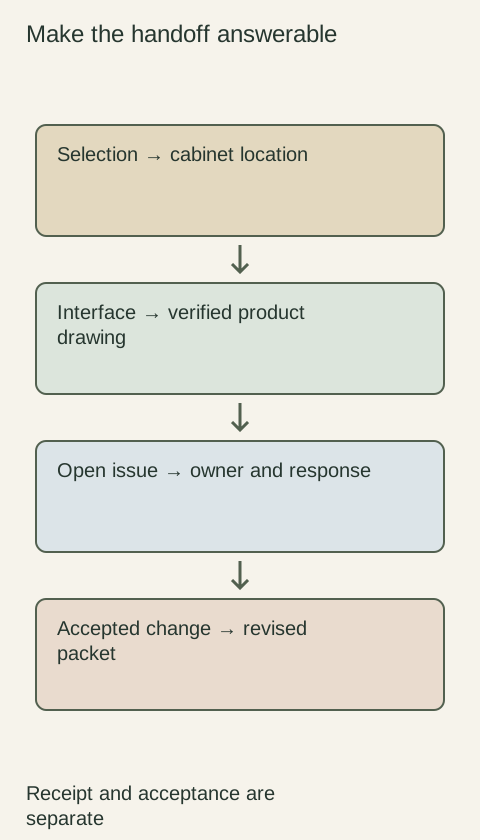
A useful cabinet supplier scorecard starts with order records, not a remembered sales experience. Define what each measure counts, keep supporting evidence and distinguish observed results from explanations that have not been confirmed. Compare similar work over a stated review period. The purpose is to identify repeatable strengths and problems that affect purchasing, rather than compressing unrelated experiences into a precise-looking grade.
Diagram Use the records from these handoffs to investigate an outcome. The diagram is not a supplier rating or evidence of actual performance.
Choose outcomes that matter to your projects
Consider delivery against the agreed schedule, completeness of the supplied scope, accuracy of product identity and how issues are resolved. ASQ's supplier-quality guidance includes delivery reliability, communication and problem-resolution costs alongside purchase price. Use those dimensions to choose relevant observations, without borrowing a generic rating system that gives weight to activities your cabinet projects do not require.
Define the evidence for each observation. A complete delivery might require reconciliation of the ordered components, not simply a truck arriving. An accurate acknowledgment can be checked against the submitted selection. A useful response should address the issue, not merely confirm receipt of the email. Write these definitions before comparing suppliers so the result does not depend on who entered the record.
Keep the counting unit and comparison group consistent
Decide whether a measure concerns orders, shipments, line items or individual parts. A partial shipment and an incomplete order are related but not identical observations. Do not count every carton as a successful order while recording a missing item as a failure of the entire project. Keep the total evaluated population visible alongside any rate or summary.
Group meaningfully comparable work. Repeat orders with settled selections differ from projects with ongoing custom changes, and a simple hardware purchase should not automatically carry the same significance as a large mixed cabinet order. Show the type and extent of work represented. When the record is sparse, say so rather than treating a small experience as a reliable prediction of future performance.
Preserve timing history instead of moving the target
Record the original agreed milestone, any accepted revision and the actual event. Distinguish shipment from arrival and arrival from receipt of the complete usable scope. A changed schedule should remain visible; replacing the original date with the latest estimate can make repeated delays disappear from the record even though they affected the project.
Imagine a shipment reaches the site as scheduled, but a required finished panel follows later. The arrival measure may be satisfied while complete-scope availability is not. Keep both observations if both matter to your work. Otherwise a single on-time label can hide why the installer could not complete the planned task.
Separate observed problems from confirmed causes
Describe the mismatch or condition and preserve the relevant order, photographs and communications. Then record the cause only as far as it is established. A late buyer revision, inaccessible receiving site, carrier event and supplier processing error should not be merged into an unexplained supplier-failure category. Unknown cause remains unknown until the information supports a clearer conclusion.
Track recovery separately from the initial issue. Note whether the response answered the question, whether the proposed part was correct and when the usable result was achieved. Keep open cases visible rather than excluding them because a completion interval cannot yet be calculated. A fast first reply and a completed replacement are different service outcomes.
Use the review to choose a specific next action
Review patterns with the people who purchased, received and installed the products. Verify unusual entries before using them to change future purchasing. If composite scores are used, make the weights and definitions explicit and retain the underlying observations. A strong total should not conceal a recurring problem that makes a particular product or service arrangement unsuitable for the next project.
Translate findings into a testable action: clarify an acknowledgment field, change a handoff requirement or observe the next comparable order. Revisit the result after the change rather than assuming the scorecard itself improves performance. This method does not rank actual suppliers or guarantee outcomes. It helps a team make a better-supported purchasing decision from the work it has genuinely observed.
Pure White
Cream White
Light Warm Gray
Gray
Navy
Black
Oak Tone
Dark Walnut Tone
Design study These finish studies are design references, not a list of currently orderable colors. Screens and lighting change the appearance; compare a physical sample before choosing.See all finish options →
Translate the design into identifiable products, details and responsibilities. A useful handoff lets another professional price and build the intended arrangement without reconstructing private conversations.
The sample shows the door frame, a separate center panel, the face frame and the cabinet box. Each component has its own place in this Shaker construction.
Shaker construction: door frame, center panel, face frame and cabinet box. The cutaway helps locate these parts; confirm each material in the specifications for the selected cabinet.
01 / Door frame
The Shaker door has rails and stiles around a separate center panel. The frame and center panel are different components; confirm their materials in the specifications for the selected cabinet.
02 / Face frame
The face frame surrounds the opening at the front of the cabinet box and sits behind the doors. The face frame, door frame and cabinet box are separate parts.
03 / Cabinet box
The sample exposes the cabinet sides, interior surfaces and layered edges. The image does not establish the wood species or material specification of a selected cabinet.