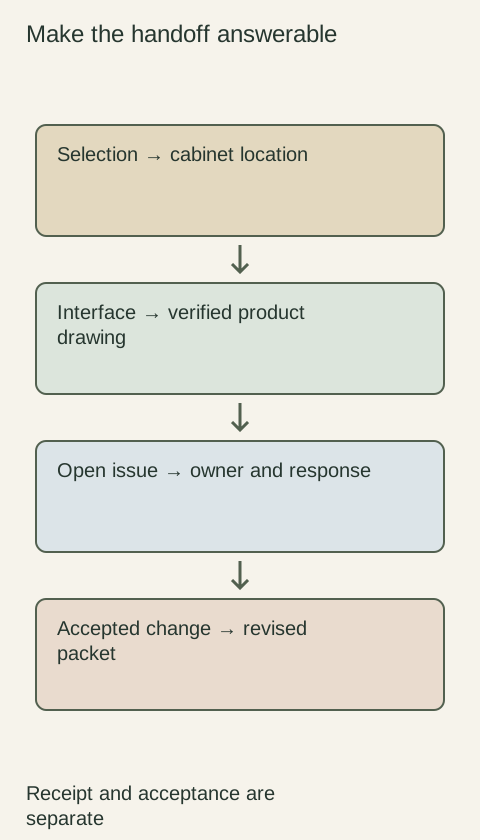
A bilingual cabinet review should make the order easier to understand while preserving the exact products and decisions. Keep original product identifiers beside translated descriptions, use a shared drawing reference and review ambiguous terms in context. Fluent wording alone does not establish that everyone is discussing the same panel, hinge application or selling unit. The practical test is whether each reader can point to the same selected component and explain the same requirement.
Diagram Use the same product identifiers and drawing references in every working language, then check the selected configuration together.
Separate fixed identifiers from explanatory wording
Keep supplier codes, finish identifiers, order references and drawing labels unchanged. Add the translated explanation next to them, rather than replacing the only searchable identity with a local nickname. Microsoft Translator documentation recognizes that selected content, such as code or brand names, may need to remain untranslated. The same preservation principle is useful in a project review, regardless of the tool used.
Designate the current product record and show its revision on each working language copy. When a copy circulates separately, retain enough header information to connect it to the accepted selection. If the translated explanation and product record appear inconsistent, flag the item for clarification. Do not resolve the conflict merely by choosing the sentence that reads more naturally.
Explain cabinet terms with their physical context
Build a small project glossary for terms that repeatedly cause confusion, using a brief definition and a relevant drawing or photograph. Include what the term refers to in this order. A generic translation for panel does not identify whether it means a door center, a cabinet side or a separate finished end panel. The product and its role need to travel with the word.
Imagine a description of a finished end panel is translated as though every face and edge has the same finish. The original selection may specify particular exposed surfaces instead. Compare the actual selected configuration and mark the intended faces on the drawing. This resolves a purchasing question that a more polished translation of the word finished alone cannot settle.
Preserve quantities, dimensions and viewing direction
Check numerical fields separately from prose. Keep the source value, unit and selling basis visible, including whether a quantity refers to individual items, pairs or an assembled set. If a conversion is needed for review, label it as a conversion and check it independently. Do not silently replace an order dimension with a rounded value that changes the information sent to the supplier.
State the viewpoint for left and right descriptions and use matching labels on the drawing. Do not allow a translated sentence to change the perspective from facing the cabinet to looking from behind it. Similarly, identify whether a dimension describes the opening, the cabinet or the finished replacement part. Translation cannot determine a measurement basis that was missing from the original instruction.
Ask the reviewer to identify the product and action
Have the reader explain which component is affected, what configuration is selected and what action is requested. This is more useful than asking only whether the translation sounds correct. A bilingual reviewer should be able to connect the wording to the product record; technical questions that remain uncertain should go to the person responsible for that selection.
Use a shared marked document to record the answer. If the issue concerns a finish option, keep the accepted code with the clarification. If it concerns a replacement, retain the component identity and location. Machine translation or a fluent conversational interpreter can help communication, but neither substitutes for checking that the described product actually matches the intended purchase.
Update every active language copy when decisions change
Record the resolved wording and revise the affected working copies together. Make superseded versions recognizable so an installation team does not continue with an earlier translated note after the purchasing team has changed the selection. A correction that exists only in a private message is difficult for the next participant to retrieve.
Before releasing the order, compare identifiers, quantities, units, orientation and unresolved questions across the copies in use. Preserve the final clarification with the relevant order line. The aim is not a large dictionary for every cabinet term, but a reliable shared understanding of this purchase, with any remaining uncertainty visible before a translated description becomes an unintended product change.
Pure White
Cream White
Light Warm Gray
Gray
Navy
Black
Oak Tone
Dark Walnut Tone
Design study These finish studies are design references, not a list of currently orderable colors. Screens and lighting change the appearance; compare a physical sample before choosing.See all finish options →
Translate the design into identifiable products, details and responsibilities. A useful handoff lets another professional price and build the intended arrangement without reconstructing private conversations.
The sample shows the door frame, a separate center panel, the face frame and the cabinet box. Each component has its own place in this Shaker construction.
Shaker construction: door frame, center panel, face frame and cabinet box. The cutaway helps locate these parts; confirm each material in the specifications for the selected cabinet.
01 / Door frame
The Shaker door has rails and stiles around a separate center panel. The frame and center panel are different components; confirm their materials in the specifications for the selected cabinet.
02 / Face frame
The face frame surrounds the opening at the front of the cabinet box and sits behind the doors. The face frame, door frame and cabinet box are separate parts.
03 / Cabinet box
The sample exposes the cabinet sides, interior surfaces and layered edges. The image does not establish the wood species or material specification of a selected cabinet.