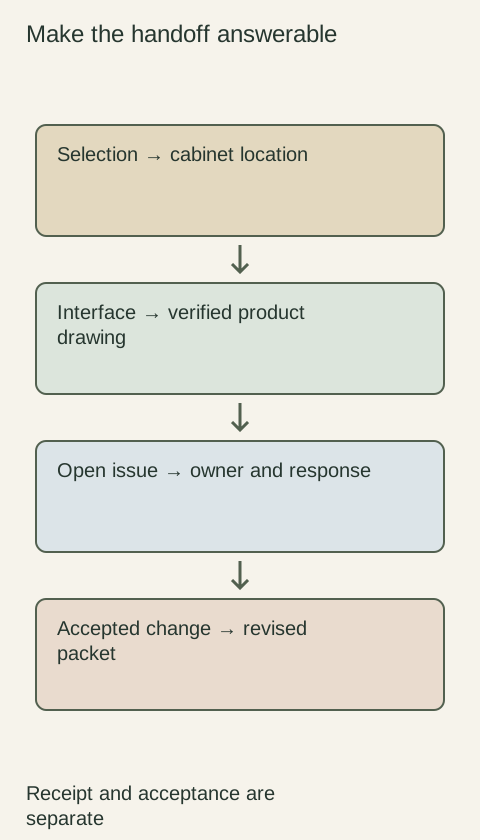
A cabinet submittal is ready for the next agreed step when its review status and remaining conditions are understood by the people preparing, approving and producing the work. Receiving a marked drawing is not enough. Track each comment to a response and the affected document, then confirm what the resulting status permits. The aim is to avoid a product being made from a drawing that looks reviewed while still containing an unanswered selection or conflicting instruction.
Diagram Link comments to their disposition and exact documents. This diagram does not authorize production.
Record exactly what the team reviewed
List the drawing set, product data, hardware information and finish samples included in the submission. Keep their identifiers and revisions together. A reviewer may have seen the cabinet elevations without seeing a later hardware change; the cover sheet should not imply a broader review than actually occurred. Identify missing items before asking the team to consider the package complete.
Assign review questions to the appropriate participants. The person selecting appearance may not be the person checking dimensions or coordinating installation information. Ask each reviewer to state the subject of their response. A finish approval should remain connected to its sample, while a question about attachment or an adjacent trade goes to the person responsible for that technical coordination.
Give each comment a traceable response
Capture the comment, its drawing or component location, the person expected to respond and the current disposition. When the supplier revises a detail, record where the revision appears. A reply saying corrected is difficult to verify if the reviewer cannot find the changed information. Keep the response next to the relevant comment rather than scattered across separate email chains.
Distinguish a clarification from a new request that changes the proposed product. If reviewers give conflicting directions, ask the designated project contact to resolve them before the supplier chooses an interpretation. Do not erase the earlier comments; preserve the decision that supersedes them. This lets another team member understand why the final drawing differs from the initial marked copy.
Understand what the actual review status allows
AWI's submittal guidance distinguishes approval from a request to revise and resubmit. Use that distinction without assuming that every project's stamps have identical definitions. Confirm the meaning and required next action under the team's agreed process.
For a conditional response, ask which notes must be incorporated and whether another review is required before the affected work proceeds. Do not invent an additional approval cycle when the agreed status already permits production with identified corrections. Equally, do not treat a receipt acknowledgment or a comment awaiting an answer as a release. Read the actual disposition, its limitations and the documents it covers.
Test whether an open comment affects proposed release
Imagine the finish sample is accepted but a door's hardware drilling information remains unresolved. The accepted color does not settle the drilling question. Identify which products and manufacturing steps depend on that answer, then ask the supplier and project decision-maker what can proceed. Avoid extending a narrow approval to unrelated dimensions or operations merely because they appear on the same drawing sheet.
If a partial release is proposed, identify the exact components released and the components held. Confirm that they can be separated without forcing an unresolved choice into the work. A general instruction to start what you can leaves too much interpretation. The supplier should understand the boundary and the information still expected, including any effect on the eventual complete package.
Issue a coherent final record
Collect the accepted drawing revision, responses, sample identities and remaining explicit conditions into the release record. State who issued the decision and which supplier contact received it. Ask for acknowledgment of the particular package, not a generic message that an attachment arrived. Where a correction is incorporated without resubmission, preserve how its implementation will be checked under the agreed workflow.
After release, route later product changes through a visible revision process rather than adding casual comments to an obsolete set. Keep earlier copies for history but make the active information easy to identify. This record does not replace technical review or establish workmanship quality; it explains which product information was accepted, which questions were closed and what work the supplier was actually told to proceed with.
Pure White
Cream White
Light Warm Gray
Gray
Navy
Black
Oak Tone
Dark Walnut Tone
Design study These finish studies are design references, not a list of currently orderable colors. Screens and lighting change the appearance; compare a physical sample before choosing.See all finish options →
Translate the design into identifiable products, details and responsibilities. A useful handoff lets another professional price and build the intended arrangement without reconstructing private conversations.
The sample shows the door frame, a separate center panel, the face frame and the cabinet box. Each component has its own place in this Shaker construction.
Shaker construction: door frame, center panel, face frame and cabinet box. The cutaway helps locate these parts; confirm each material in the specifications for the selected cabinet.
01 / Door frame
The Shaker door has rails and stiles around a separate center panel. The frame and center panel are different components; confirm their materials in the specifications for the selected cabinet.
02 / Face frame
The face frame surrounds the opening at the front of the cabinet box and sits behind the doors. The face frame, door frame and cabinet box are separate parts.
03 / Cabinet box
The sample exposes the cabinet sides, interior surfaces and layered edges. The image does not establish the wood species or material specification of a selected cabinet.