If a cabinet underside or edge repeatedly becomes damp after a countertop appliance runs, treat that as a use-pattern question rather than only a cleaning task. Identify where the moisture appears and which appliance activity precedes it. Review the appliance's placement and operating instructions together with the cabinet's care guidance. The aim is to prevent repeated exposure at the affected surface, without inventing a universal clearance or modifying how an appliance releases heat and steam.
Diagram Record repeated exposure and follow both product instructions; the diagram specifies no appliance clearance or steam modification.
Observe the pattern during ordinary use
Note the affected cabinet surface, when moisture is noticed and what was operating beforehand. Include whether the observation occurs repeatedly or followed an isolated spill. Look from a normal accessible position after use; do not put your face or hands in a steam path or run extra cycles simply to make the cabinet wet for a photograph.
Check whether the moisture is confined to an underside, reaches an edge or appears elsewhere as well. These observations can help connect a question to the relevant appliance and location, but they do not prove the cause of every mark. If moisture appears when that appliance is not operating, keep other sources open for investigation rather than attributing everything to steam.
Read the cabinet and appliance guidance together
Merillat cautions that excess heat and moisture from heat-producing appliances can damage cabinetry and addresses appliances beneath cabinets in its care guidance. Use that exposure warning as a reason to review the actual arrangement. It does not provide a universal separation distance or approve a particular countertop location for every appliance.
Find the instructions for the exact appliance model and consider its required space, intended operating surface and release of heat or steam. Ask the cabinet supplier about the affected finish or panel if its care requirements are unclear. A location must satisfy both sets of information; cabinet appearance alone cannot establish that an appliance can operate there without concern.
Change use only within the appliance’s intended arrangement
If the current position directs repeated moisture toward a cabinet, identify an appropriate operating location using the appliance instructions. Consider stable support, access and the specified clear space together. Make any change only when the appliance can be handled under those instructions, rather than pulling a hot or pressurized device forward during operation to get it out from under the cabinet.
Do not attach improvised steam deflectors, block vents or redirect a release mechanism to solve a cabinetry problem. Likewise, an added strip or cover on the cabinet should not be treated as permission to disregard appliance requirements. If the available space does not offer an acceptable arrangement, discuss the constraint with the relevant supplier instead of creating a workaround whose effects are unknown.
Care for the exposed surface without hiding the pattern
Remove accessible condensation and dry the cabinet using its permitted care method after the appliance can be approached normally. Keep an eye on edges and nearby surfaces where liquid is visible. Do not leave a damp towel over a door as a protective measure, and do not rely on wiping after every cycle as proof that repeated exposure is harmless.
Imagine a small appliance is used in the same sheltered position each morning and the underside above it is damp afterward. The owner wipes it and continues because no obvious damage has appeared. The useful next step is reviewing the operating position and product guidance, not waiting for a visible defect or assuming the cabinet finish has an unlimited tolerance for that pattern.
Separate exposure correction from damage assessment
After changing the arrangement appropriately, observe whether the moisture pattern continues during normal use. Keep a brief record if the question persists, including appliance model, location and photographs of the cabinet when safely accessible. Do not claim the cause has been proven merely because a change reduced the visible condensation; other conditions may also have changed.
If an edge lifts, a surface discolors or the panel changes shape, ask the cabinet supplier to assess that condition. Correcting an exposure source does not automatically reverse an existing change. Provide what you observed and the steps already taken without adding unapproved heat, coatings or cleaners to conceal it. The goal is an appropriate appliance-use arrangement and a separate, accurate decision about the cabinet that was exposed.
Pure White
Cream White
Light Warm Gray
Gray
Navy
Black
Oak Tone
Dark Walnut Tone
Design study These finish studies are design references, not a list of currently orderable colors. Screens and lighting change the appearance; compare a physical sample before choosing.See all finish options →
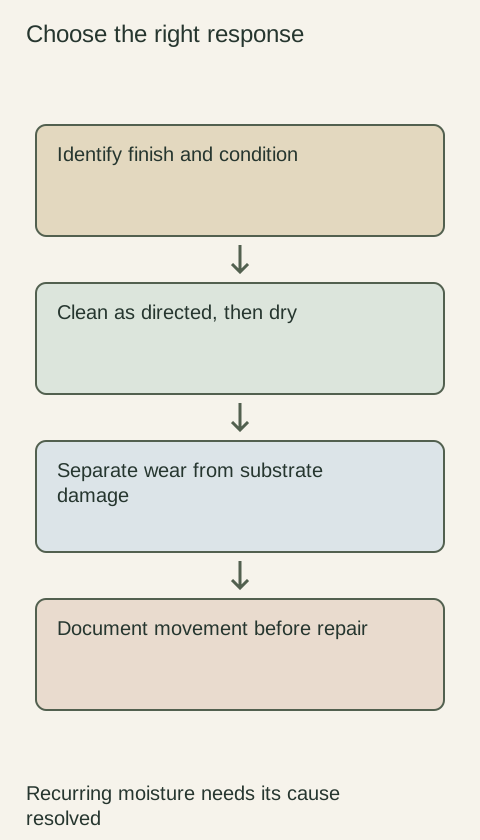
Routine cleaning, a finish touch-up and a moving wood joint need different responses. Identify the surface and condition before applying a cleaner or repair product.
The sample shows the door frame, a separate center panel, the face frame and the cabinet box. Each component has its own place in this Shaker construction.
Shaker construction: door frame, center panel, face frame and cabinet box. The cutaway helps locate these parts; confirm each material in the specifications for the selected cabinet.
01 / Door frame
The Shaker door has rails and stiles around a separate center panel. The frame and center panel are different components; confirm their materials in the specifications for the selected cabinet.
02 / Face frame
The face frame surrounds the opening at the front of the cabinet box and sits behind the doors. The face frame, door frame and cabinet box are separate parts.
03 / Cabinet box
The sample exposes the cabinet sides, interior surfaces and layered edges. The image does not establish the wood species or material specification of a selected cabinet.