The phrase soft-close stopped working can describe several different behaviors. A door might reach its closed position too quickly, stop short because something interferes, or behave differently after a hardware setting changed. These observations do not all point to the same replacement part. Identify the installed system and describe the movement before deciding that a damper has failed. A short, specific account can prevent an unnecessary purchase and give service a useful starting point.
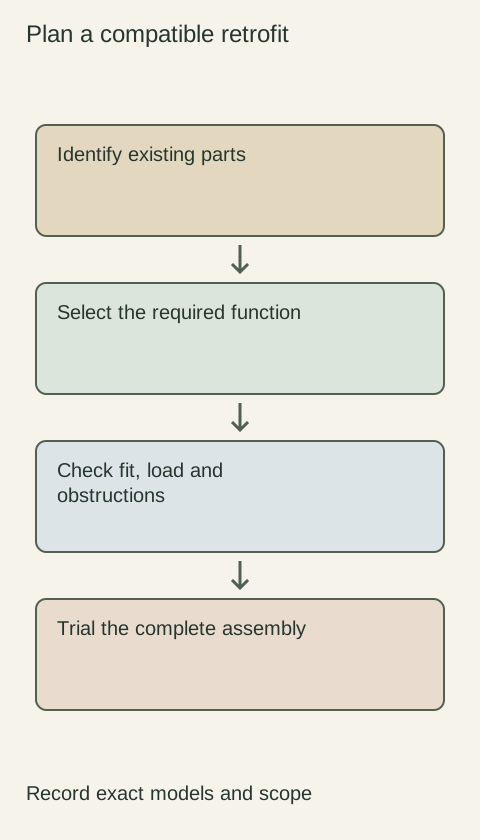
Diagram Identify the installed mechanism before checking settings; the diagram gives no universal reset or replacement diagnosis.
Say which part of the closing action changed
Record whether the door or drawer moves normally until the final approach, closes with an unexpected impact, stalls before reaching its resting position or rubs another component. Note whether the change is consistent during ordinary use. Do not repeatedly slam the front to demonstrate the problem; observe the normal action without forcing it through resistance.
Distinguish sound from movement. A new contact sound while the front still slows is different from a front that no longer appears to slow. A missing or altered contact pad may also raise a separate question from damping performance. Describe what you see and hear instead of using quietness alone as proof that the mechanism is functioning or broken.
Identify the actual mechanism and its documented state
Find the hinge or runner identification and the relevant instructions. Some soft-close behavior is integrated into a hinge or slide, while other arrangements use separate components; do not order a generic add-on before identifying what is already installed. Include photographs of visible fittings and the cabinet information when asking the supplier to identify the system.
Blum states that the damping in its CLIP top BLUMOTION hinge can be deactivated. This shows why a documented enabled or disabled state may be relevant for a particular model. It does not mean every soft-close mechanism has the same switch, location or reset procedure. Check the exact instructions before treating an unfamiliar lever as a control.
Check for an interrupted path before blaming damping
Look for accessible ordinary objects in the closing path and visible contact between fronts. If the movement stops at an obstruction, removing or assessing that obstruction is a different task from repairing a damper. Do not use additional force to make the front reach a position where you expect soft-close to engage.
For example, a drawer may stop short after a tall item is added. Its apparent failure to finish closing does not establish that the damping unit is worn out. Another drawer may travel freely but approach the end with a new impact. Keep those descriptions separate so the service response addresses the observed stage of motion rather than replacing the same part in both cases.
Review recent changes without improvising a reset
Include whether the condition followed drawer removal, hinge adjustment, replacement hardware or a changed front. These events help the supplier decide which checks are relevant. They do not justify copying a reset sequence from a different model online. Follow a documented user-level check only when it applies to the identified mechanism and can be performed as intended.
Avoid opening damping units, spraying them with lubricant or cycling a loose component by hand to test its strength. Do not disable additional devices merely to make the front close faster or match a neighboring cabinet. If hardware is damaged, unstable or detached, request service rather than continuing the movement comparison. A functional setting question and a secure-attachment question need different answers.
Request a specific service decision
Send the model information, changed behavior, approximate onset and any previous adjustments. Ask whether the next step is confirming a documented setting, checking installation and retention, or evaluating a particular replacement component. Availability and compatibility must be confirmed for that system; the general term soft-close is not a sufficient replacement specification.
After the appropriate response, review normal closing, contact and secure operation together. Keep the part or setting record so a future user understands the result. If slowing returns but rubbing or a new impact remains, report that separately. The useful completion standard is the intended ordinary action of the whole door or drawer, not merely the presence of a new damper.
Pure White
Cream White
Light Warm Gray
Gray
Navy
Black
Oak Tone
Dark Walnut Tone
Design study These finish studies are design references, not a list of currently orderable colors. Screens and lighting change the appearance; compare a physical sample before choosing.See all finish options →
Routine cleaning, a finish touch-up and a moving wood joint need different responses. Identify the surface and condition before applying a cleaner or repair product.
The sample shows the door frame, a separate center panel, the face frame and the cabinet box. Each component has its own place in this Shaker construction.
Shaker construction: door frame, center panel, face frame and cabinet box. The cutaway helps locate these parts; confirm each material in the specifications for the selected cabinet.
01 / Door frame
The Shaker door has rails and stiles around a separate center panel. The frame and center panel are different components; confirm their materials in the specifications for the selected cabinet.
02 / Face frame
The face frame surrounds the opening at the front of the cabinet box and sits behind the doors. The face frame, door frame and cabinet box are separate parts.
03 / Cabinet box
The sample exposes the cabinet sides, interior surfaces and layered edges. The image does not establish the wood species or material specification of a selected cabinet.