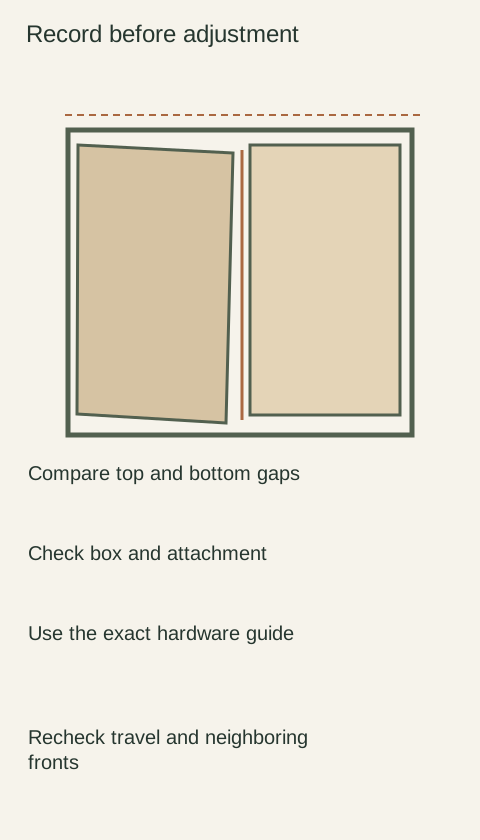
A drawer that will not close smoothly may have something in its path, but that should be checked rather than assumed. First describe where it resists, then inspect only what is visible and normally accessible. Removing ordinary contents can help distinguish a content-related condition from one that persists in the drawer assembly. It does not prove the slides are good or bad, and it does not require pulling the drawer out of the cabinet by force.
Diagram Use the diagram to describe movement; it supplies no universal drawer-release method or load rating.
Describe the motion before changing anything
Note whether resistance begins immediately, occurs at a repeatable point or appears near closing. Include whether the drawer front touches a neighboring part, the box seems uneven or a sound accompanies the movement. If the drawer cannot move normally, stop rather than using momentum to get it past the obstacle. Preserve the observation without repeatedly stressing the assembly.
Record whether the problem followed adding contents, changing an organizer, removing the drawer for cleaning or a period of earlier normal use. This history directs the investigation but does not determine its conclusion. A problem appearing after reloading might involve an object, changed loading or another condition; the timing alone is not a diagnosis of overloaded hardware.
Check visible contents and reachable obstructions
Look for an item protruding above the drawer box, an organizer shifted sideways or an object visibly caught in the closing path. Remove accessible ordinary contents carefully and keep them outside the drawer during the initial comparison. Do not reach blindly into hidden spaces or put fingers into moving runner mechanisms to search for something you cannot see.
If a loose object can be removed without disturbing installed parts, record whether the same normal movement is now possible. Do not dismantle a fitted organizer or slide component merely because it is near the resistance. A drawer that is jammed shut may require service access; forcing it open can turn an uncertain obstruction into a damaged front, box or attachment.
Interpret the unloaded observation narrowly
Where the drawer remains stable and can be operated normally, compare its behavior with accessible contents removed. If it moves more freely, that suggests the contents or their arrangement matter, but it is not a load test or confirmation of the drawer's capacity. Check the actual product guidance before deciding what can be returned and how it should be used.
Imagine a utensil handle projects above the box and meets the opening as the drawer closes. Removing that item may resolve the interference without changing any slide. In another drawer, resistance remains at the same point after contents are removed. That second result deserves a drawer-and-hardware assessment rather than an assumption that a different organizer will solve it.
Treat drawer removal as a separate operation
If the next step requires removing the drawer, identify the installed system first. KraftMaid's instructions for a specified drawer arrangement include a release process and confirmation that its locking devices engage after reinsertion, before refilling. The important principle is that removal and secure return belong to the product's instructions, not to a universal pull-harder technique.
Do not infer release locations from the color or shape of a different drawer's fittings. Where the model is unknown, the drawer is unstable or access is awkward, ask the supplier or installer for the appropriate procedure. An empty drawer still has its own weight and attachments. Unloading contents does not make an unidentified removal method suitable.
Give service a repeatable description
Report the resistance location, whether accessible contents were removed and whether the behavior changed. Include overall views of the drawer front and visible fittings, along with any earlier removal or adjustment. Avoid spraying lubricant or changing multiple adjustments before that report; doing so can obscure which condition remains and adds products or settings that the service person needs to understand.
After an appropriate correction, verify ordinary travel, closing and retention using the actual instructions, then return only permitted contents. If the problem reappears, describe the specific change rather than forcing another cycle. A useful diagnosis separates what an object was physically blocking from questions about the box, installation and runner system, so each receives the kind of attention it requires.
Pure White
Cream White
Light Warm Gray
Gray
Navy
Black
Oak Tone
Dark Walnut Tone
Design study These finish studies are design references, not a list of currently orderable colors. Screens and lighting change the appearance; compare a physical sample before choosing.See all finish options →
Routine cleaning, a finish touch-up and a moving wood joint need different responses. Identify the surface and condition before applying a cleaner or repair product.
The sample shows the door frame, a separate center panel, the face frame and the cabinet box. Each component has its own place in this Shaker construction.
Shaker construction: door frame, center panel, face frame and cabinet box. The cutaway helps locate these parts; confirm each material in the specifications for the selected cabinet.
01 / Door frame
The Shaker door has rails and stiles around a separate center panel. The frame and center panel are different components; confirm their materials in the specifications for the selected cabinet.
02 / Face frame
The face frame surrounds the opening at the front of the cabinet box and sits behind the doors. The face frame, door frame and cabinet box are separate parts.
03 / Cabinet box
The sample exposes the cabinet sides, interior surfaces and layered edges. The image does not establish the wood species or material specification of a selected cabinet.