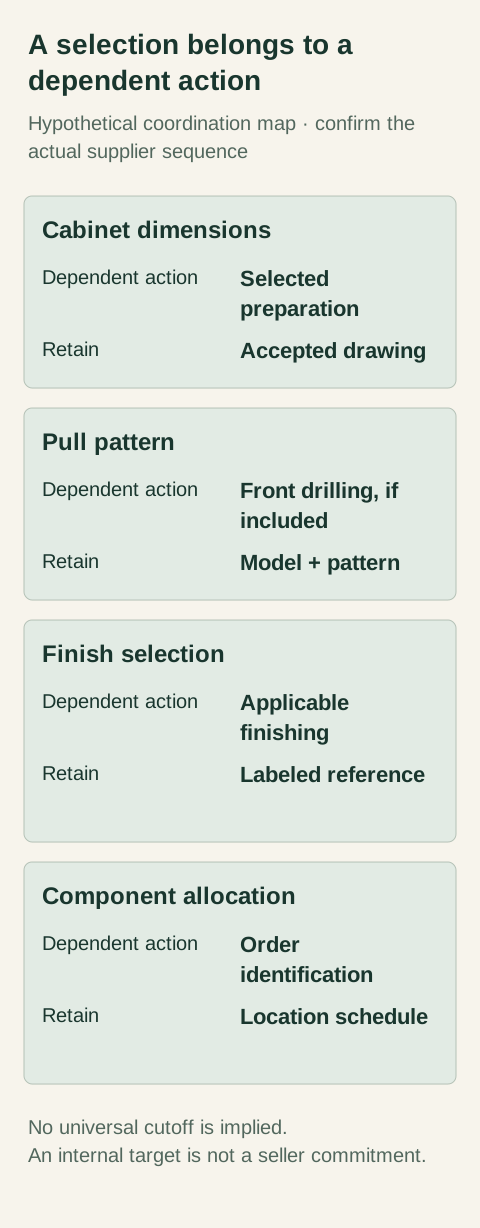
Freeze cabinet selections at the operation they actually affect
Connect each unresolved cabinet choice to the supplier action that needs it, so the team can request real decision points instead of assuming one universal deadline.
A cabinet selection becomes difficult to change when the supplier has taken an action that depends on it. That action may happen before a promised arrival date and may differ from the action that commits another choice. Build a selection map that connects dimensions, hardware preparation, finish and component allocation to the actual supplier workflow. Then request written decision points for your order rather than borrowing another seller's cutoff.
Separate a design preference from an ordering input
An owner may say the kitchen style is settled while several production inputs remain open. A chosen door profile does not establish its exact size, preparation or finish. A preferred metal color does not identify a decorative pull's mounting pattern. Break the selection into the fields the supplier needs to supply the intended item. Keep the owner-facing choice readable, but connect it to the product identity and supporting documents.
For each open field, identify the responsible decision-maker and the evidence needed. Appearance may require a labeled sample; a component configuration may require a product drawing. Record the fixed requirements alongside the open choice. This prevents a late response about color from reopening an accepted material or profile without anyone noticing. It also gives the supplier a specific question rather than a vague request for more time.
Ask which action uses the information
Diagram Hypothetical coordination example. The actual seller determines its process, accepted scope and change conditions.
Ask the seller to identify the action that depends on each field. Dimensions may be needed for cutting, a hardware selection for preparation and a finish for the relevant finishing process. The actual sequence varies, and some suppliers accept only complete product selections at order entry. Do not assume every operation can be paused separately or that a seller will hold an incomplete order while the owner continues choosing.
Record the supplier's own descriptions of accepted, queued, processed or completed states. Ask what evidence confirms the state of the affected item and who can provide it. An overall order status may be too broad to show whether a specific component can still change. Conversely, a production estimate is not permission to alter it. Keep the response tied to the exact order line and choice.
A small-looking pull choice can change preparation
In a hypothetical example, the owner is choosing between decorative pulls with mounting centers of 3 inches and 5 inches for 8 cabinet fronts. The finish color is similar, but the required hole pattern differs. The team should retain the front identities, chosen pull model and confirmed preparation before the supplier performs any dependent operation. These invented values are not installation instructions or specifications of available usaKT.com hardware.
The project should ask whether drilling is part of the quoted supply scope at all. If it is excluded, identify who will decide and perform that later work, and what product information they need. Do not add a factory hold for an operation the seller never agreed to perform. If it is included, obtain the seller's actual process for confirming the pattern and handling a change after preparation.
Give appearance approvals a defined product scope
Link a finish decision to the exact door style, material and relevant components. The selected sample should identify what was reviewed and any intentionally different surfaces. A front approval does not automatically settle an exposed end panel in another material. Before closing the finish choice, ask whether the accepted reference covers every visible component the project expects to coordinate.
If appearance requirements connect components, keep that relationship in the selection map. Do not assume that splitting their decisions leaves matching expectations unchanged. Ask the supplier what needs to be selected together and what comparison evidence it provides. This does not establish an exact color-match guarantee. It records the actual acceptance basis and prevents an owner preference from being represented more broadly than it was reviewed.
Request real decision points, not invented dates
Ask the supplier when it needs each outstanding input under the proposed order arrangement. Write the answer with its conditions and the action that follows. An internal design target can be earlier to give the team review time, but label it as an internal target. It should not be presented as the seller's cancellation deadline, production promise or guaranteed extension.
If the seller requires all selections before acceptance, the map should say so. It can still help the team organize its remaining work without pretending staged selection is available. If the seller permits a specific later choice, record its exact scope. Avoid phrases such as “hardware can wait” when the permission covers only decorative finish and excludes mechanism or drilling changes.
Keep requests separate from confirmed changes
Barker Cabinets documents accepted changes through a new order confirmation. That is a seller-specific documentation example, not usaKT.com's change policy. For your actual seller, retain the required confirmation rather than assuming that a revised selection sheet automatically replaces the accepted order. Ask for the response before changing the status in the project's purchasing record.
When a late choice differs from an accepted field, list the old and proposed values and the connected components. Request the actual price and schedule consequences, if any, without supplying guessed amounts. If a requested pause is needed, ask for it explicitly and confirm whether it was accepted. Sending an urgent message does not establish that processing stopped or that the new choice became available.
Close each selection where others can use it
Once resolved, put the exact product identity, option and applicable sample or drawing into the source schedule. Record who accepted it and which supplier confirmation includes it. Keep the earlier selection history rather than overwriting it. Then check dependent documents: the cabinet list, panel schedule, hardware preparation and any separate purchaser's scope should all use the accepted information where relevant.
Before release, review remaining open fields by their dependent actions. Some may prevent a complete order; some may be outside the seller's supply scope; others may have an explicitly accepted later process. Distinguish those states. A blank field is not a permitted later selection. The team should be able to explain how every required input will reach the responsible party before the relevant action.
Finish references
Pure White
Cream White
Light Warm Gray
Gray
Navy
Black
Oak Tone
Dark Walnut Tone
Design study These finish studies are design references, not a list of currently orderable colors. Screens and lighting change the appearance; compare a physical sample before choosing.See all finish options →
The sample shows the door frame, a separate center panel, the face frame and the cabinet box. Each component has its own place in this Shaker construction.
Shaker construction: door frame, center panel, face frame and cabinet box. The cutaway helps locate these parts; confirm each material in the specifications for the selected cabinet.
01 / Door frame
The Shaker door has rails and stiles around a separate center panel. The frame and center panel are different components; confirm their materials in the specifications for the selected cabinet.
02 / Face frame
The face frame surrounds the opening at the front of the cabinet box and sits behind the doors. The face frame, door frame and cabinet box are separate parts.
03 / Cabinet box
The sample exposes the cabinet sides, interior surfaces and layered edges. The image does not establish the wood species or material specification of a selected cabinet.