A door gap that looks different later in the year may justify observation, but the calendar alone does not identify its cause. Make a repeatable record of the same gap, the door's resting condition and any intervening work. This helps distinguish a persistent change, a recurring pattern and an apparent difference caused by photographs or adjustments. A log supports a service decision; it does not set a universal tolerance or excuse a door that no longer operates properly.
Diagram Track the same unforced condition; this diagram sets no acceptable gap or environmental range.
Define the gap you are following
Identify the cabinet and the exact pair of edges: between neighboring doors, between a door and drawer front or between a front and frame. A joint line within a door is a different observation and should have its own description. Avoid combining them under a general note that the cabinets are moving, because the supplier may need to evaluate different components.
Choose recognizable reference locations and photograph the whole group as well as the gap. Use the same orientation and normal resting position on later checks. Do not press a door shut for one record and leave it resting freely for the next. If a measurement is requested, keep its location and method consistent and note who supplied the method.
Record ordinary conditions without inventing a target
The USDA Forest Products Laboratory explains that wood exchanges moisture with surrounding air and that this relationship affects its properties. This makes environmental context relevant, but it does not assign a particular installed gap to a seasonal cause. Record what you know about the room rather than deriving a diagnosis from the month.
Useful context includes a prolonged interruption to normal heating or cooling, a known moisture event or a recent change in use. If you already have a room reading, note the device and location consistently. Do not present a casual room reading as the moisture content of the door, and do not invent a target range that the cabinet manufacturer has not supplied.
Keep adjustments and observations in different entries
Record hinge changes, front removal, hardware replacement and other work alongside their dates. An adjustment between photographs changes the comparison. Keep the view before work and the view afterward, so a later reviewer can separate the effect of service from the condition that prompted it. Otherwise, a gap may appear to have recovered when it was simply repositioned.
Resist repeatedly tuning the same gap while trying to learn its pattern. Where operation requires attention, arrange the appropriate correction and record it rather than preserving a problem for the sake of a clean experiment. The log should serve the cabinet's use. It should not require tolerating rubbing, an unstable attachment or a condition needing prompt assessment.
Interpret a recurring pattern cautiously
Imagine a gap looks narrower during one part of the year and wider later, with no intervening adjustment recorded. That is a useful repeated observation, especially if photographed consistently. It still does not prove every part moved for the same reason or that the amount is acceptable for the product. Share the pattern and ask what the manufacturer wants evaluated.
Now imagine the apparent wider gap follows a hinge adjustment, while the earlier image was taken at a steeper angle. That comparison cannot support the same conclusion. Label the changed conditions instead of smoothing them out of the story. Honest records containing a known interruption are more useful than a tidy seasonal chart built from incompatible views.
Connect the log to a decision and an endpoint
Ask the supplier what observation would help decide whether further monitoring, alignment work or component assessment is appropriate. Include changes in operation, not just appearance. If a door begins rubbing or a connection becomes loose, report that directly rather than waiting for another season to complete the record. A functional change can require a different response from a small visual variation.
Keep the original images, dated notes and service replies together. When the question is resolved, record the conclusion and any ongoing care instruction without presenting it as a rule for every cabinet. The useful output is a clear history of this installation: what changed, what else changed at the same time and what action the responsible person recommends.
Pure White
Cream White
Light Warm Gray
Gray
Navy
Black
Oak Tone
Dark Walnut Tone
Design study These finish studies are design references, not a list of currently orderable colors. Screens and lighting change the appearance; compare a physical sample before choosing.See all finish options →
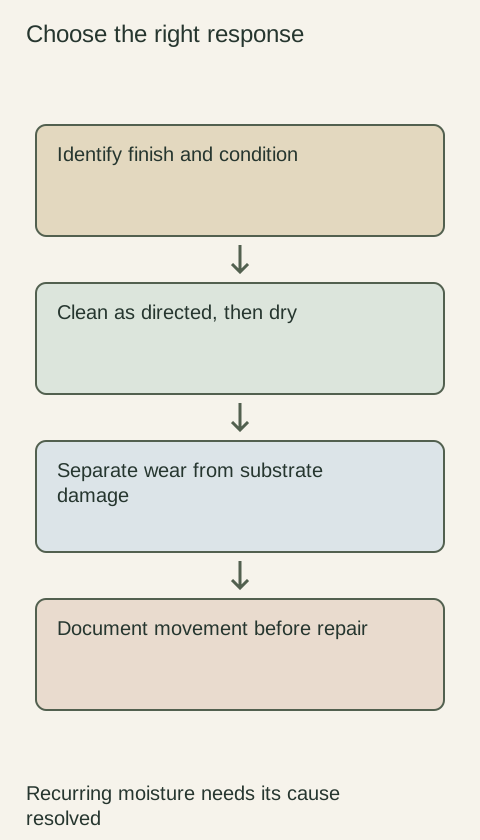
Routine cleaning, a finish touch-up and a moving wood joint need different responses. Identify the surface and condition before applying a cleaner or repair product.
The sample shows the door frame, a separate center panel, the face frame and the cabinet box. Each component has its own place in this Shaker construction.
Shaker construction: door frame, center panel, face frame and cabinet box. The cutaway helps locate these parts; confirm each material in the specifications for the selected cabinet.
01 / Door frame
The Shaker door has rails and stiles around a separate center panel. The frame and center panel are different components; confirm their materials in the specifications for the selected cabinet.
02 / Face frame
The face frame surrounds the opening at the front of the cabinet box and sits behind the doors. The face frame, door frame and cabinet box are separate parts.
03 / Cabinet box
The sample exposes the cabinet sides, interior surfaces and layered edges. The image does not establish the wood species or material specification of a selected cabinet.