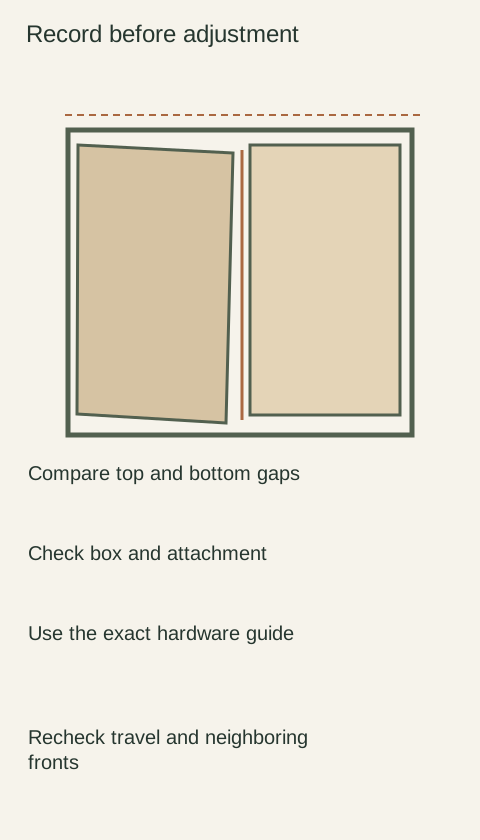
A corner standing forward does not by itself prove that a cabinet door is warped. Hinge position, the cabinet opening, contact points and the panel's own shape may all need consideration. Document the visible relationship without pressing the door into a preferred position. A useful record lets the supplier decide what assessment is needed, while preserving the condition and avoiding a homemade flattening treatment that changes the evidence.
Diagram Show the door without applied force; the diagram does not establish flatness, a tolerance or a warranty outcome.
Identify the exact door and orientation
Use the order or part record to identify the affected front, including its material and finish where known. Mark its position on an overall photograph of the cabinet group. Describe top, bottom, hinge side and handle side consistently. A close image labeled only warped door may not tell the supplier which component to assess or which corner appears displaced.
Include whether this is a newly delivered loose part, a newly installed door or a change after normal use. Keep those conditions separate because the surrounding information differs. Do not remove an installed door just to imitate a photograph of a loose panel; removal and support should be arranged according to the actual hardware and the service provider's instructions.
Show the natural resting condition
Photograph the front in its normal resting position and add a side view that makes the reported projection visible. Explain whether the door closes fully, stops before closing or rubs another part. Avoid holding a corner inward for one photograph and releasing it for another without saying so; comparisons should reflect the same unforced condition.
If the supplier requests a specific measurement or reference method, ask for clear instructions appropriate to the part and setting. Do not treat the neighboring door, a countertop edge or a phone image as a certified flatness reference. Record a requested observation as measured, and leave the applicable tolerance or acceptance decision to the product-specific assessment.
Describe timing and exposure without assigning blame
Note when the shape concern was first noticed, whether earlier photographs show the same relationship and any relevant changes in installation or room conditions. Include known wetting or prolonged exposure if it occurred. Keep confirmed events separate from assumptions about delivery, manufacturing or household use; the visible condition alone does not establish who caused it.
Dura Supreme discusses wood movement under temperature and humidity extremes. This makes environmental history relevant context, but it does not diagnose your door or establish that a particular gap must recover. Use the actual cabinet care guidance for ordinary conditions and avoid deriving a universal target or recovery schedule from a general wood-movement statement.
Use a comparison that preserves alternative explanations
Imagine the upper handle-side corner stands forward while the rest of the front appears close to the frame. A side photograph and a note about the resting position are useful. Calling it a twisted slab and immediately adjusting every hinge is less useful because it changes the relationship before the cause has been assessed.
Ask whether the supplier needs an installation check, a door-condition assessment or both. If an installer changes alignment as part of that process, keep the before-and-after observations and describe the change. A visible improvement after adjustment does not establish that the original panel was perfectly flat, just as an unchanged corner does not alone prove a manufacturing defect.
Agree on the next observation or service action
The service response should identify what is being evaluated and whether any additional documentation is needed. If monitoring is proposed, ask which condition to record and when to report worsening, rather than accepting an open-ended instruction to wait. If replacement is proposed, confirm the exact part identity and how its installed fit will be checked.
Do not clamp, heat, wet or weight the door to force it into shape while awaiting guidance. Those actions can alter the panel and its finish without answering the original question. Keep the record focused on unforced geometry, operating effect and verified history. That gives the supplier a clearer basis for deciding between installation correction, further observation and a part-specific remedy.
Pure White
Cream White
Light Warm Gray
Gray
Navy
Black
Oak Tone
Dark Walnut Tone
Design study These finish studies are design references, not a list of currently orderable colors. Screens and lighting change the appearance; compare a physical sample before choosing.See all finish options →
Routine cleaning, a finish touch-up and a moving wood joint need different responses. Identify the surface and condition before applying a cleaner or repair product.
The sample shows the door frame, a separate center panel, the face frame and the cabinet box. Each component has its own place in this Shaker construction.
Shaker construction: door frame, center panel, face frame and cabinet box. The cutaway helps locate these parts; confirm each material in the specifications for the selected cabinet.
01 / Door frame
The Shaker door has rails and stiles around a separate center panel. The frame and center panel are different components; confirm their materials in the specifications for the selected cabinet.
02 / Face frame
The face frame surrounds the opening at the front of the cabinet box and sits behind the doors. The face frame, door frame and cabinet box are separate parts.
03 / Cabinet box
The sample exposes the cabinet sides, interior surfaces and layered edges. The image does not establish the wood species or material specification of a selected cabinet.