How to read cabinet reviews without letting one story decide
Separate product, delivery, installation and service experiences. Look for comparable details and repeated mechanisms, not just repeated adjectives or an overall star rating.
A review can describe a real experience and still be a poor match for your cabinet purchase. The reviewer may have bought another construction option, used a different installer or received a different delivery service. Instead of treating one enthusiastic or angry account as the verdict, use reviews to identify questions worth checking against the exact product and buying process you are considering.
Identify which part of the project the review describes
Separate the cabinet itself from the sales, delivery, assembly, installation and service stages. A damaged carton, an incorrectly ordered filler and a drawer that binds after installation are different observations. The same phrase, poor quality, may be used for all of them, but it does not identify the cause or the party able to resolve it.
Read for details rather than assigning blame. Does the reviewer name the cabinet line, describe when the issue appeared, show the relevant part or report the response received? A missing detail does not make the experience false. It limits what you can infer from it. Save the unanswered question instead of filling the gap with your own explanation.
Look for a recurring mechanism
A useful pattern is more specific than several people saying the finish is bad. For example, independent accounts might describe the same edge location and the same condition in a comparable product. That gives you a focused question about that component. Accounts involving scratches at unpacking and discoloration after years of use should not automatically be counted as the same issue.
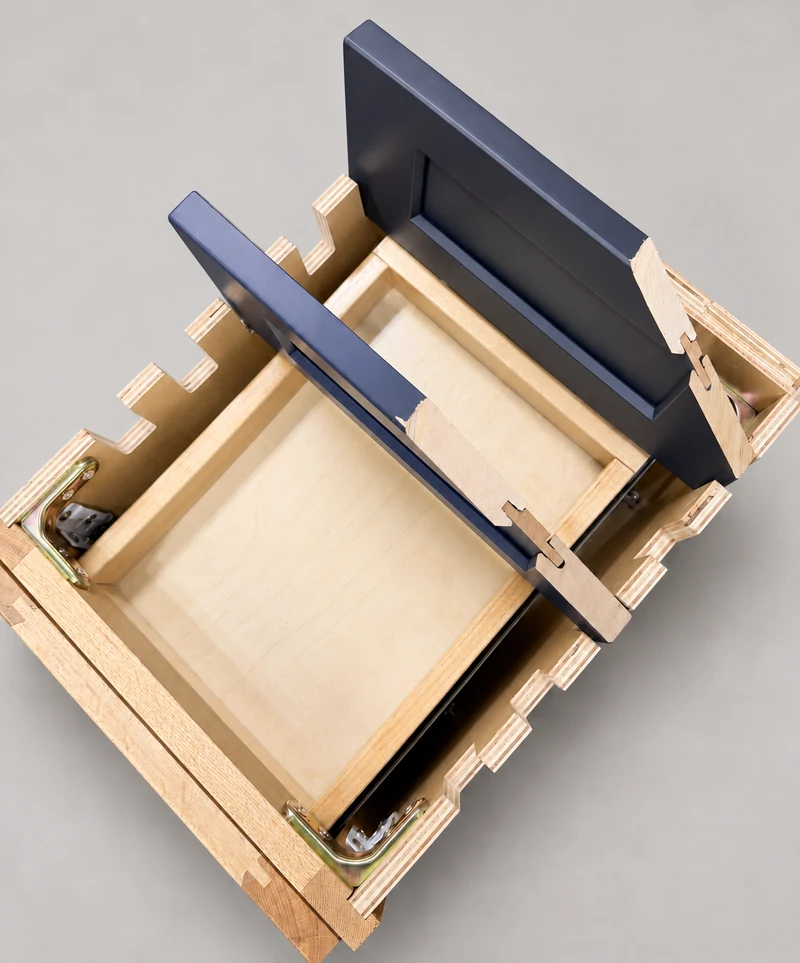
Physical sample Component-specific descriptions make a review easier to investigate. This sample is not evidence of any reported defect.
Check whether apparently repeated stories are actually the same purchase copied across sites or updated by the same reviewer. Several posts may provide useful detail about one event without representing several independent events. Keep the event and the posts distinct. Similarly, a collection of online reviews is not a known count of all customers, so it cannot establish a product failure rate on its own.
Read what happened after the first complaint
Look for a documented outcome: replacement received, missing item supplied, adjustment completed, or an issue still unresolved. A company’s public reply can indicate a proposed next step without proving that the step happened. An updated customer account can add that information. Keep the sequence intact instead of reading only the opening complaint or the first reassurance.
An account of a successful resolution is useful even when the original problem remains relevant. Ask what evidence was required and which work the customer still had to arrange. Do not assume that one resolution establishes the terms for every buyer; use it to identify the service process you need explained before ordering.
Turn the evidence into questions for your order
If the concern involves missing trim, ask how your cabinet list identifies fillers and finished panels. If it concerns damage, ask about the stated inspection and reporting process for the selected delivery. If it concerns a component, request the applicable specification and care information. The question should address the observed mechanism rather than repeat a broad accusation.
You do not need to decide whether every reviewer is right before choosing cabinets. You need to know which reports are comparable, what remains unexplained and whether the supplier gives a clear answer about your configuration. Save a small set of useful examples with your questions. A star average can help you find experiences to read; the details are what make those experiences useful to a purchase.
Pure White
Cream White
Light Warm Gray
Gray
Navy
Black
Oak Tone
Dark Walnut Tone
Design study These finish studies are design references, not a list of currently orderable colors. Screens and lighting change the appearance; compare a physical sample before choosing.See all finish options →
A ranked list can hide its comparison rules. Find the tested product, the scoring priorities and the missing conditions before applying the result to your cabinet order.
The sample shows the door frame, a separate center panel, the face frame and the cabinet box. Each component has its own place in this Shaker construction.
Shaker construction: door frame, center panel, face frame and cabinet box. The cutaway helps locate these parts; confirm each material in the specifications for the selected cabinet.
01 / Door frame
The Shaker door has rails and stiles around a separate center panel. The frame and center panel are different components; confirm their materials in the specifications for the selected cabinet.
02 / Face frame
The face frame surrounds the opening at the front of the cabinet box and sits behind the doors. The face frame, door frame and cabinet box are separate parts.
03 / Cabinet box
The sample exposes the cabinet sides, interior surfaces and layered edges. The image does not establish the wood species or material specification of a selected cabinet.