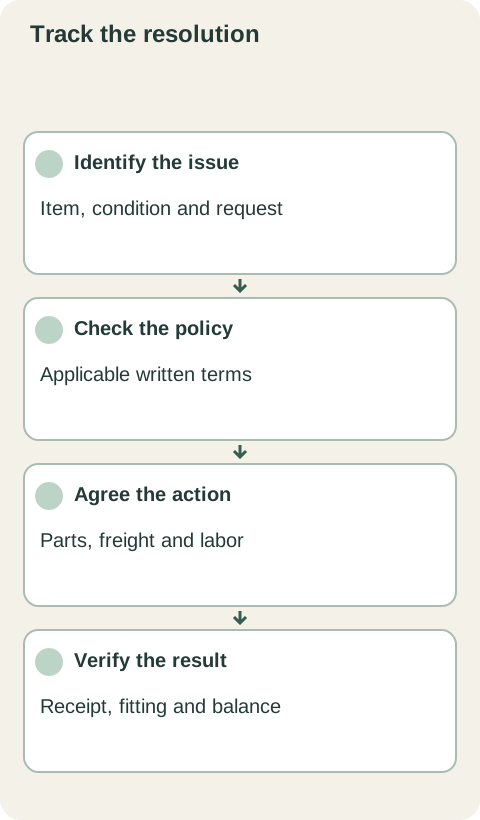
A cabinet that arrived damaged, an unwanted item and a part needed years later can require different processes. Before purchasing, obtain the written return and warranty information for the selected order. After a problem, identify the item and request a specific next action. Keep track of what has been requested, accepted and completed, including any separate site work.
Match the policy to the product and seller
Request the policy that applies to the chosen cabinet line, seller and order type, and save a dated copy with the quote. Read how it identifies eligible products, people, conditions, exclusions and the route for submitting requests. KraftMaid publishes warranty information for its own cabinetry; that document does not define another supplier’s coverage. For your purchase, identify the actual applicable document rather than relying on the word warranty in a general description. Ask for clarification of wording you need to understand before accepting the order.
A return of an unwanted item, transit-damage report, wrong-item correction, product concern and paid reorder are different requests. Describe the condition and desired response without deciding in advance which policy will cover it. KraftMaid’s FAQ shows how order records can identify its products and replacement parts; preserve that information for your chosen supplier. Send the order identifier, product or position, finish and useful photos. Keep the requested action clear enough that the response can accept it, decline it or ask for more evidence.
Diagram Parts, freight and site labor need their own explicit scope in a resolution.
Check return handling before moving the item
Read whether the particular product may be returned, what authorization is needed, required condition and packaging, stated time conditions, shipping arrangements and any quoted charges. Use the seller’s actual instructions before sending anything back. An inspection report is not automatically return authorization. KraftMaid’s delivery-inspection guide supports early checking so an issue can be identified before installation. Preserve labels and relevant packaging while the applicable process is clarified. Do not invent a universal return period or assume freight will be reimbursed.
If a replacement, repair or credit is offered, identify the affected part and the work included. A replacement door and a replacement complete cabinet are different supplies. Separately ask about removal, disposal, reinstallation, adjustment, service visits and any work involving adjacent finishes or other trades. Record who authorizes each action and whether any cost has been accepted. Product coverage and labor payment must be read from the actual agreement; one cannot be inferred simply because the other is mentioned.
Treat a reorder as a fresh compatibility check
Keep original SKU, dimensions, handing, finish and construction information. Ask whether the item is still supplied and whether the current version is compatible with the existing cabinet or hardware. A matching name does not confirm identical construction or an exact visual match. Review samples or technical information as appropriate, including what can be learned before purchase. For a paid reorder, get a current quote and delivery scope. Do not treat an old invoice as a current availability or pricing commitment.
Close the request only after checking the result
Keep a request log with documents, responses, accepted actions and open questions. When a replacement arrives, inspect it against the approved resolution and original identification before scheduling work that depends on it. If a credit or reimbursement is agreed, track actual application separately from approval. Record remaining labor or parts still needed. Preserve the final product identification and care information for future service. The goal is a usable resolution record rather than a message thread that says the matter was discussed.
Write a resolution scope the installer can read
When a proposal is accepted, list the supplied part, its finish and identification, the delivery arrangement and the authorized site work. Give the installer only the current agreed scope, while preserving earlier correspondence in the record. If labor has not been agreed, leave that item open instead of describing the entire problem as resolved. Also decide how the original affected item should be retained, returned or otherwise handled under the instructions received. Close each part when it is completed. This makes a partial solution visible without losing the remaining work.
Before you release the order
Save the applicable policy with product and order identifiers.
Separate return, damage, warranty concern and paid reorder.
Request written scope for parts, freight and labor.
Check the completed remedy before closing the record.
Finish references
Pure White
Cream White
Light Warm Gray
Gray
Navy
Black
Oak Tone
Dark Walnut Tone
Design study These finish studies are design references, not a list of currently orderable colors. Screens and lighting change the appearance; compare a physical sample before choosing.See all finish options →
Choose the service that covers the decisions your remodel actually needs. Compare product choices, room coordination, drawings and compensation before paying for overlapping work.
A microwave on a table is not a complete meal arrangement. Decide what you will prepare, where the supplies will live and how cleanup works before the old kitchen is removed.
A smaller first order is useful only if it leaves a finished, usable kitchen and does not force expensive work to be repeated. Separate genuinely independent additions from connected cabinet and countertop work.
The sample shows the door frame, a separate center panel, the face frame and the cabinet box. Each component has its own place in this Shaker construction.
Shaker construction: door frame, center panel, face frame and cabinet box. The cutaway helps locate these parts; confirm each material in the specifications for the selected cabinet.
01 / Door frame
The Shaker door has rails and stiles around a separate center panel. The frame and center panel are different components; confirm their materials in the specifications for the selected cabinet.
02 / Face frame
The face frame surrounds the opening at the front of the cabinet box and sits behind the doors. The face frame, door frame and cabinet box are separate parts.
03 / Cabinet box
The sample exposes the cabinet sides, interior surfaces and layered edges. The image does not establish the wood species or material specification of a selected cabinet.