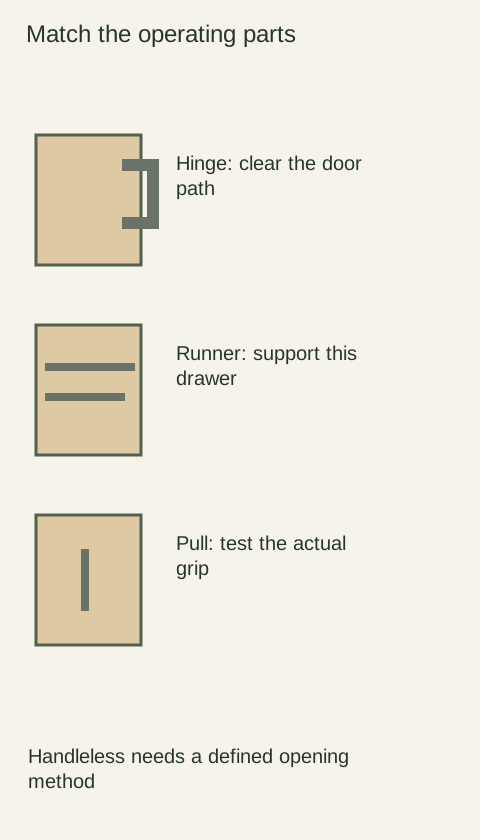
A squeak or rough movement does not automatically call for lubricant. First identify the hinge, runner or other mechanism and check its maintenance instructions. The relevant answer may be permitted cleaning, a specified lubrication procedure, an adjustment assessment or replacement service. Do not select a spray solely because it says suitable for metal. The product must be appropriate for the actual mechanism and the condition you are trying to address.
Diagram Identify the mechanism and its maintenance instructions; the diagram recommends no lubricant or application method.
Name the mechanism and the symptom separately
Locate available manufacturer markings and product records. Describe whether the issue is noise, resistance, uneven travel, failure to slow or a visible loose connection. Record when it occurs during normal movement and whether any substance was previously applied. These details allow a useful inquiry without assuming that every symptom comes from insufficient lubrication.
A sound at a door's contact point, for example, is not the same observation as roughness along a runner's travel. A loose mounting point is another question entirely. Do not use a change in sound after spraying as proof that the underlying attachment or alignment is corrected. Identify what needs attention before choosing a maintenance product.
Read the applicability statement before the procedure
Check that the document names the actual product family and covers the installed application. Accuride explicitly limits one cleaning and lubrication guide to standard ball-bearing slides and excludes specialty refrigerator and oven slides. This is a concrete example of why a manufacturer's article can be valid within a defined scope without applying to every mechanism in a home.
Do not extend a runner procedure to soft-close hinge damping, a lift mechanism or powered hardware simply because the components are nearby. If the model is unclear, send photographs and identification to the supplier first. A search result title containing drawer lubricant is not enough to establish that the instructions match what is installed.
Ask for a complete maintenance answer
Where lubrication is recommended, obtain the permitted product specification, application location, preparation and any access or reassembly requirements. Confirm what should be kept free of the product and how surrounding cabinet finishes should be protected. A recommendation saying use a little oil leaves important details unanswered and should not be converted into a universal household recipe.
Also ask whether the proposed work is routine owner maintenance or requires service access. Some instructions may involve removing or separating parts, which is a separate operation requiring the correct procedure. If the available guidance does not identify your mechanism or you cannot safely follow it, request an appropriate service response rather than experimenting with an easier-to-reach location.
Keep previous applications in the history
Imagine a noisy drawer has already received a general-purpose spray, then a different grease, and now feels less consistent. The next useful step is to list what was applied and where, not add another product because someone recommends it for a different slide. The service provider needs that history to decide what cleaning or assessment is appropriate.
If nothing has been applied, preserve that simpler starting condition while checking the documentation. Do not flush out visible factory material merely because it looks dirty or assume more lubricant is always better. A maintenance procedure should explain the intended treatment for the identified system; an appearance judgment alone does not establish which material should be removed.
Evaluate the intended result without hiding other problems
After any approved maintenance, check the normal movement described in the instructions and note whether the original symptom changed. Include closing, retention and contact behavior where relevant. If noise improves but sticking or movement at a mounting point remains, report those separately. An improvement in one symptom does not establish that every part of the assembly is sound.
Keep the document version, product used and date with the hardware record. Do not create a repeating lubrication schedule unless the manufacturer actually calls for one for that product. If the issue recurs, use the record to ask for a specific next step. Good maintenance follows an identified system and leaves a clearer history, rather than a collection of unknown substances inside the cabinet.
Pure White
Cream White
Light Warm Gray
Gray
Navy
Black
Oak Tone
Dark Walnut Tone
Design study These finish studies are design references, not a list of currently orderable colors. Screens and lighting change the appearance; compare a physical sample before choosing.See all finish options →
Routine cleaning, a finish touch-up and a moving wood joint need different responses. Identify the surface and condition before applying a cleaner or repair product.
The sample shows the door frame, a separate center panel, the face frame and the cabinet box. Each component has its own place in this Shaker construction.
Shaker construction: door frame, center panel, face frame and cabinet box. The cutaway helps locate these parts; confirm each material in the specifications for the selected cabinet.
01 / Door frame
The Shaker door has rails and stiles around a separate center panel. The frame and center panel are different components; confirm their materials in the specifications for the selected cabinet.
02 / Face frame
The face frame surrounds the opening at the front of the cabinet box and sits behind the doors. The face frame, door frame and cabinet box are separate parts.
03 / Cabinet box
The sample exposes the cabinet sides, interior surfaces and layered edges. The image does not establish the wood species or material specification of a selected cabinet.