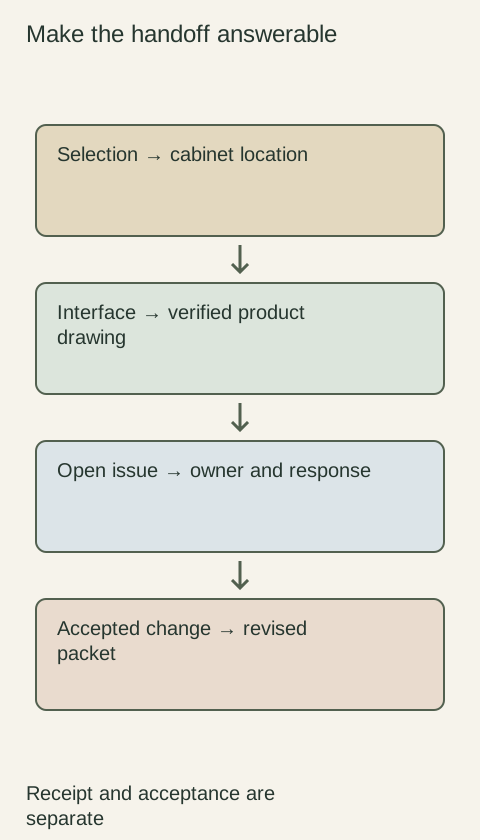
A useful cabinet handoff gives the resident an understandable care method and a clear way to report a change. It should identify the actual finishes, explain which ordinary tasks are appropriate and separate those from service work. A folder of unrelated manuals or an unlabeled bottle does not achieve that. Prepare a brief everyday guide backed by the applicable product documents, with instructions for the specific cabinets the resident will use.
Diagram Connect actual finishes and service contacts to a resident reference; this is care guidance, not a rental agreement.
Identify the surfaces before listing cleaners
Record the cabinet brand or supplier information where known, the finish type and any areas needing different care. An exterior door, an interior surface and a glass insert may not share the same instructions. Use an overall photograph or simple location description to connect each care note to the right part of the home.
Merillat publishes separate care guidance for wood finishes and laminate, melamine and vinyl surfaces, including gentle cloth cleaning and drying. That distinction supports a finish-specific handoff instead of a universal clean everything instruction. Use the actual cabinet guidance to decide which method belongs in the resident's short reference; do not transfer another manufacturer's products or polishing schedule automatically.
State the permitted cloth and cleaning method in plain language, with the exact product identity if one has been approved for those cabinets. Explain how to handle ordinary spills and drying according to the care instructions. Avoid shorthand such as use a gentle cleaner if the resident has no way to tell which supplied product meets that description.
Keep containers labeled and accessible with their original use information. Do not hand over a decanted, unidentified solution or assume a cleaning contractor's routine matches the cabinetry. If residents use their own cleaner, give them a contact for checking suitability before trying it. The guide should reduce guessing during an ordinary cleaning task rather than require them to interpret a finish chemistry label.
Separate reporting from attempted repair
Explain what to report promptly: visible water, a lifting surface, a loose door or an unusual change in operation. Ask for the cabinet location, when it was noticed and a useful photograph where normal access allows. Do not make a perfect photo package a prerequisite to reporting an active leak or an unstable component.
Identify the service route and what the resident should do while awaiting instructions for that particular condition. Routine wiping and reporting are different from removing doors, adjusting unidentified screws or applying touch-up products. Make the boundary practical: the resident should know whom to contact and what information helps, without being expected to diagnose hardware or decide whether a panel needs replacement.
Walk through a realistic handoff example
Imagine a resident notices water inside the sink cabinet and assumes wiping it dry is all that is expected. A better guide distinguishes immediate permitted care from reporting the observation to the named maintenance contact. The report can say where water appeared and when it was found, without asking the resident to identify the plumbing source or wait until the cabinet visibly deteriorates.
At handoff, show where the care reference and contact information are stored and ask the resident to locate them. Demonstrate ordinary opening and closing of any unfamiliar mechanism using its instructions. This checks whether the information is usable. A signed receipt for a manual does not, by itself, establish that the resident knows which instructions apply to which cabinet.
Keep condition and service updates together
Include a simple initial condition record that identifies existing marks and unresolved service items. Describe them accurately without assigning causes that have not been established. When a part is replaced or a finish is repaired, update the relevant care information and installed-part record, so future guidance reflects the material actually present rather than only the original order.
Provide the reference in a language the resident can understand and retain consistent product names across versions. Keep the maintenance contact current and make revised instructions easy to find. The intended result is ordinary care carried out appropriately and changes reported early, with a usable service path that continues after the move-in conversation is over.
Pure White
Cream White
Light Warm Gray
Gray
Navy
Black
Oak Tone
Dark Walnut Tone
Design study These finish studies are design references, not a list of currently orderable colors. Screens and lighting change the appearance; compare a physical sample before choosing.See all finish options →
Routine cleaning, a finish touch-up and a moving wood joint need different responses. Identify the surface and condition before applying a cleaner or repair product.
The sample shows the door frame, a separate center panel, the face frame and the cabinet box. Each component has its own place in this Shaker construction.
Shaker construction: door frame, center panel, face frame and cabinet box. The cutaway helps locate these parts; confirm each material in the specifications for the selected cabinet.
01 / Door frame
The Shaker door has rails and stiles around a separate center panel. The frame and center panel are different components; confirm their materials in the specifications for the selected cabinet.
02 / Face frame
The face frame surrounds the opening at the front of the cabinet box and sits behind the doors. The face frame, door frame and cabinet box are separate parts.
03 / Cabinet box
The sample exposes the cabinet sides, interior surfaces and layered edges. The image does not establish the wood species or material specification of a selected cabinet.