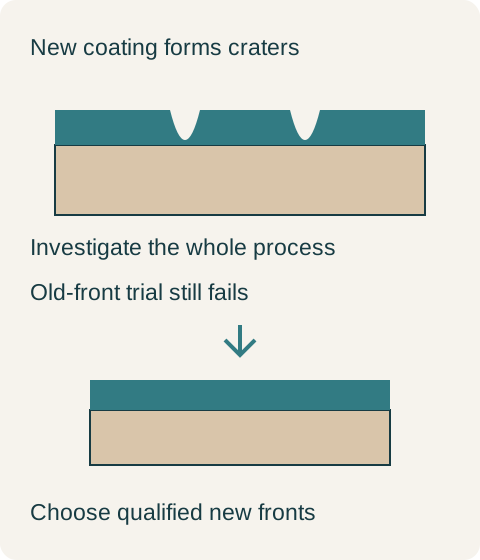
A cabinet repaint should not be priced as a simple color change when a prepared trial develops repeated craters in the new coating. Those defects belong to the proposed finishing process, even if the old door looked smooth beforehand. The purchase question is whether a qualified refinishing method can deliver the required result on the existing surfaces, or whether the affected fronts should be replaced.
A crater is evidence, not a chemical identification
Sherwin-Williams describes fisheyes as depressions or voids associated with surface tension. Its wood-finishing training lists silicone, oil and excess moisture among possible causes, and includes the application environment and compressed-air supply in troubleshooting. A photograph of a crater therefore cannot establish that the homeowner used a particular cleaner.
General Finishes addresses a specific complication in previously finished cabinets: silicone from dusting products may remain unnoticed until a new finish is applied. It warns that even stripping and sanding do not guarantee success if contamination has entered grain through cracks. This is a reason to qualify the actual refinishing system, not a claim that every old cabinet contains silicone.
Ask the refinisher to separate a failure on the old substrate from one in the equipment or coating process. A clean control piece coated through the same setup can help the professional investigate that distinction, while a representative existing door tests the proposed scope. The trial should include the intended preparation, complete coating system and appropriate cure and acceptance procedure, rather than a quick color dab.
Teaching example Conceptual hypothetical refinishing decision, not a diagnosis of a photographed cabinet. The crater drawing does not identify a particular contaminant.
Replace the failing fronts, retain the qualified cabinet work
In a hypothetical repaint proposal, the refinisher corrects the spray setup and obtains an acceptable clean control. Prepared trials on the old doors still crater, and the proposed remediation does not meet the agreed finish acceptance. Separate trials on the exposed cabinet frames pass the refinisher’s complete acceptance procedure. The owner selects newly made fronts finished through the qualified process, retains the approved frame-refinishing work and removes old-door repainting from the order. This buys a defined result without paying for repeated coats over the same unresolved front surfaces.
The frame result cannot be inferred from the door result in either direction. If the frames also fail, the example’s retained scope is no longer justified. Likewise, replacement fronts still need the correct dimensions, attachment compatibility and approved color relationship to the retained parts. A new substrate solves only the old-front substrate problem, not every coordination issue.
Separate the trial cost from the full repaint commitment
A useful proposal identifies the qualification work, the accepted result and the alternative scope if the trial fails. Compare that complete replacement-front package with the qualified refinishing package, including removal, fitting and treatment of visible companion parts. No universal cost ranking follows from the material names alone.
Keep trial records and finish-system identity with the order. Do not treat a fisheye additive, a barrier coat or aggressive sanding as a guaranteed shortcut based on its name. The coating supplier and refinisher must qualify any such change within the actual system. Once the chosen scope is accepted, preserve the preparation and process that produced that result.
Pure White
Cream White
Light Warm Gray
Gray
Navy
Black
Oak Tone
Dark Walnut Tone
Design study These finish studies are design references, not a list of currently orderable colors. Screens and lighting change the appearance; compare a physical sample before choosing.See all finish options →
The sample shows the door frame, a separate center panel, the face frame and the cabinet box. Each component has its own place in this Shaker construction.
Shaker construction: door frame, center panel, face frame and cabinet box. The cutaway helps locate these parts; confirm each material in the specifications for the selected cabinet.
01 / Door frame
The Shaker door has rails and stiles around a separate center panel. The frame and center panel are different components; confirm their materials in the specifications for the selected cabinet.
02 / Face frame
The face frame surrounds the opening at the front of the cabinet box and sits behind the doors. The face frame, door frame and cabinet box are separate parts.
03 / Cabinet box
The sample exposes the cabinet sides, interior surfaces and layered edges. The image does not establish the wood species or material specification of a selected cabinet.