A cloudy patch or raised-looking edge can tempt you to try a stronger cleaner. Before doing that, decide whether you are looking at something deposited on the surface or a change in the finish itself. You may not be able to settle that question at home. The useful first decision is whether ordinary approved care can continue, or whether the surface should be left alone for the supplier to assess.
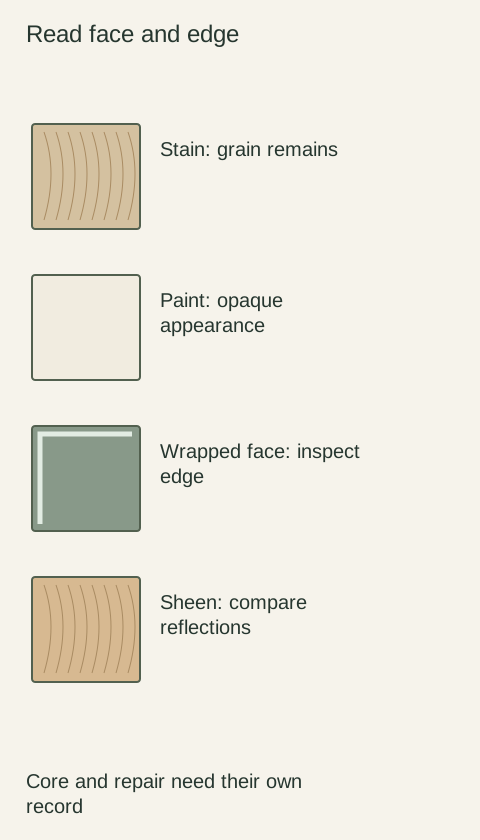
Diagram Identify the actual finish before selecting care; the diagram cannot diagnose a photographed patch.
Describe the patch without labeling the cause
Photograph the whole door or panel and the affected area from a normal viewing position. Record whether the patch appears cloudy, streaked, raised, cracked or visibly lifted at an edge. Include whether it follows a wipe pattern, surrounds a handle or occurs along a joint. These details identify the complaint without claiming that appearance alone proves contamination or coating failure.
Check when it first appeared and what happened beforehand. Useful history includes a new cleaning product, tape removal, a spill or repeated handling. Preserve the exact cleaner name and any actions already taken. Do not invent a cause because the timing seems persuasive; the supplier may need to consider the material and the previous care history together.
Verify the surface and its permitted care
Find the cabinet's actual finish information. A general instruction for painted wood does not automatically apply to a decorative film or acrylic surface. Dura Supreme explicitly separates its stained and painted care instructions from its acrylic, foil and laminate guide. That division is a reason to confirm the applicable instructions before selecting a cleaning method.
Use a clean cloth assigned to this task, rather than a cloth carrying grease or cleaner from another job. Residue on the tool complicates the observation: a new streak could come from what the cloth deposits rather than what the cabinet releases. Keep the product and cloth choice simple enough that you can accurately describe what touched the surface.
Keep any cleaning check within ordinary care
If the surface appears intact and the cabinet instructions permit cleaning, use only the stated gentle method on a limited area and evaluate it after drying as directed. Do not escalate through several chemicals simply because the first pass did not remove a mark. A stubborn patch is a reason to reconsider the diagnosis, not evidence that a stronger product is needed.
If there is an obviously loose flap, missing finish or a lifting edge, avoid rubbing, scraping or pulling at it to see how far it goes. A fingernail or adhesive-tape test can change the condition being reported. Preserve what is visible and ask for assessment. Color transferred to a cloth should also prompt a pause; it does not by itself identify what material transferred.
Compare a changed patch with an unchanged edge
Imagine a hazy band beside a pull becomes less visible after permitted gentle cleaning and drying, while a lifted edge near the bottom remains unchanged. Report those as separate observations. The improved band suggests the cleaning altered that area, but it does not prove the entire door only had residue or that the raised edge needs the same treatment.
Likewise, a mark that looks better while wet but returns after drying has not been demonstrated to be repaired. Compare dry views under similar lighting and avoid polishing just to make the photograph look uniform. The practical result of the check is a clearer service question, not a requirement to name the coating chemistry from household observations.
Ask for the next method, not merely a stronger cleaner
Send the supplier the finish identity if known, overall and close views, onset history and the cleaning method already used. Ask whether the remaining condition calls for additional approved cleaning, a localized finish assessment or replacement evaluation. If the material identity remains unknown, make that explicit rather than selecting a treatment from a visually similar cabinet online.
Keep any proposed procedure tied to the actual surface and affected area. Do not coat over an unresolved loose layer or assume a touch-up pen addresses adhesion. A successful next step should clarify what is being removed or restored, what appearance can reasonably be expected and when further cleaning should stop. That is more useful than a shelf full of increasingly aggressive products.
Pure White
Cream White
Light Warm Gray
Gray
Navy
Black
Oak Tone
Dark Walnut Tone
Design study These finish studies are design references, not a list of currently orderable colors. Screens and lighting change the appearance; compare a physical sample before choosing.See all finish options →
Routine cleaning, a finish touch-up and a moving wood joint need different responses. Identify the surface and condition before applying a cleaner or repair product.
The sample shows the door frame, a separate center panel, the face frame and the cabinet box. Each component has its own place in this Shaker construction.
Shaker construction: door frame, center panel, face frame and cabinet box. The cutaway helps locate these parts; confirm each material in the specifications for the selected cabinet.
01 / Door frame
The Shaker door has rails and stiles around a separate center panel. The frame and center panel are different components; confirm their materials in the specifications for the selected cabinet.
02 / Face frame
The face frame surrounds the opening at the front of the cabinet box and sits behind the doors. The face frame, door frame and cabinet box are separate parts.
03 / Cabinet box
The sample exposes the cabinet sides, interior surfaces and layered edges. The image does not establish the wood species or material specification of a selected cabinet.