Before paying for cabinets, make sure the payment request identifies the order you intend to buy. Keep a dated quote, cabinet schedule and accepted drawing together. Payment, design approval and release for fulfillment are related events, but the seller’s written process should explain what each event does. Request the payment methods and any credit terms applicable to your usaKT.com order in writing before choosing an arrangement.
Tie the payment to the complete order
Check the payee, order identifier, revision, selected products and amount against the accepted quote. Product choices affect the cabinet package, as KraftMaid’s purchasing FAQ illustrates for its own line. A payment request should not quietly refer to an earlier selection. Ask which payment methods are accepted and whether charges or conditions apply. Use the seller’s established payment route and preserve the receipt with the corresponding order revision, so a later transaction can be explained without guessing.
Get the sequence for approval, payment, release, production or allocation, and shipment in writing. Ask whether a deposit starts any work and what further approval is needed. Do not infer those milestones from the label on a receipt. A project can also have separate installer or site-work payments; KraftMaid’s scope guide is a reminder that the renovation may extend beyond cabinet supply. Keep those arrangements identifiable rather than treating every invoice as part of the same contract or service.
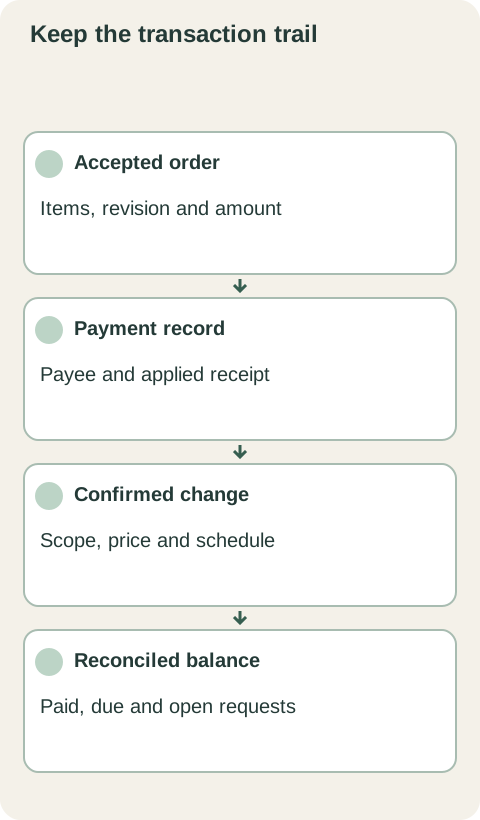
Diagram A requested change becomes part of the order only through the agreed acceptance process.
Use a written change request
Identify the order and revision, cabinet location, old item and proposed replacement. Explain whether the change affects finish, quantity, dimensions, accessories or delivery plans. Request confirmation of price, scheduling impact and whether the change can still be made before authorizing it. If the supplier cannot accept the request, preserve that answer with the original order. Receiving guidance emphasizes checking what arrives; an accepted change record tells the receiver which version to expect. A sent message alone is not proof the order changed.
Ask what the word credit means in the discussion. It may mean a proposed account adjustment, a refund request or a financing arrangement, and each needs different records. For an adjustment, identify the affected item, approved amount and how it will be applied. For financing, request the provider’s current written terms, including charges, payment schedule, promotional conditions and what happens when those conditions are not met. Do not infer approval or affordability from an advertised monthly amount.
Reconcile balances after a revision
When a change is accepted, obtain the revised order total and a record of payments already applied. Check whether any further amount is due or an adjustment remains pending. Keep proposed, approved and completed adjustments distinct in your notes. If a requested cancellation, return or refund is involved, use the actual written procedure rather than assuming a general deadline or outcome. Assign a follow-up owner and preserve responses. Avoid recording a requested credit as money already received.
Build a transaction file that survives the project
Save the accepted quote, drawing revision, payment receipts, change approvals and adjustment records in one place. At delivery, link any shortage or damage request to the item and revision, and keep it separate from the original payment history. If another person will manage the project, provide a concise balance and open-request list. The outcome should make it possible to see what was ordered, what was paid, which changes were accepted and what is still awaiting an answer.
Summarize a change before authorizing payment
Prepare a short transaction summary showing the accepted order, the requested change, the supplier’s response and the resulting balance. Send that same summary to the person who approves payment and the person who handles release. If a requested adjustment is not yet accepted, leave it outside the completed-payment total. This prevents a project spreadsheet from showing a lower balance than the seller has actually confirmed. Preserve receipts for the transaction that occurs, including its order reference. A clear ledger helps a new project manager continue without reinterpreting earlier informal messages.
Before you release the order
Match payment requests to the accepted revision.
Ask which event authorizes fulfillment.
Obtain written acceptance of changes and their effects.
Track requested, approved and applied adjustments separately.
Finish references
Pure White
Cream White
Light Warm Gray
Gray
Navy
Black
Oak Tone
Dark Walnut Tone
Design study These finish studies are design references, not a list of currently orderable colors. Screens and lighting change the appearance; compare a physical sample before choosing.See all finish options →
Choose the service that covers the decisions your remodel actually needs. Compare product choices, room coordination, drawings and compensation before paying for overlapping work.
A microwave on a table is not a complete meal arrangement. Decide what you will prepare, where the supplies will live and how cleanup works before the old kitchen is removed.
A smaller first order is useful only if it leaves a finished, usable kitchen and does not force expensive work to be repeated. Separate genuinely independent additions from connected cabinet and countertop work.
The sample shows the door frame, a separate center panel, the face frame and the cabinet box. Each component has its own place in this Shaker construction.
Shaker construction: door frame, center panel, face frame and cabinet box. The cutaway helps locate these parts; confirm each material in the specifications for the selected cabinet.
01 / Door frame
The Shaker door has rails and stiles around a separate center panel. The frame and center panel are different components; confirm their materials in the specifications for the selected cabinet.
02 / Face frame
The face frame surrounds the opening at the front of the cabinet box and sits behind the doors. The face frame, door frame and cabinet box are separate parts.
03 / Cabinet box
The sample exposes the cabinet sides, interior surfaces and layered edges. The image does not establish the wood species or material specification of a selected cabinet.