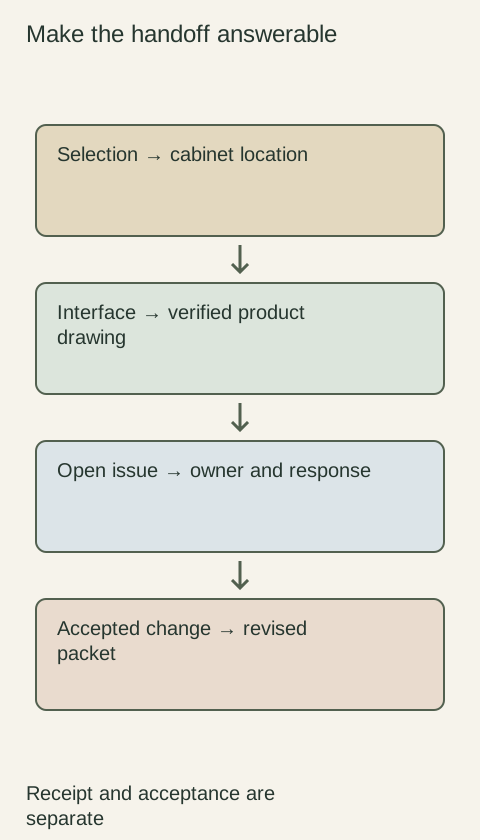
When a cabinet part is damaged, incorrect or still under review, keep its status visible at the place where someone might select it for installation. A message in the buyer's inbox is not enough. Separate the affected item within an appropriate storage arrangement, preserve its identity and give the crew a clear instruction to wait. The purpose is to prevent an unresolved product decision from being made accidentally by whoever picks up the next piece.
Diagram Keep the affected item linked to its open question and release contact; the diagram does not diagnose the part or decide its remedy.
Identify the exact item and reason for holding it
Use the product and project references already associated with the cabinet. Write a short factual description of the open issue: finish awaiting comparison, damaged edge reported or component identity not confirmed. Avoid broad labels such as all cabinets bad when the concern applies to a particular piece. The crew needs to know which item is affected and what remains undecided.
HomeCabinets instructs customers not to assemble cabinets with damaged parts while awaiting directions, and to retain packaging. That is a supplier example of preserving the affected goods during review. Confirm the instruction for your actual case; a hold label does not itself determine whether the part needs replacement or another response.
Choose an appropriate location with the site lead where the item remains protected and identifiable but is not mixed into the ready-to-use group. Do not move it to an unsuitable damp or exposed corner merely to get it out of the way. If a large assembly cannot sensibly be relocated, agree how its status will be made unmistakable without unsafe handling.
Put the added notice on suitable packaging or a protected associated record, keeping supplier labels readable. Do not attach unverified adhesives directly to finished faces. Identify any related parts being held with it, and distinguish them from similar unaffected items. A loose notice left on top of a busy workbench can become detached from the product it was meant to control.
Give the installer a clear next action
Tell the crew which item should not be installed or altered yet, why it is pending and whom to contact. Make the instruction available before the work reaches that product. A crew arriving after the buyer's earlier discussion may reasonably assume that material placed with the installation stock has already been reviewed, unless the current status is clearly communicated.
Avoid improvising a correction while waiting for the supplier. Drilling, cutting, sanding or fitting the questionable part can change the condition being reviewed and create additional work. If an installer believes a specific action is appropriate, route that proposal to the person coordinating the case and obtain the relevant product guidance. Do not turn an informal suggestion into an unrecorded change to the held item.
Define what will release the item
Record who is coordinating the answer and what information or assessment is still required. Release the part only after the relevant response has been reviewed for that exact item and communicated to the installer. If the response calls for a further check, the task remains open until that check is completed; an email received is not necessarily a decision to use the product.
Imagine an incorrect-looking front sits beside accepted fronts while the seller checks its finish reference. Someone removes a temporary note during cleanup, and the installer takes the front as the next available piece. A clear product-linked hold and a named release contact would keep that unresolved comparison from becoming an installed condition that now needs additional work to reverse.
Keep the old item distinct when a replacement arrives
Check the replacement independently and identify it separately from the held original. Do not remove the original notice merely because another box has arrived. Confirm which product is cleared for the planned work and what should happen to the affected item afterward. Retention, inspection or return instructions may still be open even when the new component is ready.
Update the inventory and tell the crew about the release, partial resolution or continued hold. Keep a record of the decision so a later shift does not rely on a missing sticker to infer approval. This simple control works when the physical item, its open question and the person coordinating the answer stay connected. A label is useful only while that connection remains accurate.
Pure White
Cream White
Light Warm Gray
Gray
Navy
Black
Oak Tone
Dark Walnut Tone
Design study These finish studies are design references, not a list of currently orderable colors. Screens and lighting change the appearance; compare a physical sample before choosing.See all finish options →
The sample shows the door frame, a separate center panel, the face frame and the cabinet box. Each component has its own place in this Shaker construction.
Shaker construction: door frame, center panel, face frame and cabinet box. The cutaway helps locate these parts; confirm each material in the specifications for the selected cabinet.
01 / Door frame
The Shaker door has rails and stiles around a separate center panel. The frame and center panel are different components; confirm their materials in the specifications for the selected cabinet.
02 / Face frame
The face frame surrounds the opening at the front of the cabinet box and sits behind the doors. The face frame, door frame and cabinet box are separate parts.
03 / Cabinet box
The sample exposes the cabinet sides, interior surfaces and layered edges. The image does not establish the wood species or material specification of a selected cabinet.