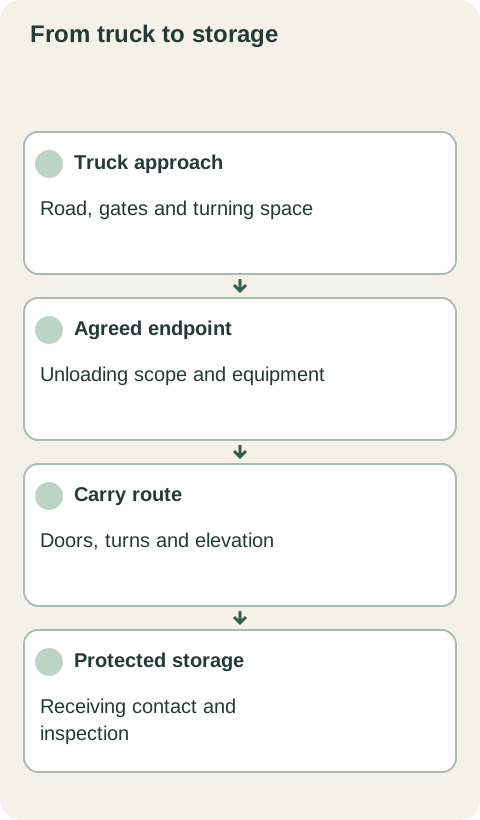
On a shared jobsite, knowing that cabinets were delivered is only the first step. The owner also needs to know where they were placed, who can arrange a move and who has taken them for installation. Set up a simple handoff record and a controlled storage arrangement with the project lead. This makes the goods easier to protect and locate while different crews work around them, without relying on a message that somebody saw the boxes yesterday.
Diagram Continue the record after delivery through storage moves and installer collection; this is not proof of who caused a later loss or mark.
Name the person managing the stored goods
Before delivery, identify the receiving contact and the person responsible for the cabinets after the carrier leaves. They may be different people. Tell the seller and project team which contact handles arrival questions and which one approves later moves within the site. Arrange a backup for absence rather than leaving any available worker to decide where the shipment should go.
KraftMaid recommends a secure staging location away from regular foot traffic. Use that principle when selecting the actual area with the site lead. A sign naming the storage zone does not by itself control who enters it; agree how access will be managed under the project's arrangements and who will keep that arrangement working as crews change.
Establish the receiving handoff as the starting record
Record the shipment reference, the products or packages received, their initial storage location and who accepted them. Keep condition observations linked to that arrival record. If the goods enter a temporary receiving area before moving elsewhere, record that additional handoff rather than treating the final storage room as if the carrier had delivered directly into it.
Give the storage contact access to the current inventory and any unresolved item notes. They need to distinguish goods awaiting inspection, items available for the next work stage and pieces being held for a supplier response. Do not assume the person controlling the room has read every email between buyer and seller or knows which similar-looking cabinet is involved in an open issue.
Record movements when other work needs the space
Ask crews to coordinate cabinet moves through the named site contact. For each move, identify the product or carton, previous location, new location, time and person handling the handoff. Use the existing cabinet references rather than creating unrelated names in different crew notes. A short shared record is more useful than detailed recollections reconstructed after an item cannot be found.
When work requires moving cabinets out of the way, confirm a suitable new location before the move happens and arrange appropriate handling. Update the storage index at the same time. Avoid allowing the changed physical location to remain known only to the person who moved the goods, especially if that crew will leave before the installer arrives.
Make collection for installation a distinct handoff
Have the installer and site contact identify which items are leaving storage for the agreed work. Note the destination and any associated parts taken with them. If something remains in storage, keep it on the list rather than marking the entire cabinet group gone. Return unused parts to an identified location and update the record instead of leaving them in a different crew's supply area.
Imagine a finishing crew moves cartons to clear its work area and leaves before the cabinet installer arrives. The original storage spot is empty, but the goods are in another room. Without a movement record, the team may start a missing-delivery inquiry or order duplicates. A named handoff and updated location allow the project to resolve the actual problem: the goods moved, and the next person was not told.
Investigate discrepancies without turning guesses into facts
If an item is unlocated, compare the receiving list, latest movement and installation handoff before deciding what happened. Ask the relevant contacts about the specific product reference. Record the last verified location and anything still unknown. A gap in the record does not establish theft, and discovering a mark after a move does not by itself identify who caused it.
Report observable product or packaging changes through the agreed project and supplier channels, keeping the timing and people who observed them clear. Review access and handoff arrangements if the same confusion repeats. The practical result should be a traceable path from receiving to storage to use, with actual observations supporting each update. It is a coordination tool, not a substitute for inspecting the goods or a guarantee against loss.
Pure White
Cream White
Light Warm Gray
Gray
Navy
Black
Oak Tone
Dark Walnut Tone
Design study These finish studies are design references, not a list of currently orderable colors. Screens and lighting change the appearance; compare a physical sample before choosing.See all finish options →
The sample shows the door frame, a separate center panel, the face frame and the cabinet box. Each component has its own place in this Shaker construction.
Shaker construction: door frame, center panel, face frame and cabinet box. The cutaway helps locate these parts; confirm each material in the specifications for the selected cabinet.
01 / Door frame
The Shaker door has rails and stiles around a separate center panel. The frame and center panel are different components; confirm their materials in the specifications for the selected cabinet.
02 / Face frame
The face frame surrounds the opening at the front of the cabinet box and sits behind the doors. The face frame, door frame and cabinet box are separate parts.
03 / Cabinet box
The sample exposes the cabinet sides, interior surfaces and layered edges. The image does not establish the wood species or material specification of a selected cabinet.