For a project with repeated dwelling units, define a complete standard cabinet package and assign each dwelling to the applicable package revision. Record the exceptions for that particular dwelling before calculating the combined purchase. A shared unit name is a useful organizing label, not proof that every installation condition and selected component is identical. The purchasing record should explain both what repeats and what changes, without asking the supplier to infer exceptions from scattered plans.
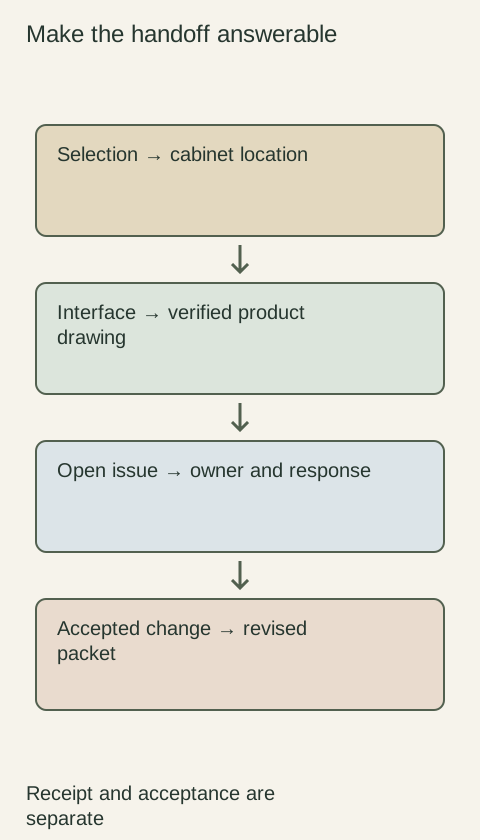
Diagram Keep the standard package and dwelling exceptions connected. This illustration does not verify any unit’s dimensions or quantities.
Define what the standard package actually contains
List the cabinets and finishing components included in a complete representative package, together with their product selections and relevant options. Identify the drawing and selection records supporting it. Do not call a collection standard while required items remain unpriced or unresolved. Those open choices will be multiplied along with the quantities if they are not kept visible.
Give the package a revision and a clear description of its application. If mirrored arrangements require different handed products or exposed-side treatment, distinguish them in the purchasing definition. Mirroring a drawing does not automatically change a product code or order option. Have the responsible team confirm whether the physical components actually remain the same or require a separate variant.
Assign actual dwellings rather than relying on a total count
Create an assignment list showing each dwelling identifier, selected package revision and current review status. Check that every dwelling in the intended purchasing scope appears and that none appears under competing packages unintentionally. The total number of units alone cannot reveal that a particular dwelling was omitted while another was counted twice.
Eagle Woodworking distinguishes review of submitted orders from the customer's project-specific measurement and fit decisions. The relevant lesson is that a supplier's order check does not verify that repeated dwellings have identical conditions. Have the project team confirm which locations fit the chosen package and identify differences that affect what must be purchased.
Attach each exception to the affected dwelling and standard item. State whether it adds something, removes something or replaces an item with a different selection. A replacement needs both the removal of the original and the addition of the new component in the resulting purchasing count. A note naming only the new product can accidentally leave both in the order.
Imagine a dwelling requires a different finished end panel while the rest of its cabinet package stays unchanged. Record the panel being removed and its replacement, with the applicable finish and location. Do not create a vague note saying special unit and expect receiving staff to know the distinction later. The exception should be understandable without reconstructing the original design discussion.
Expand the package before aggregating the purchase
Prepare the resulting component list for each assigned dwelling, incorporating its accepted exceptions. Then aggregate identical ordered products for pricing or procurement while retaining the destination links. Check the combined result back against the assignment list. This reveals whether the exception was applied to the correct dwelling and whether its corresponding standard component was removed when necessary.
Keep finish or hardware variants separate where they represent different products, even if the cabinet dimensions match. Do not group unresolved choices into the most common selection merely to make a clean total. Mark the affected dwelling as pending and explain what confirmation is needed. An honest incomplete count is easier to correct than a complete-looking order built on an unstated default.
Control standard revisions without erasing accepted differences
When the standard package changes, identify which dwellings should receive the new revision and which retain an earlier accepted selection. Recheck their exceptions against the revised baseline; a previous replacement may no longer apply or may now duplicate a standard item. Avoid updating every assignment automatically just because the master package file has changed.
Before issuing the purchase, provide the supplier with the aggregate list and a usable breakdown of dwelling assignments and exceptions. Ask how those distinctions will be represented in its order records and packing information. Retain the accepted assignment list for receiving and installation. Standardization reduces repeated definition work only when the actual differences remain explicit and the final quantities can still be traced to the dwellings they serve.
Pure White
Cream White
Light Warm Gray
Gray
Navy
Black
Oak Tone
Dark Walnut Tone
Design study These finish studies are design references, not a list of currently orderable colors. Screens and lighting change the appearance; compare a physical sample before choosing.See all finish options →
Translate the design into identifiable products, details and responsibilities. A useful handoff lets another professional price and build the intended arrangement without reconstructing private conversations.
The sample shows the door frame, a separate center panel, the face frame and the cabinet box. Each component has its own place in this Shaker construction.
Shaker construction: door frame, center panel, face frame and cabinet box. The cutaway helps locate these parts; confirm each material in the specifications for the selected cabinet.
01 / Door frame
The Shaker door has rails and stiles around a separate center panel. The frame and center panel are different components; confirm their materials in the specifications for the selected cabinet.
02 / Face frame
The face frame surrounds the opening at the front of the cabinet box and sits behind the doors. The face frame, door frame and cabinet box are separate parts.
03 / Cabinet box
The sample exposes the cabinet sides, interior surfaces and layered edges. The image does not establish the wood species or material specification of a selected cabinet.