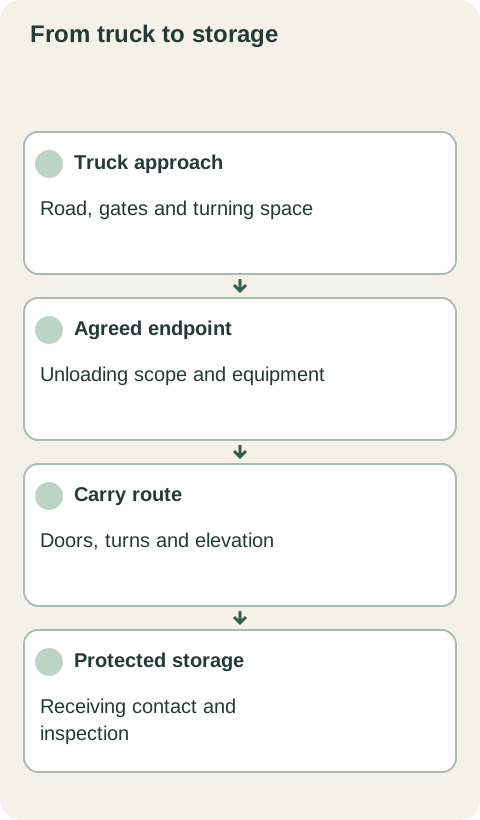
Liftgate service addresses the movement between the truck and the ground; the route from that point to the receiving area still needs its own plan. Confirm the packaged load, equipment and actual path with the delivery provider. A pallet jack on the truck does not establish that the loaded pallet can travel across every surface or through every entrance. Treat the ground movement as a specific task with an agreed endpoint.
Diagram Evaluate the path after the liftgate lowers the load. This diagram does not establish equipment capacity or approve a moving method.
Separate lowering the load from moving it onward
FedEx Freight defines a liftgate as a platform that raises and lowers freight between the trailer and the ground. That explains its function, not the suitability of a particular cabinet load or the distance a delivery crew will move it afterward. Confirm what the booked service includes after the platform reaches ground level.
Identify where the vehicle can position and where the load is intended to be placed. If the receiving area is elsewhere, show the intervening route rather than simply requesting liftgate service. Ask who performs that movement and what equipment will be used. A lowering device and a complete plan to place the cabinets are different pieces of the delivery arrangement.
Give the provider the packaged-load information
Supply the shipment's actual pallet dimensions and weight where available, including packaging, rather than only the dimensions of a cabinet inside. Identify long, tall or irregular packages and any loose items traveling separately. Ask the provider to confirm suitability for its vehicle, platform and handling equipment; do not infer compatibility from a generic maximum-weight description alone.
Keep the load configuration tied to the plan. If the supplier changes packaging or combines items onto a different pallet, ask whether the receiving arrangement still works. A quoted equipment service cannot evaluate information it never received. Record unknown load details for follow-up rather than replacing them with a guess based on the size of the finished room.
Show the entire ground route, including transitions
Describe pavement, gravel, soft ground, slopes, thresholds, turns and available clear space along the proposed path. Photographs should show the route in context and the transitions between surfaces. Include the loaded pallet's required passage, not only the clearance for a person walking through the entrance. Ask the provider which conditions require a different arrangement.
Crown's hand pallet truck instructions, for example, advise avoiding grades and ramps and identify other route-related limits. This reinforces the need to check the actual equipment's instructions and the operator's assessment. It is not a universal slope allowance or a method for moving cabinet freight over a difficult surface.
Resolve a broken connection before the truck arrives
Imagine the truck can unload on a paved area, while the path to the intended garage crosses gravel and ends at a raised threshold. The liftgate may address the truck-to-ground step without resolving that route. Describe the conditions in advance and agree on suitable delivery equipment, a different supported service or another receiving point that your project can actually use.
Do not assume a borrowed pallet jack or improvised boards will complete the missing connection. Likewise, changing to loose-carton handling requires a plan for the packages, people and protection involved; it is not an automatic fallback for an unsuitable pallet route. Have the responsible provider assess the approach before the receiving team depends on it.
Keep the confirmed route available on delivery day
Share the agreed unloading point, route and endpoint with the receiving person. Recheck that temporary materials, parked vehicles or ongoing work have not blocked the planned movement. If conditions have changed, tell the delivery organizer and obtain an updated arrangement. An earlier photo of a clear path does not establish that the same path remains usable when the load arrives.
Keep the receiving area ready for the package form being delivered, and identify who takes over after the carrier's agreed work ends. If the planned movement cannot be completed, pause that movement and resolve the mismatch with the provider rather than pressuring someone to improvise. A successful liftgate booking is only part of a successful cabinet handoff; load information and a workable ground route complete the plan.
Pure White
Cream White
Light Warm Gray
Gray
Navy
Black
Oak Tone
Dark Walnut Tone
Design study These finish studies are design references, not a list of currently orderable colors. Screens and lighting change the appearance; compare a physical sample before choosing.See all finish options →
The sample shows the door frame, a separate center panel, the face frame and the cabinet box. Each component has its own place in this Shaker construction.
Shaker construction: door frame, center panel, face frame and cabinet box. The cutaway helps locate these parts; confirm each material in the specifications for the selected cabinet.
01 / Door frame
The Shaker door has rails and stiles around a separate center panel. The frame and center panel are different components; confirm their materials in the specifications for the selected cabinet.
02 / Face frame
The face frame surrounds the opening at the front of the cabinet box and sits behind the doors. The face frame, door frame and cabinet box are separate parts.
03 / Cabinet box
The sample exposes the cabinet sides, interior surfaces and layered edges. The image does not establish the wood species or material specification of a selected cabinet.