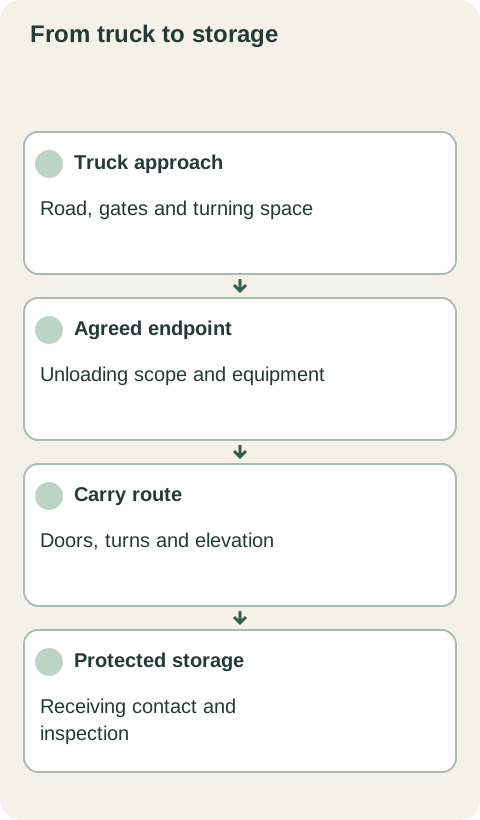
An accepted residential shipping address does not settle whether the assigned delivery vehicle can reach the intended receiving point. Share the actual approach, entrance and stopping conditions with the delivery organizer before the route is finalized. A street address can identify the property accurately while still sending a truck toward an entrance that cannot serve the shipment. The useful question is where that vehicle can arrive and stop for the agreed handoff.
Diagram Match the vehicle approach to the actual entrance and stopping point; the diagram does not confirm a particular vehicle can enter.
Follow the approach beyond the map pin
Trace the route from the street to the intended vehicle stopping area. Identify narrow bends, private lanes, gates, overhead obstructions and changes introduced by nearby construction. A map pin may point to the front door even when deliveries must approach from another side. Label the receiving entrance clearly enough that someone unfamiliar with the property can distinguish it from the mailing entrance.
Estes identifies access obstacles, including low branches and overhead wires, as factors that can change residential delivery placement. That is a reason to disclose observed conditions, not to apply another carrier's published service details to your order. Have the assigned provider assess its own vehicle and planned approach.
Report conditions without declaring the route suitable
Provide current photographs showing the entrance, approach turns and proposed stopping area in context. When measurements are requested, label their location and units and explain what was actually measured. A gate opening and a clear travel path are different observations. Keep unknown overhead clearance or pavement suitability marked for assessment rather than guessing from a passenger car's experience.
Tell the provider about seasonal or temporary conditions that the photos may not reveal, such as a lane partly occupied by construction materials. The receiving person's job is to communicate the condition accurately. Vehicle maneuvering, load access and equipment suitability need the responsible provider's evaluation; an owner saying a truck has visited before is not a substitute for that assessment.
Resolve gates and arrival contacts before dispatch
Confirm how the driver reaches the proper entrance and who can make that entrance available during the agreed arrival period. Share access instructions through the delivery provider's appropriate channel, with a reachable contact for questions. Avoid putting private access details on documents that will circulate broadly through the project simply because everyone needs the cabinet packing list.
If a staffed gate or managed community controls entry, obtain its current delivery procedure and send the relevant instructions to the organizer. Check whether the access period is compatible with the booked arrival arrangement. A receiving person waiting inside the house does not help a driver who cannot identify or enter the approved gate, and a gate reservation does not itself confirm carrier scheduling.
Correct the entrance before it becomes a delivery-day problem
Imagine the order lists the home's front address, but a narrow bend blocks the approach to the intended receiving area. A different entrance reaches that area from the rear. Sending an unconfirmed note saying “use back gate” leaves unanswered where the entrance is, whether the vehicle can use it and who opens it.
Provide the alternate approach in advance and request confirmation that it has been reviewed for the assigned delivery. If it cannot be used, agree on another supported handoff arrangement that the project can actually receive. Do not assume a neighbor's driveway or an unplanned public stopping point is available just because it appears convenient on a map. The alternative needs its own confirmed access and receiving plan.
Recheck the approach when conditions change
Before delivery, verify that the expected entrance and stopping area remain available. Report a newly closed lane, changed gate arrangement or obstruction through the delivery organizer, with an updated description. Keep the receiver informed of the accepted route rather than letting different people send conflicting last-minute directions to the driver.
If the vehicle arrives and the approved approach is unusable, stop treating the original placement as settled. Contact the provider to resolve a suitable next step without moving wires, altering obstacles or directing vehicle maneuvers yourself. Clear access information is valuable because it supports an assessed plan; it cannot make an unsuitable approach suitable by wording alone.
Pure White
Cream White
Light Warm Gray
Gray
Navy
Black
Oak Tone
Dark Walnut Tone
Design study These finish studies are design references, not a list of currently orderable colors. Screens and lighting change the appearance; compare a physical sample before choosing.See all finish options →
The sample shows the door frame, a separate center panel, the face frame and the cabinet box. Each component has its own place in this Shaker construction.
Shaker construction: door frame, center panel, face frame and cabinet box. The cutaway helps locate these parts; confirm each material in the specifications for the selected cabinet.
01 / Door frame
The Shaker door has rails and stiles around a separate center panel. The frame and center panel are different components; confirm their materials in the specifications for the selected cabinet.
02 / Face frame
The face frame surrounds the opening at the front of the cabinet box and sits behind the doors. The face frame, door frame and cabinet box are separate parts.
03 / Cabinet box
The sample exposes the cabinet sides, interior surfaces and layered edges. The image does not establish the wood species or material specification of a selected cabinet.