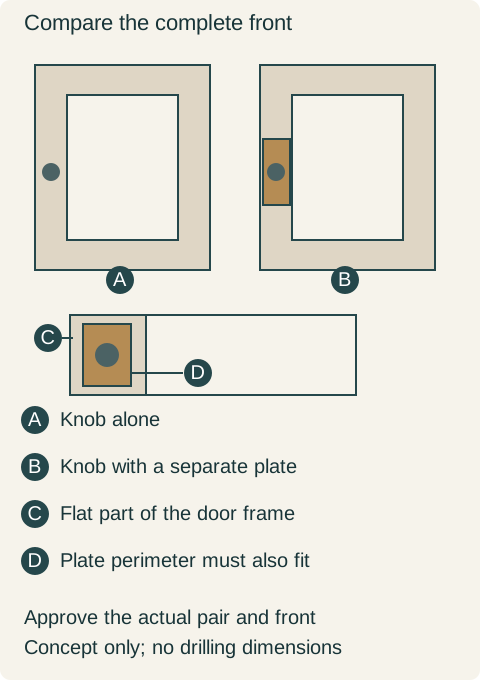
Cabinet hardware backplates: compare the complete front before adding another outline
A backplate changes the shape seen behind a knob or pull. Compare that combined shape with the door frame, then confirm that the actual hardware pair fits together.
A knob can look quiet on its own and much more prominent over a decorative backplate. That extra outline may be exactly what a plain cabinet front needs, or it may crowd an already detailed door. Decide with the complete front in view. A backplate is a separate design choice, not a required companion to every knob, and choosing one does not automatically establish that the knob shown beside it will fit.
What the plate contributes to the cabinet
Look at the knob alone first. Its base meets the front, while the graspable shape stands away from it. Adding a plate introduces another visible perimeter between that base and the cabinet. A broad plate can make a small knob read as a larger composition without changing the part held by the hand. A cutout plate can add another kind of outline. Compare these effects deliberately instead of calling every plate a way to make hardware more substantial.
The door already has its own lines. A slab front gives the plate a relatively uninterrupted background. On a framed door, the plate also relates to the stile, rail and inner profile. When the plate reaches across a change in level, appearance is no longer the only question: the proposed assembly needs a suitable mounting surface. A drawing of a plate centered over a door frame does not prove it can sit properly there.
Stand back far enough to see several doors together. Repeated plates may make a strong pattern that was not apparent while holding a single sample. That pattern can work well on a selected hutch or island, but it need not continue onto every small front elsewhere. Decide where the additional outline belongs before making a complete quantity list.
A compatible color is not a compatible assembly
Emtek sells its Modern Cabinet Knob Backplate separately and identifies size, finish and fit incompatibilities with particular knobs. The product illustrates why a same-brand or same-color pairing still needs a specific compatibility check.
Read the plate and knob as separate items in the proposal. Identify their models and finish codes, then ask the supplier to confirm the intended combination. A plate can look wide enough in a photograph while the knob base is unsuitable for its opening or shape. Equally, a finish that appears coordinated does not settle how the pieces meet. Do not file, reshape or force parts to make an unapproved combination work; choose a documented compatible assembly or another design.
For a pull, the mounting-center relationship adds another check, but it is not the only one. The overall plate footprint must also suit the front and the pull bases. View the manufacturer's drawing with the actual door or drawer design. A pull-sized plate and a knob-sized plate may belong to the same collection without being interchangeable parts.
Teaching example Conceptual elevations comparing a knob alone and a knob with a decorative plate on the same framed front. The lower detail distinguishes plate perimeter from available flat mounting area. No manufacturer geometry, fit approval or drilling dimensions are shown.
Compare at the real mounting location
Hold or temporarily display the permitted sample combination at the intended position without marking a new front. Include the finished door profile and adjacent hardware. Look at the visible border around the knob, how the plate relates to the door edge, and whether the shape looks balanced when the door is open. The useful reference is the combined hardware at that location, not a close-up cropped so tightly that the cabinet disappears.
Then try the opening action using an approved display or sample arrangement. Keep the hand clearance and neighboring surfaces in view. A plate changes what is next to the hand even when the knob itself is unchanged. Do not assume that a more decorative composition improves grip. The chosen hardware should still let the intended user open the actual front comfortably, with the fastening arrangement confirmed for the completed assembly.
The hutch keeps the plate; the kitchen doors do not
Consider a hypothetical kitchen with plain inset doors and a separate glazed hutch. The owners like a square backplate under the selected knob. On the hutch, the repeated square helps connect the hardware to the cabinet's restrained framed pattern. On the narrower kitchen-door stiles, the same combination looks crowded, although the knob alone feels comfortable and looks balanced. Their comparison is made with representative finished fronts, not an assumption that every door has the same available flat area.
The owners choose approved knob-and-plate pairs for the hutch and the knob alone for the kitchen doors. They keep the agreed pulls on drawers. The supplier checks both knob configurations and the installer reviews the fastening needed at each front. The finished hardware list records complete pairs where plates are used, rather than treating the photograph of a pair as proof that both pieces are included in one package.
This decision does not solve damage or disguise old holes; these are new fronts. It selects where a decorative outline contributes to the room. Another household could reasonably use the plate throughout a simpler run. What matters is that the repeated pattern, the flat mounting area and the actual compatible components have all been considered together.
Order the combination that was approved
Before placing the order, compare the list against the elevation. A line for a knob and a line for its plate should correspond to the same intended location and quantity. Check what the supplier includes with each item rather than assuming all fasteners or companion parts arrive together. Keep plate-free positions explicit so installation does not acquire an extra decorative layer merely because spare plates were delivered.
Use the same complete comparison if a substitute is offered. A similar outer rectangle can have a different opening, base relationship or finish, so the old approval should not automatically transfer. Retain the accepted pair's identity and a photograph showing it on the actual front. That gives the installer a clear appearance reference while preserving the product details needed to assemble it correctly.
Backplates can also be considered when replacing hardware, but covering an old mark is a separate problem. Existing holes, finish damage and the underlying front still need assessment. For a new cabinet purchase, the stronger reason to choose a plate is simple: the complete combination looks and works better in its assigned place than the knob or pull alone.
Pure White
Cream White
Light Warm Gray
Gray
Navy
Black
Oak Tone
Dark Walnut Tone
Design study These finish studies are design references, not a list of currently orderable colors. Screens and lighting change the appearance; compare a physical sample before choosing.See all finish options →
Choose the complete pattern of hardware, not a favorite handle in isolation. Start with the busiest cabinet run, then resolve upper doors, drawers and appliance panels.
Choose antiqued mirror for the reflected scene and concealed storage you want. Compare the full door group, its patterned surface and the view when it opens before replacing transparent glass.
The sample shows the door frame, a separate center panel, the face frame and the cabinet box. Each component has its own place in this Shaker construction.
Shaker construction: door frame, center panel, face frame and cabinet box. The cutaway helps locate these parts; confirm each material in the specifications for the selected cabinet.
01 / Door frame
The Shaker door has rails and stiles around a separate center panel. The frame and center panel are different components; confirm their materials in the specifications for the selected cabinet.
02 / Face frame
The face frame surrounds the opening at the front of the cabinet box and sits behind the doors. The face frame, door frame and cabinet box are separate parts.
03 / Cabinet box
The sample exposes the cabinet sides, interior surfaces and layered edges. The image does not establish the wood species or material specification of a selected cabinet.