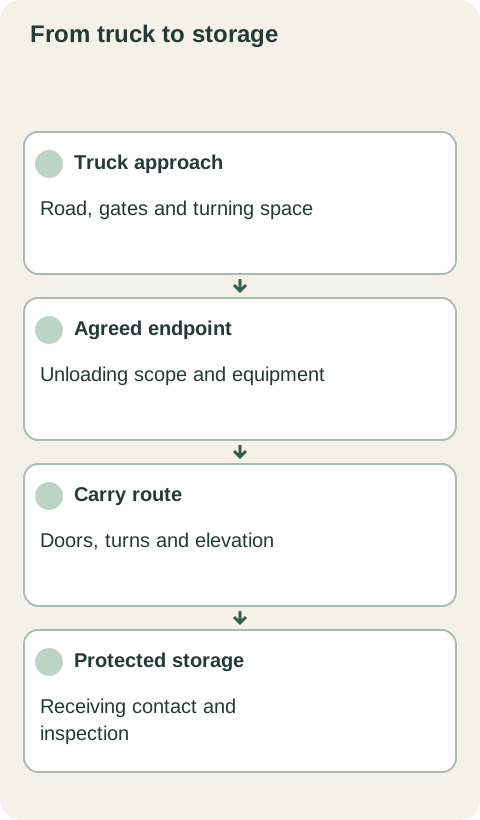
Freight-terminal pickup can be workable when the carrier and supplier support it and you have a suitable plan to collect, transport and unload the cabinets. Confirm the arrangement before choosing it as an alternative to delivery. A terminal address and a tracking update are not enough. You need the correct facility, confirmation that the actual shipment can be collected, and a complete plan for what happens after it leaves the carrier's yard.
Diagram Terminal collection moves the handoff location; transport and unloading after collection still need a confirmed arrangement.
Arrange collection as a specific shipment instruction
Ask the supplier and carrier whether terminal collection is available for this order and how the request must be confirmed. Identify the serving facility rather than selecting whichever carrier building is nearest on a map. Keep the accepted collection instructions attached to the shipment so it is not still being prepared for a different delivery arrangement.
ArcBest's support documentation illustrates the distinction by including a separate destination choice for customer pickup at the serving service center. That example supports explicitly arranging the mode; it does not establish availability, pricing or the current booking process for another shipment. Get the actual collection instructions from the parties handling your cabinets.
Wait for collection readiness, not merely a terminal scan
Confirm which shipment reference to use and what notice establishes that the freight is ready for customer collection. Ask the facility about its collection hours, appointment process and any outstanding steps before release. General facility operating hours may describe freight operations without telling you when a customer vehicle can be received.
Estes explains that its “at break terminal” tracking status refers to an intermediate transfer before the delivering terminal. This is a useful reminder that a terminal event can describe progress through the network rather than collection readiness. Do not drive toward a location solely because a tracking entry says the freight is there.
Confirm the person, vehicle and loading arrangement
Give the facility the proposed collecting person's details through its requested process and ask what identification and shipment records to bring. If a contractor or mover collects for you, confirm that arrangement in advance. They need the correct reference and instructions, not just a screenshot of the original cabinet purchase confirmation.
Obtain the actual loaded-pallet or package dimensions, weights and count for the collection plan. Ask what loading assistance the facility can provide for the proposed vehicle and packaging configuration. Do not assume terminal equipment can load every rental vehicle, or that staff will dismantle pallets to fit smaller spaces. An unsuitable collection vehicle leaves the final transport problem unresolved even when the freight is ready.
Compare the complete trip with delivery
Imagine a buyer selects terminal pickup to avoid a difficult residential approach. A vehicle is reserved before package details arrive, and the final shipment includes long cartons that do not fit the proposed loading plan. The address problem has been exchanged for a collection problem. Resolve the package and vehicle match before committing to that trip.
Include vehicle rental or mover service, travel, loading arrangements, protection and unloading at the destination in the comparison. Ask whether the changed delivery mode affects the supplier's quote or creates any terminal-related charges, and obtain the applicable response without assuming pickup is automatically cheaper. A staffed loading facility at the start does not provide equipment or people at home when the load arrives there.
Record the collection and preserve a workable alternative
At the agreed handoff, reconcile the shipment references and visible package count with the collection documents, and record observable condition through the facility's process. Keep the receipt and relevant photographs with the order. If something differs, contact the supplier or carrier before changing the handling plan or leaving with an unclear record of what was received.
If the shipment is not ready, the vehicle is unsuitable or the loading arrangement cannot be supported, ask the organizer for the next workable option. Confirm how a revised collection or delivery will be recorded, including any applicable timing or charge implications. Terminal pickup is a change in the delivery chain, so its value depends on completing the final segment as carefully as the carrier completed the earlier one.
Pure White
Cream White
Light Warm Gray
Gray
Navy
Black
Oak Tone
Dark Walnut Tone
Design study These finish studies are design references, not a list of currently orderable colors. Screens and lighting change the appearance; compare a physical sample before choosing.See all finish options →
The sample shows the door frame, a separate center panel, the face frame and the cabinet box. Each component has its own place in this Shaker construction.
Shaker construction: door frame, center panel, face frame and cabinet box. The cutaway helps locate these parts; confirm each material in the specifications for the selected cabinet.
01 / Door frame
The Shaker door has rails and stiles around a separate center panel. The frame and center panel are different components; confirm their materials in the specifications for the selected cabinet.
02 / Face frame
The face frame surrounds the opening at the front of the cabinet box and sits behind the doors. The face frame, door frame and cabinet box are separate parts.
03 / Cabinet box
The sample exposes the cabinet sides, interior surfaces and layered edges. The image does not establish the wood species or material specification of a selected cabinet.