A customer-pickup plan should establish that the actual packages can enter the vehicle, travel within its applicable limits and be unloaded at the destination. A large-looking cargo area does not answer all those questions. Obtain the package list before selecting the vehicle and review the proposed arrangement with the supplier and, where needed, a qualified transport provider. Self-collection works when the complete load has a supported route home.
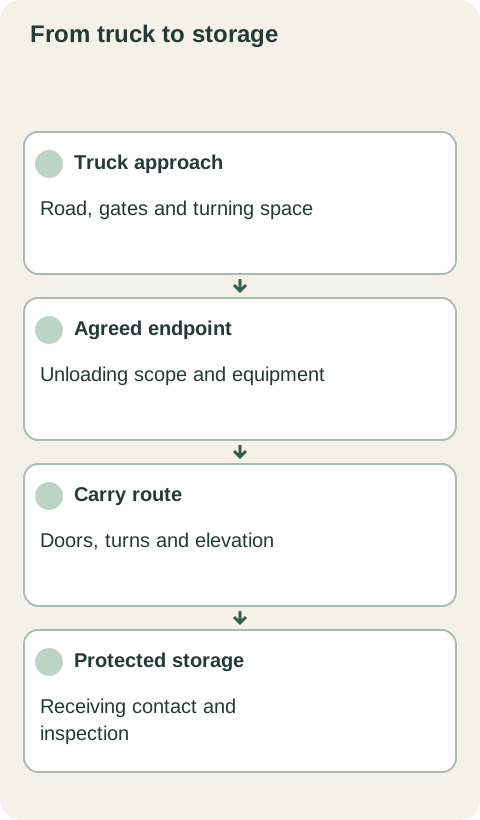
Diagram For customer pickup, verify the actual vehicle and load separately. This diagram provides no vehicle capacity or loading approval.
Build the vehicle decision from the package list
Ask for package dimensions, packaged weights and carton count for the order being collected. Include trim, panels, hardware cartons and any pallets or crates that will remain with the load. Confirm whether a product line on the order corresponds to a single package or several pieces. The product photograph does not show the transport shape or the space occupied by protection.
IKEA's US pickup guidance reminds customers to use an appropriately sized vehicle for their purchase. For cabinets, translate that reminder into a check of your exact packages and vehicle, rather than a general assumption that a van or pickup truck will do. Vehicle class names conceal different openings, interiors and configurations.
Do not substitute the seller's overall order weight for every detail. Total weight helps evaluate load limits, but individual dimensions and weights also affect entry, handling and unloading. A long trim package can create a fit problem even in an order whose total weight seems modest.
Check cargo access and load allowance separately
Compare the actual loading opening, internal obstructions and usable cargo area with the packaged items. Account for the intended passenger arrangement and equipment already in the vehicle. A box that would fit in an empty interior may not pass through its door, and an arrangement based on removed seats is not the same as the vehicle arriving with those seats occupied.
Ford's owner guidance defines payload as the combined weight of cargo and passengers and directs owners to vehicle-specific load information. Review the applicable manual and labels for the actual vehicle rather than taking a model advertisement's maximum figure as your available allowance. No cabinet order can be approved from cargo volume alone.
Keep transport protection and load restraint in the planning discussion. Ask a qualified provider to assess the proposed arrangement when it is outside your experience. Do not treat an open tailgate, improvised roof placement or a change in package orientation as an automatic answer to a fit problem. A vehicle that can accept an object still needs a supported way to transport it.
Arrange handling at collection and at home
Confirm what loading assistance the pickup location provides and whether it matches the vehicle and package form. If the order is palletized, ask whether it must be collected as a pallet or whether another supplier-supported arrangement exists. Do not arrive expecting staff to disassemble a cabinet or remove protective packing merely because the chosen vehicle is too small.
Plan the destination handoff before departure as well. Identify the receiving area and the people or equipment arranged to unload the actual packages. Store loading assistance does not travel home with you. A successful collection can still leave a cabinet stranded in a vehicle if the receiving plan was based on small loose boxes but assembled units arrive.
Imagine a buyer reserves a spacious van but also plans to carry helpers and a vehicle full of tools. The package plan was checked against an empty van. Reconcile the real passenger, equipment and cabinet load before collection, and change the vehicle or transport arrangement if needed. The question is not whether the model can carry cabinets in general, but whether this trip is properly planned.
Reconcile the collected load before leaving
Use the package list to confirm what is being handed over and note differences in count, packaging form or observable condition. If the actual load differs from the information used to select the vehicle, stop and reassess with the supplier before loading proceeds. Do not solve the mismatch by discarding protection or excluding an item without a clear record of what remains to collect.
If collection needs separate trips, confirm that the seller supports partial collection and document the items taken and remaining. Otherwise, arrange a suitable vehicle or delivery service. Preserve the collection record with the order so the later receiving check can follow the same package identities. A complete pickup plan makes the load, vehicle and destination work together before the journey starts.
Pure White
Cream White
Light Warm Gray
Gray
Navy
Black
Oak Tone
Dark Walnut Tone
Design study These finish studies are design references, not a list of currently orderable colors. Screens and lighting change the appearance; compare a physical sample before choosing.See all finish options →
The sample shows the door frame, a separate center panel, the face frame and the cabinet box. Each component has its own place in this Shaker construction.
Shaker construction: door frame, center panel, face frame and cabinet box. The cutaway helps locate these parts; confirm each material in the specifications for the selected cabinet.
01 / Door frame
The Shaker door has rails and stiles around a separate center panel. The frame and center panel are different components; confirm their materials in the specifications for the selected cabinet.
02 / Face frame
The face frame surrounds the opening at the front of the cabinet box and sits behind the doors. The face frame, door frame and cabinet box are separate parts.
03 / Cabinet box
The sample exposes the cabinet sides, interior surfaces and layered edges. The image does not establish the wood species or material specification of a selected cabinet.