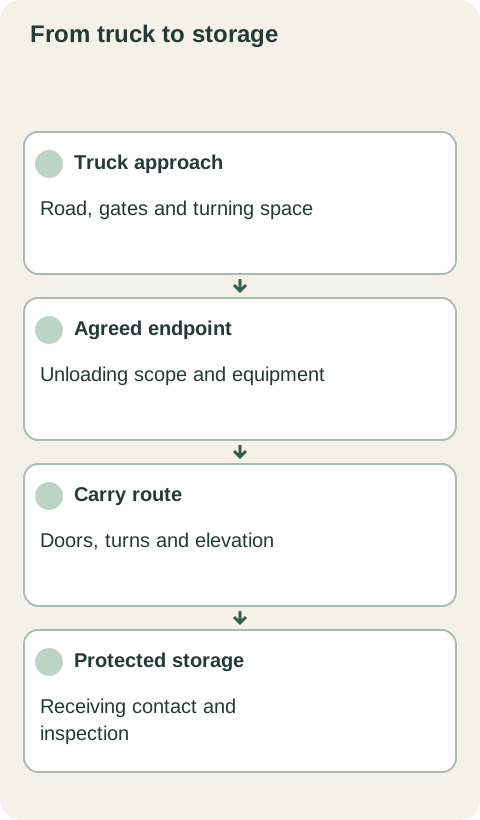
When cabinet freight is going to a business without a usable loading dock, tell the delivery organizer before dispatch and confirm a supported unloading arrangement. A commercial address does not describe the equipment or people available there. An office, showroom or renovation site may receive small packages every day while having no way to handle an arriving pallet. Book against the location's actual receiving capability rather than its business label.
Diagram Document the actual business receiving capability; a commercial address alone does not confirm a usable dock or unloading equipment.
Describe the receiving point, not just the company
Identify the tenant, entrance and person who will receive the shipment. State plainly whether that location has a loading dock, ground-level receiving area or another arrangement. In a shared building, a dock elsewhere on the property is not necessarily available to your business or suitable for your appointment. Confirm access with the party who manages it before listing it as a receiving resource.
FedEx Freight instructs shippers to establish dock availability at both ends and identifies liftgate requests when a dock is absent. The useful purchasing lesson is to disclose the missing capability before assigning equipment. Ask your actual provider which arrangement it supports for the shipment; do not assume a generic commercial booking already includes it.
Test equipment availability against the delivery itself
If the site proposes using its own unloading equipment, identify who will assess the loaded pallets and handle the work. Confirm that the equipment and responsible operator will actually be available during receipt. A forklift belonging to another tenant or normally kept at a different branch is not a dependable plan without a specific arrangement to use it for this delivery.
Give the provider packaged dimensions, weights and configuration where available. Keep the plan tied to those details and the equipment assessment. A statement that the business “has a warehouse” is too broad to resolve a shipment arriving at the office entrance, and a ground-level roll-up door does not itself bridge the difference between the truck and the receiving surface.
Coordinate receiving hours and the shared work area
Ask the business to name the receiving contact and the times when that person and the planned resources are available. Office opening hours may differ from receiving hours or equipment availability. Tell the organizer about breaks, access controls or other booked deliveries that affect the agreed handoff, without assuming the driver can wait until the resource becomes free.
Set aside the agreed receiving area so that customer traffic, stored materials and other deliveries do not occupy it when the cabinets arrive. Identify how the project takes over after the carrier's work ends. The business should know whether it is accepting the freight for immediate onward movement or keeping the packages until the project team collects them.
Compare a nominal dock with a confirmed alternative
Imagine a showroom uses the rear dock shared by neighboring businesses. The order lists “dock available,” but the building manager has not reserved access and the showroom's staff cannot operate the unloading equipment. That entry describes a feature on the property, not a confirmed receiving arrangement. Correct it before the truck is scheduled around it.
The options might include an accepted ground-level unloading service, a properly coordinated use of the shared receiving resources or another agreed receiving site. Compare the complete handoff and any quoted service changes, not just the address that appears easiest to enter on the order. Avoid directing a truck to another business on arrival without the supplier, carrier and receiving contact knowing the revised destination.
Send the final capability statement to the delivery organizer
Summarize the confirmed entrance, dock status, unloading arrangement, receiving contact and availability in the delivery instructions. Ask the organizer to confirm that those conditions match the booked service. Keep the receiver's copy current if a resource or arrival arrangement changes, and remove an old “dock available” note rather than leaving conflicting instructions attached to the shipment.
On delivery day, check that the promised site resources are present. If they are not, report the mismatch before the affected unloading begins and resolve it with the organizer. Business classification is useful address information, but the confirmed resources at the receiving point are what turn a cabinet freight booking into a workable handoff.
Pure White
Cream White
Light Warm Gray
Gray
Navy
Black
Oak Tone
Dark Walnut Tone
Design study These finish studies are design references, not a list of currently orderable colors. Screens and lighting change the appearance; compare a physical sample before choosing.See all finish options →
The sample shows the door frame, a separate center panel, the face frame and the cabinet box. Each component has its own place in this Shaker construction.
Shaker construction: door frame, center panel, face frame and cabinet box. The cutaway helps locate these parts; confirm each material in the specifications for the selected cabinet.
01 / Door frame
The Shaker door has rails and stiles around a separate center panel. The frame and center panel are different components; confirm their materials in the specifications for the selected cabinet.
02 / Face frame
The face frame surrounds the opening at the front of the cabinet box and sits behind the doors. The face frame, door frame and cabinet box are separate parts.
03 / Cabinet box
The sample exposes the cabinet sides, interior surfaces and layered edges. The image does not establish the wood species or material specification of a selected cabinet.