Before buying a cabinet sample, establish whether you are purchasing it, borrowing it or paying a refundable deposit. Then ask separately about any credit toward a cabinet order. These arrangements can produce the same small package at your door but leave you with different responsibilities and different amounts actually recoverable. A sample is useful even without a credit, provided its purpose and cost are clear.
Physical sample An appearance sample can support a finish decision. This image establishes no sample price, loan, return or credit offer.
Start with what you will receive
A finish chip, a small door and a full display door answer different questions. Confirm the product description, material or finish identification supplied by the seller, dimensions shown in the listing, and whether the sample represents the proposed door profile. A flat chip cannot show every shadow around a shaped frame or the full variation across stained wood.
Find out whether the sample is yours to keep. A showroom loan may need to come back in usable condition, while a purchased sample may have no return option. Do not infer either arrangement from the word sample. Photograph its identifying label when it arrives and keep the order record with it so the physical reference remains connected to the transaction.
Read the policy for this sales channel
Check the page or written terms attached to the actual seller and purchase channel. KraftMaid's direct online policy distinguishes those purchases from retail-store transactions and lists finish chips and door samples as nonreturnable. That is a manufacturer-specific example, not a policy for usaKT or another seller.
Ask what happens if the wrong sample arrives or it is damaged, separately from what happens if you simply dislike the color. An exclusion for preference returns does not answer how the seller handles a shipment error. Save the relevant written response rather than assuming the general cabinet return policy covers small appearance samples in the same way.
Describe a future credit precisely
If a credit is offered, ask who issues it, which later purchase qualifies and how it is applied. It may depend on buying a particular product through a particular seller. Establish whether the credit appears in the cabinet quote, reduces a later payment or requires a separate request after the order. Until confirmed, carry the sample purchase as an expense.
Also clarify which part of the sample transaction is eligible. Product cost, delivery and return postage are separate entries; an offer covering one does not automatically cover the others. Keep any stated deadline, proof requirements and qualifying conditions with the sample receipt. Do not subtract a possible credit from the cabinet budget and then subtract it again when the quote actually includes it.
Compare useful evidence rather than sample quantity
Imagine choosing between a borrowed profile door in the wrong color and a purchased flat chip in the intended finish. The door can help evaluate frame proportions; the chip can help compare the finish with nearby fixed materials. Neither alone answers both questions. Before paying for more samples, identify the unresolved choice and request the sample that can address it.
If a dealer permits a loan, arrange the return method before leaving the showroom. Protect the surface, avoid attaching sticky labels to the finish, and keep packaging if requested. Do not cut, drill or clean an unfamiliar sample with an unapproved product to investigate it. Ask whether a separate expendable piece is available for any destructive examination.
Close the sample transaction deliberately
After making the cabinet selection, identify the approved sample in the project record and ask whether it can remain available through delivery. If a loan must be returned sooner, agree on another identified physical reference. A photograph helps document which sample was used but does not reproduce its exact color under every light.
Retain proof of a return, refund or applied credit as applicable. Confirm that the final cabinet quote carries the correct selected finish and any promised adjustment. The useful outcome is a resolved appearance decision plus a closed financial record, not a drawer full of unlabelled samples or an assumed refund that nobody has agreed to process.
Pure White
Cream White
Light Warm Gray
Gray
Navy
Black
Oak Tone
Dark Walnut Tone
Design study These finish studies are design references, not a list of currently orderable colors. Screens and lighting change the appearance; compare a physical sample before choosing.See all finish options →
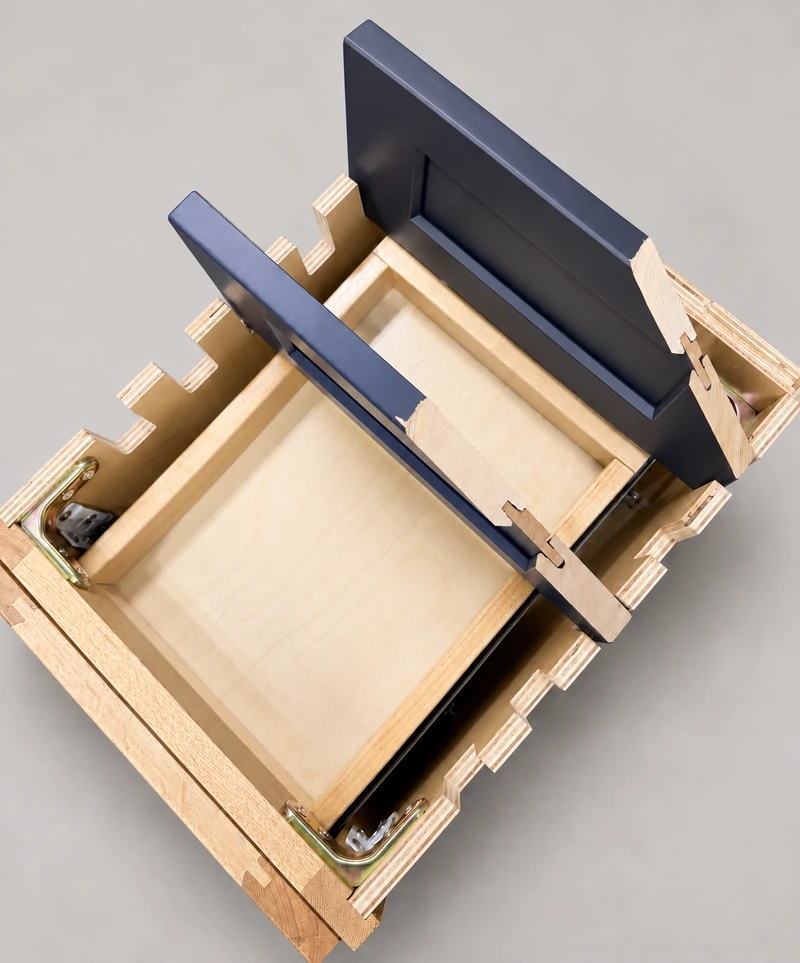
The sample shows the door frame, a separate center panel, the face frame and the cabinet box. Each component has its own place in this Shaker construction.
Shaker construction: door frame, center panel, face frame and cabinet box. The cutaway helps locate these parts; confirm each material in the specifications for the selected cabinet.
01 / Door frame
The Shaker door has rails and stiles around a separate center panel. The frame and center panel are different components; confirm their materials in the specifications for the selected cabinet.
02 / Face frame
The face frame surrounds the opening at the front of the cabinet box and sits behind the doors. The face frame, door frame and cabinet box are separate parts.
03 / Cabinet box
The sample exposes the cabinet sides, interior surfaces and layered edges. The image does not establish the wood species or material specification of a selected cabinet.