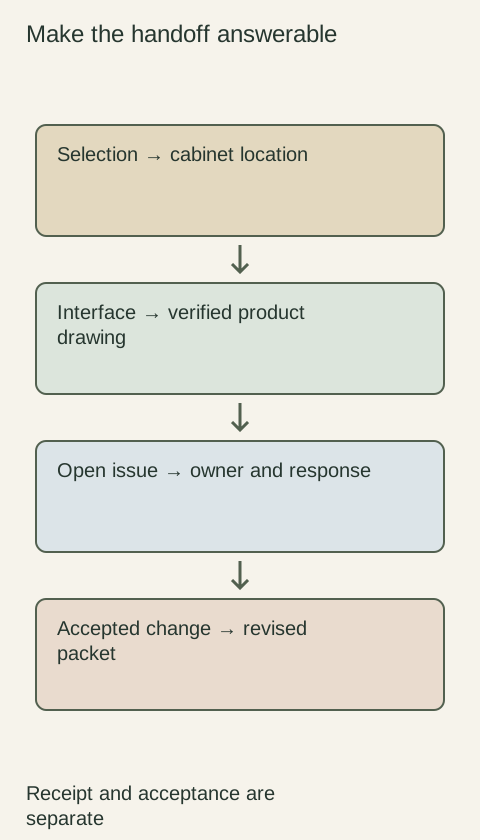
A ready-to-assemble cabinet price becomes comparable with an assembled option only after you account for the work needed to reach the same condition. Define that condition first: inspected, correctly assembled units with specified parts fitted and ready for the installer to receive. Then compare the product cost, assembly scope and handling arrangements. A generic time estimate per cabinet cannot describe every drawer, accessory or construction system.
Diagram Attach the actual product list and model instructions to the assembly scope. This diagram is not an assembly sequence or labor estimate.
Find out what arrives assembled
Ask for the contents and assembly state of the actual product. The cabinet box, drawer box, front and hardware may arrive in different states of completion. Do not infer the entire workload from a photograph of the finished cabinet. Request the relevant instructions before accepting an assembly quote so the person pricing the work can see the connections and components involved.
Conestoga's resource library lists different assembly resources for different cabinet forms, with mounting information listed separately. That is a useful reminder to obtain instructions for the selected unit rather than treating every cabinet as the same task. The library itself does not establish a labor allowance or show that your selected product uses that construction.
Draw the boundary between assembly and installation
An assembly scope should say whether it includes unpacking, checking parts, building the box, assembling drawers, fitting supplied hardware and attaching fronts. Ask what adjustment or inspection happens before handoff. Installation introduces different tasks, such as positioning and attaching cabinets at the site; these should not disappear merely because the cabinet arrives already built.
Clarify whether pulls, decorative panels or other separately ordered pieces are fitted during assembly or left for installation. Some decisions depend on the specific product and installer sequence. Avoid paying for the same step in both quotes, but also avoid deleting it from both. A short written handoff list is more useful than the broad promise that everything will be ready.
Price the mix of units and the workspace
Give the assembler the exact cabinet list, not only the total cabinet count. A unit with several moving components presents a different work scope from a simple empty box. Ask which items are included in the stated price and which require a separate estimate. If you plan to do the work yourself, read the instructions before deciding whether the required tools and handling are available.
Include a clean working area, protected staging space and movement of completed units in the plan. Identify who supplies consumables specified by the manufacturer and who removes packaging. There is no need to invent a wage for your own time, but record the work you are accepting and the point at which outside help would be needed.
Compare an actual handoff scenario
Imagine a buyer whose installer expects completed drawer boxes and fitted slides, while the assembly quote covers only cabinet carcasses. The lower assembly price leaves a real task unassigned. Resolve it by extending the assembly scope or getting the installer to quote that work explicitly. The issue is not whether flat-pack products are inherently better value; it is whether the comparison reaches the same usable condition.
Also ask what happens when unpacking reveals a missing or damaged component. Identify who documents it, contacts the seller and holds the affected unit aside. Do not improvise a substitute fastener or alter a joint to keep the schedule moving. Confirm how a return visit would be discussed if assembly cannot be completed with the supplied parts.
Accept assembled work with visible checks
At handoff, check product identification, completion of the agreed steps and any remaining open items. Ask the assembler to demonstrate fitted moving parts and describe adjustments left for installation. Keep the manufacturer instructions and unused identified parts with the project. Cosmetic and functional concerns are easier to trace when recorded before units move to their final locations.
Compare totals only after product, assembly, transport and installation boundaries are understood. A preassembled option can still require installation adjustments, while an economical assembly quote can be appropriate when its limited scope suits your team. Choose the arrangement your project can execute, and retain the scope and acceptance record instead of relying on a universal assembly-time claim.
Pure White
Cream White
Light Warm Gray
Gray
Navy
Black
Oak Tone
Dark Walnut Tone
Design study These finish studies are design references, not a list of currently orderable colors. Screens and lighting change the appearance; compare a physical sample before choosing.See all finish options →
The sample shows the door frame, a separate center panel, the face frame and the cabinet box. Each component has its own place in this Shaker construction.
Shaker construction: door frame, center panel, face frame and cabinet box. The cutaway helps locate these parts; confirm each material in the specifications for the selected cabinet.
01 / Door frame
The Shaker door has rails and stiles around a separate center panel. The frame and center panel are different components; confirm their materials in the specifications for the selected cabinet.
02 / Face frame
The face frame surrounds the opening at the front of the cabinet box and sits behind the doors. The face frame, door frame and cabinet box are separate parts.
03 / Cabinet box
The sample exposes the cabinet sides, interior surfaces and layered edges. The image does not establish the wood species or material specification of a selected cabinet.