When cabinet delivery becomes uncertain, review the demolition start before the crew removes a usable installation. Ask the contractor what must be physically available and checked before that work should proceed, and what disruption follows if the remaining delivery moves again. The aim is to make an informed project decision while you still have options. A date on the original calendar should not silently become permission to start after the assumptions behind it have changed.
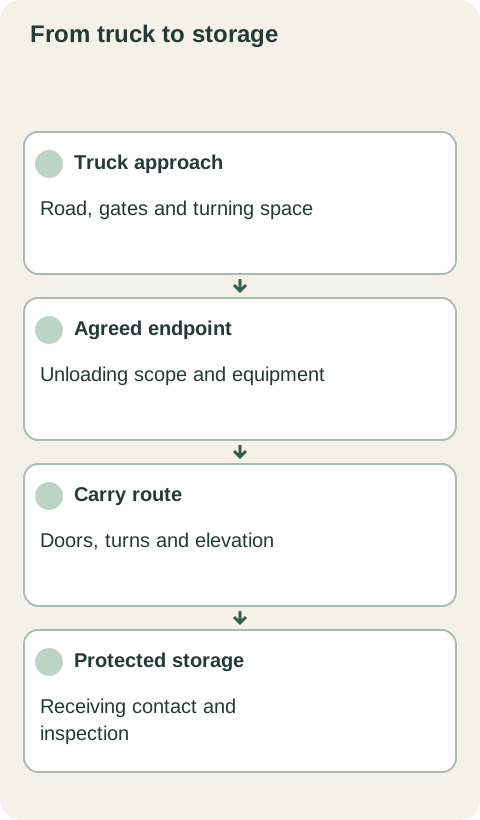
Diagram Actual receiving status is one input to the contractor’s start decision; a shipping milestone alone does not establish site readiness.
Define the event that supports starting
Distinguish an estimated production finish, dispatch, a delivery appointment and receipt of the required products. Each answers a different question. Ask which event the contractor used when setting the demolition date and whether that event has actually happened. If the plan relied on arrival, an update that says production is nearly complete does not satisfy the same condition.
IKEA's installation guide advises having the new parts and appliances before dismantling the old kitchen. That is a useful manufacturer example of connecting removal to product readiness, rather than only a calendar date. Your contractor still needs to consider the scope of your project and whether site work creates a different sequence.
Confirm which products are needed for the next phase
Have the contractor identify the items that matter to the planned transition, including any separately purchased products. Ask how completeness and condition will be checked. A shipment on the driveway may contain only part of the order, or an item may still need assessment after unpacking. Physical arrival reduces one uncertainty but does not automatically resolve every prerequisite for starting work.
Keep the review focused on the actual project. Some jobs require site preparation before cabinets can be placed or delivered to the intended area. Where that is the case, ask the contractor to explain the necessary early work and the consequences of waiting. Do not turn a readiness preference into a universal rule that no removal may occur until every decorative piece arrives.
Compare disruption while you can still choose
Ask what function will be lost when demolition begins and what arrangements are needed during the resulting gap. Consider how the household will use the space, how long uncertainty can be tolerated and whether unfinished areas affect other planned work. These are project-specific practical questions, not a reason to predict a standard number of days without a working room.
Compare the consequences of delaying the crew with the consequences of starting before required products are ready. Confirm any rescheduling arrangements directly with the contractor and delivery organizer; do not assume either change is free or automatically available. If early work is necessary, agree what limited scope can be completed and how the project will be left between stages, with qualified people handling the relevant work.
Reopen the decision when the evidence changes
Imagine the original demolition booking followed an expected cabinet arrival. The seller later reports dispatch, but a required unit is still listed separately with no confirmed arrival. Simply keeping the old demolition date would preserve the calendar while discarding its original premise. Ask the contractor whether the required set is ready and what the remaining uncertainty means for the proposed start.
The answer may be to reschedule, perform a limited preparatory task or proceed under a revised plan that the parties understand. Record the reason and outstanding dependencies. Do not replace a missing delivery confirmation with the most optimistic estimate in a message thread. Use the latest item-specific status and identify which facts remain unknown.
Set the next check before committing resources
Agree who will obtain the next delivery update, who verifies the received products and who makes the work-start decision with the owner. Choose the information that must be available at that check, not just another date to repeat the same uncertainty. Tell affected trades what has actually been decided so they do not infer that every booking is confirmed.
When the agreed milestone is reached, review the product and site conditions together before releasing the planned work. Preserve the distinction between a tentative slot and an agreed start. This does not eliminate delays, but it keeps a delivery change from causing an avoidable period of disruption simply because nobody revisited a demolition date chosen under different circumstances.
Pure White
Cream White
Light Warm Gray
Gray
Navy
Black
Oak Tone
Dark Walnut Tone
Design study These finish studies are design references, not a list of currently orderable colors. Screens and lighting change the appearance; compare a physical sample before choosing.See all finish options →
The sample shows the door frame, a separate center panel, the face frame and the cabinet box. Each component has its own place in this Shaker construction.
Shaker construction: door frame, center panel, face frame and cabinet box. The cutaway helps locate these parts; confirm each material in the specifications for the selected cabinet.
01 / Door frame
The Shaker door has rails and stiles around a separate center panel. The frame and center panel are different components; confirm their materials in the specifications for the selected cabinet.
02 / Face frame
The face frame surrounds the opening at the front of the cabinet box and sits behind the doors. The face frame, door frame and cabinet box are separate parts.
03 / Cabinet box
The sample exposes the cabinet sides, interior surfaces and layered edges. The image does not establish the wood species or material specification of a selected cabinet.