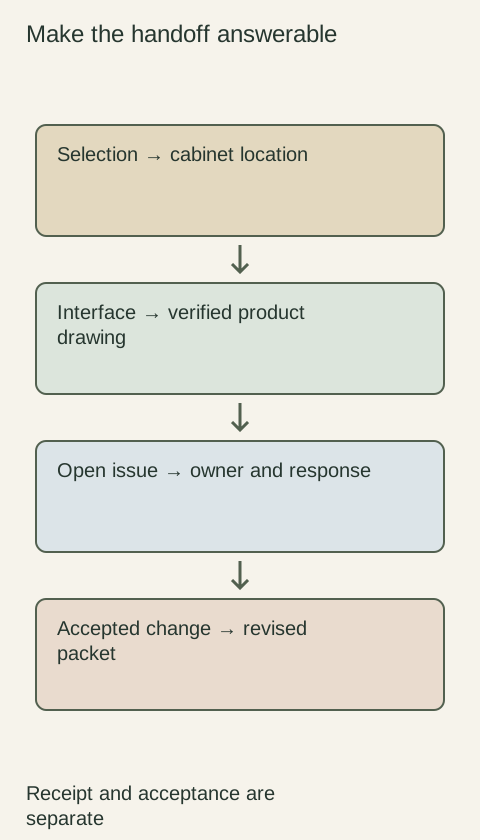
A split delivery changes installation planning when the missing item is needed for the next task, even if most of the order has arrived. Start with an accurate list of received, pending and disputed items, then ask the installer to connect that list to the work sequence for the actual cabinet system. The useful question is not how much of the purchase is on site. It is which complete, appropriate tasks can proceed with what is there.
Diagram Connect the current received-parts list to the installer’s work-stage review; the diagram does not prescribe an installation sequence.
Turn the shipment list into a work-stage review
Give the installer the accepted cabinet schedule, current delivery record and the product instructions. Mark pending components by their exact identifiers rather than writing a general note that trim or hardware is missing. Include separately ordered items that the planned work also needs. A carton count alone cannot tell the crew whether the required fixing component or finishing piece is present.
IKEA's installation guide directs customers to compare packages and parts with their order and freight lists and use the product assembly instructions. That supports checking the contents against the intended work; it is not a universal sequence for every cabinet system. Ask your installer to make the dependency decisions for the products actually supplied.
For each pending item, ask which task needs it and what later work depends on that task. Some missing pieces may prevent a unit from being assembled or positioned correctly. Others may affect completion after earlier work is independently ready. Do not decide that a piece is nonessential just because it is small, decorative or packed separately from the large cabinets.
Record the installer's answer in practical terms: which work is ready, which work waits and what must be reviewed before the waiting work can start. If the effect is uncertain, keep it unresolved instead of inventing a temporary substitute. A supplier's estimated arrival date is useful for planning, but it does not make a required component physically available.
Compare a partial start with the cost of returning
Ask what the crew could complete without needing to undo or obstruct that work later. Include the access needed when the remaining parts arrive, protection of partly completed cabinets and any repeated setup or return visit. Confirm the scope and pricing of a revised visit with the installer rather than assuming the original arrangement covers every additional trip.
Consider the other trades affected by the proposed partial start. Give them a description of what will actually be complete, not simply a message that cabinet installation has begun. A later contractor may need a specific completed condition before taking measurements or performing work. Let that contractor confirm the prerequisite instead of treating the start of one trade as the release of all the others.
Use a missing-component example to test the plan
Imagine the cabinet assemblies arrive while a specified attachment component remains in a later shipment. The quantity delivered looks encouraging, but the installer identifies that component as necessary for the intended installation stage. Booking the crew to perform that stage anyway would not resolve the dependency. The buyer needs the pending item's actual status and an updated work decision.
In a different project, the installer may identify a final decorative component that can be fitted later without disturbing completed work. That can support a limited start if the rest of the requirements are satisfied. The distinction comes from product instructions and the planned method, not from a general rule that all decorative pieces can wait or all split orders must stop completely.
Keep later arrivals connected to the revised plan
Assign someone to update the inventory as each shipment is checked. Change a pending item to received only after identifying it, and keep any unresolved condition issue visible. Tell the installer what changed and ask whether that change releases the waiting task. Do not silently substitute a similar piece from another location just to make a list look complete.
Before confirming the next visit, review the remaining dependencies and the actual work scope again. Preserve a list of unfinished items after any partial installation so the final visit has a clear purpose. A split shipment is manageable when shipment status and installation readiness stay connected. It becomes confusing when a delivery confirmation is allowed to stand in for a technical decision about what the crew can finish.
Pure White
Cream White
Light Warm Gray
Gray
Navy
Black
Oak Tone
Dark Walnut Tone
Design study These finish studies are design references, not a list of currently orderable colors. Screens and lighting change the appearance; compare a physical sample before choosing.See all finish options →
The sample shows the door frame, a separate center panel, the face frame and the cabinet box. Each component has its own place in this Shaker construction.
Shaker construction: door frame, center panel, face frame and cabinet box. The cutaway helps locate these parts; confirm each material in the specifications for the selected cabinet.
01 / Door frame
The Shaker door has rails and stiles around a separate center panel. The frame and center panel are different components; confirm their materials in the specifications for the selected cabinet.
02 / Face frame
The face frame surrounds the opening at the front of the cabinet box and sits behind the doors. The face frame, door frame and cabinet box are separate parts.
03 / Cabinet box
The sample exposes the cabinet sides, interior surfaces and layered edges. The image does not establish the wood species or material specification of a selected cabinet.