

For professionals
Slow-moving cabinet inventory: complete a useful package before cutting the price
For cabinet dealers, a warehouse count does not show what can actually be sold. Separate committed goods from surplus, test whether the remaining pieces form a usable project, and compare redeployment with an accurately described markdown.
Find out why the cabinets have stopped moving
Do not start a cabinet stock review by applying the same discount to every old carton. First establish whether the goods are actually surplus and whether a buyer can complete a useful project with them. A cabinet can be perfectly usable yet difficult to sell because the supporting panels are missing, its finish is no longer represented accurately or its quantity does not suit the jobs being quoted.
The decision is whether to keep, redeploy, complete or mark down a specific group of goods. It is not a reason to promise that any inexpensive cabinet will fit the next customer's room. A hurried sale can transfer an unresolved selection problem to the buyer and leave the dealer answering questions the listing should have settled.
Shopify uses dead stock in its retail sense for inventory that is not selling within the expected period. That definition helps identify an operating problem; it does not establish a universal age at which a cabinet must be discounted.
Reading note: Shopify — What Is Dead Stock and How Can You Prevent It?.
Remove goods that already belong to a job
Reconcile the warehouse list with accepted orders, reservations, replacement requests and installation balances. A carton with no recent movement may be waiting for the customer's agreed release rather than lacking demand. Mark those goods separately before evaluating surplus. Check the actual agreement instead of assuming a payment or an old quote means the same thing in every case.
Ask why an item entered stock. A routine replenishment cabinet, a canceled project item and a replacement ordered for service have different histories. Keep the original identity and any unresolved disposition visible. Changing the warehouse category should not erase an open customer's need or make another salesperson believe the same cabinet can be sold twice.
Inspect a sellable group, not just a carton count
Record the product line, door, finish, configuration and actual condition. Check the labels against the contents using an appropriate inspection method. Keep different specifications separate even when their descriptions sound alike. A broad label such as white base cabinet is insufficient for deciding that several units form a coordinated package.
Then identify the supporting parts. An exposed cabinet may require a finished side that is absent from the surplus group. A run can need fillers, matching fronts or trim. Determine whether the actual necessary parts can be supplied and on what terms before advertising a complete kitchen. Do not purchase more questionable stock simply to make an old total look more complete.
Include handling and storage history when they affect condition. Opened cartons and installed displays should not quietly rejoin a list described as unopened new goods. Photograph accessible surfaces and explain what has not been inspected. A lower price does not replace an accurate description of modifications, missing components or visible wear.
Test redeployment against a real layout
Look for current inquiries that the existing goods genuinely serve. An independent laundry run or a straightforward cabinet replacement may use a small coherent set. That is different from pushing a buyer toward an unsuitable kitchen because the dealer wants to clear a rack. Compare the actual room, functional requirements and product identities before proposing a match.
Preserve the complete cost of making that package work. Added panels, a necessary companion cabinet, handling or assembly can change the result. Ask whether the completed package remains attractive compared with a currently supported alternative. Surplus that requires expensive additions may be less useful than a smaller accurately presented individual-item offer.
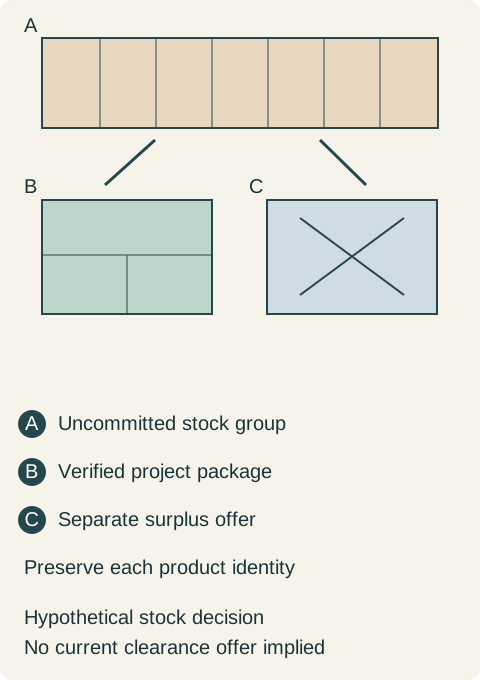
Consider a hypothetical group of 8 uncommitted units. A verified laundry plan can use 3, while 2 are a different finish revision and cannot be described as matching that group without further review. The remainder is not automatically another complete room. Keep the distinct goods identifiable and decide their next use separately. These invented counts describe the review, not usaKT.com inventory.
A markdown should explain the limitation it is pricing
State the exact items, condition and inclusions in an offer. If a finish cannot be extended, say what has actually been confirmed about the present group and later additions. If inspection is incomplete, identify the limitation. Do not use a broad new-product photograph as the only description of the goods being sold.
Compare a group offer with individual sales. A coherent group may suit a buyer better and preserve a useful finish match. Separate items can suit small jobs when the group does not form a sensible project. Neither approach should imply that unverified additional cabinets are available. Let the actual product information determine what the buyer can reasonably plan.
Discuss dismantling, packing, pickup or delivery as part of the offer. Identify the actual endpoint and handling work instead of assuming a clearance buyer will collect everything unaided. Record any accepted return or service terms from the seller's real arrangement; do not invent a standard final-sale policy for all surplus goods.
Compare recovery after the extra work
The highest advertised selling price is not necessarily the strongest recovery. A proposed completion purchase can require new freight, inspection and further storage. A lower-priced group sale may avoid some of that work. Use actual estimates and distinguish money already spent from new spending required to carry out each option. This is an operating comparison, not a valuation or tax calculation.
Keep staff time visible without pretending it has a universal rate. Repeatedly opening cartons, searching for missing identities and producing incompatible quotes consumes real capacity. A well-described offer can reduce that uncertainty. It cannot guarantee a buyer, and a markdown should not become a reason to conceal the questions still unresolved.
Close the stock decision without losing the history
When goods are assigned or sold, update their location, quantity and destination and retain the condition record. Remove the committed pieces from other live offers. If a review finds a recurring cause such as ordering an unsupported finish or omitting necessary panels, correct that buying decision rather than relying on the next discount event.
Keep slow stock when there is a credible use and its condition can be maintained. Redeploy it when a real layout fits. Mark it down when a fully described offer provides the sensible recovery. The useful outcome is accurate stock that another person can select and receive with confidence, rather than a smaller warehouse number achieved by moving an incomplete problem onward.
Sources & further reading
- Shopify — What Is Dead Stock and How Can You Prevent It?